No products in the cart.
Best Knapp Kit Supplier in Saudi Arabia: 2026 Buyers Guide
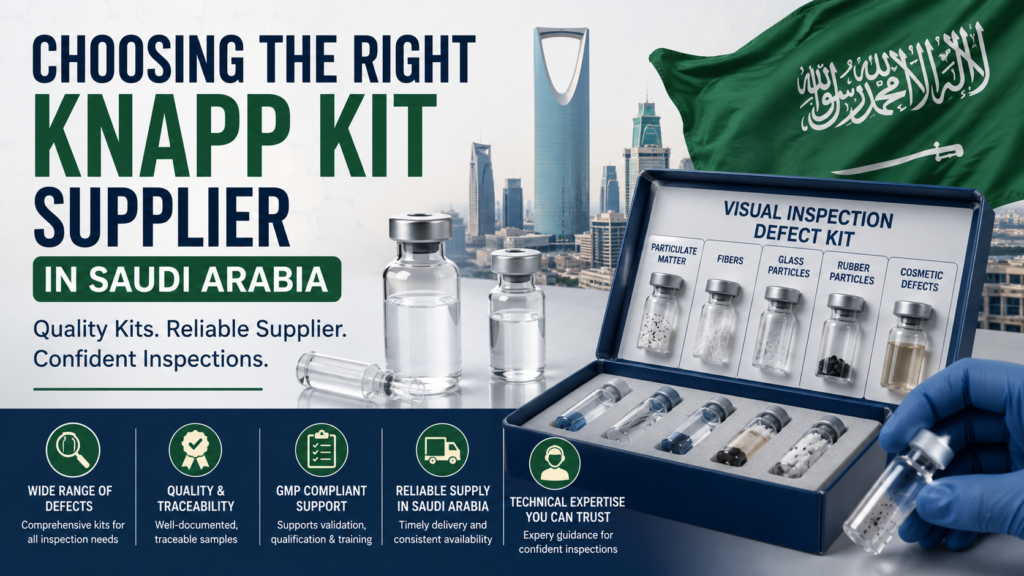
Visual inspection is one of those pharmaceutical quality activities that can look simple from the outside but requires considerable control behind the scenes.
An inspector may appear to be doing nothing more than examining a vial, cartridge or prefilled syringe under controlled lighting. In reality, the effectiveness of that inspection depends on the product, container, lighting, background, inspection conditions, defect characteristics and inspector capability.
For pharmaceutical manufacturers in Saudi Arabia, this makes the selection of a Knapp Kit supplier in Saudi Arabia an important quality decision.
A visual inspection defect kit should not be treated simply as a box of samples. When properly incorporated into a pharmaceutical quality system, it can support practical training, defect recognition, inspector qualification and ongoing assessment of visual inspection capability.
Saudi Arabia’s GMP framework is particularly relevant here. The Saudi Food and Drug Authority (SFDA) GMP Guide states that manual inspection should be performed under suitable and controlled illumination and background conditions. It also states that operators should undergo visual inspection qualification at least annually using appropriate samples from the manufacturer’s defect library, while considering worst-case factors such as inspection time, line speed, container size and fatigue.
That means choosing the right supplier requires more than comparing prices.
You need to evaluate whether the supplier can provide the right defects, suitable formats, appropriate documentation, dependable supply and technical understanding of pharmaceutical visual inspection.
This guide explains exactly what Saudi pharmaceutical companies should consider.
Why the Right Knapp Kit Supplier Matters
A defect kit is ultimately a training and qualification tool.
If the samples do not represent the types of defects your inspectors may encounter, the qualification exercise may provide limited value.
For example, an injectable manufacturing facility may need to train personnel to recognize different types of:
- Particles
- Fibers
- Glass-related defects
- Foreign matter
- Product-related defects
- Container defects
- Closure defects
- Other visually detectable abnormalities
The appropriate defect library depends on the manufacturer’s process, container-closure system and historical quality data.
SFDA’s GMP guidance specifically calls for appropriate samples from the manufacturer’s defect library and consideration of worst-case inspection scenarios.
Therefore, a good supplier should be able to discuss your application rather than simply offering a generic product.
What Is a Knapp Kit?
A Knapp Kit, in the context of pharmaceutical visual inspection, is a set of controlled defect samples used to help simulate visual inspection challenges.
The purpose can include:
- Inspector training
- Defect recognition
- Visual inspection qualification
- Requalification
- Inspection process assessment
- Demonstration of representative defects
The exact contents and configuration should be selected according to the manufacturer’s approved procedure and product-specific requirements.
For example, Confianca Pharmazon’s current product information describes its Knapp Kits as manual visual inspection kits covering liquid and lyophilized formulations with vial, cartridge and prefilled syringe formats. The product page also states that the kits can be used for manual and automatic visual inspection machines and offers particulate matter in different micron-size ranges.
This type of flexibility is particularly useful when a pharmaceutical company operates more than one injectable presentation.
8 Factors to Consider When Choosing a Knapp Kit Supplier in Saudi Arabia
1. Check the Supplier’s Understanding of Pharmaceutical Visual Inspection
The first question should not be:
“How much does the kit cost?”
A better question is:
“Does the supplier understand what we are trying to qualify?”
Visual inspection is affected by numerous variables. USP <1790>, for example, explains that visual inspection is probabilistic and that detection probability can change depending on particle size, shape, color and density, as well as the product and container.
A supplier should therefore understand that a defect kit is part of a broader inspection system.
Ask potential suppliers:
- What types of defects are available?
- Which container formats are supported?
- Can defects be selected according to product risk?
- Are different particle sizes available?
- Can samples be used with manual inspection?
- Can they support automated inspection challenges?
- What documentation accompanies the samples?
A supplier who can answer these questions clearly is more likely to understand the application.
2. Evaluate Defect Coverage
One of the most important criteria when choosing a Knapp Kit supplier in Saudi Arabia is the range and relevance of available defects.
A pharmaceutical manufacturer should not automatically choose the kit with the largest number of samples.
Instead, ask:
Does the kit cover the defects that matter to our process?
Your quality team should consider:
- Historical deviations
- Batch rejection trends
- Customer complaints
- Container-closure problems
- Component supplier risks
- Equipment-related contamination
- Particulate investigations
- Previous inspection failures
For example, if a facility has historically experienced fiber contamination, fiber-related challenges should receive appropriate consideration in the inspection training program.
Likewise, if glass or elastomeric contamination is a known process risk, the defect library should reflect that risk.
The objective is relevance, not simply quantity.
3. Match the Kit to Your Container Format
Different injectable products require different inspection considerations.
A supplier should be able to support the container formats used at your facility.
Common formats include:
- Glass vials
- Cartridges
- Prefilled syringes
- Liquid formulations
- Lyophilized products
Confianca Pharmazon’s product page specifically lists liquid and lyophilized formulations and vial, cartridge and PFS formats among its Knapp Kit offerings.
This is an important consideration for Saudi pharmaceutical manufacturers with diverse injectable portfolios.
A kit designed around one presentation may not automatically provide the most relevant training experience for another.
4. Look for Representative Particle Challenges
Particulate matter is one of the most important areas of injectable visual inspection.
However, particles are not all equally easy to detect.
Their visibility can vary according to:
- Size
- Shape
- Color
- Contrast
- Density
- Movement
- Product characteristics
- Container characteristics
This is why a supplier should be able to provide appropriately characterized challenge samples rather than generic “particle” samples.
A useful procurement discussion should cover:
Particle size
Different size ranges can be relevant to different qualification or training strategies.
Particle type
Different materials can produce very different visual characteristics.
Particle appearance
Dark, transparent, reflective and fibrous materials can behave differently under inspection.
Container presentation
The particle must be evaluated in a realistic inspection context.
The goal is to create a meaningful challenge rather than an artificially easy exercise.
5. Ask About Documentation and Traceability
Documentation is often overlooked when companies compare suppliers.
But for GMP environments, documentation can be just as important as the physical kit.
Before purchasing, ask what information is supplied with the kit.
Depending on the supplier and product, relevant information may include:
- Sample identification
- Defect identification
- Particle information
- Sample configuration
- Batch or serial identification
- Storage information
- Handling instructions
- Certificate or supporting documentation where applicable
Your own quality system should define what documentation is required.
Remember that a supplier’s certificate does not replace your company’s qualification procedure.
The supplier provides the challenge material.
Your pharmaceutical quality system determines how that material is used.
6. Consider Support for Manual and Automated Inspection
Modern pharmaceutical facilities may use a combination of manual and automated inspection.
SFDA’s GMP guidance addresses both.
For manual inspection, the guidance calls for suitable and controlled illumination and background conditions, controlled and qualified inspection rates, visual inspection qualification and representative defect samples.
For automated inspection, the SFDA guide states that the process should be validated to detect known defects that may impact quality or safety and should be equal to or better than manual inspection methods. Equipment performance should also be challenged using representative defects before startup and at regular intervals throughout the batch.
Therefore, if your facility has automated inspection equipment, ask the Knapp Kit supplier in Saudi Arabia whether the available samples are appropriate for your automated inspection strategy.
This can become particularly important during:
- Equipment qualification
- Validation
- Routine challenge testing
- Change control
- Periodic performance assessment
7. Evaluate Training and Technical Support
A supplier can provide excellent samples but still offer limited value if there is no technical support.
Before choosing a supplier, ask:
- Can the supplier explain how the kit should be used?
- Can they help identify appropriate defect categories?
- Can they discuss manual versus automated applications?
- Can they support different injectable formats?
- Can they provide guidance on sample selection?
- Is post-sale technical assistance available?
For a Saudi pharmaceutical manufacturer, responsiveness can be particularly important when training schedules, audits or qualification activities are time-sensitive.
This is where supplier communication and technical responsiveness become part of the procurement decision.
8. Consider Supply Reliability and Logistics
A visual inspection qualification program should not depend on a kit that is difficult to replace or replenish.
Saudi pharmaceutical companies should evaluate:
- Lead time
- International shipping arrangements
- Packaging
- Sample protection
- Replacement policy
- Availability of repeat orders
- Communication during shipment
- Export/import documentation where applicable
Also consider whether your facility expects to expand.
If you are qualifying dozens or hundreds of inspectors, you may require repeat sets or replacement samples over time.
A supplier who can support the program over its lifecycle may be more valuable than a supplier offering a lower initial price.
Why Saudi GMP Expectations Make Defect Libraries Important
The Saudi GMP Guide provides a particularly useful reason for pharmaceutical manufacturers to think carefully about defect libraries.
For manual visual inspection, SFDA says operators should undergo visual inspection qualification using appropriate samples from the manufacturer’s defect library and that worst-case scenarios should be considered.
This means a pharmaceutical company should ideally understand its own defect history and risks before finalizing the challenge samples used for qualification.
The supplier is therefore one part of the process.
The overall chain looks like:
Process Risk → Defect Library → Training → Qualification → Inspection → Trending → Investigation → CAPA → Continuous Improvement
This is much stronger than simply purchasing a kit and placing it in the training room.
Questions to Ask a Knapp Kit Supplier Before Purchasing
Use this checklist when comparing suppliers.
Product Questions
- What container formats are available?
- Are both liquid and lyophilized products supported?
- Are vial, cartridge and PFS formats available?
- What particle sizes can be supplied?
- What defect categories are available?
- Can the kit be customized or configured?
Quality Questions
- What documentation accompanies the samples?
- How are samples identified?
- How is sample integrity maintained?
- What storage conditions are recommended?
- Is replacement support available?
Technical Questions
- Can the kit support manual inspection training?
- Can it support automated inspection challenges?
- Can the supplier help select representative defects?
- Can the supplier provide technical guidance?
Commercial Questions
- What is the lead time to Saudi Arabia?
- What are the shipping arrangements?
- What happens if a sample is damaged?
- Can repeat orders be supplied?
- Is long-term support available?
Red Flags When Choosing a Supplier
Not every inexpensive kit is necessarily the right kit.
Be cautious if a supplier:
Cannot explain the defects
If the supplier cannot clearly explain what the samples represent, your quality team should investigate further.
Provides no meaningful documentation
GMP training requires controlled processes and records.
Offers only generic samples
Your defect library should be connected to your product and process risks.
Cannot support your container format
A vial manufacturer, cartridge manufacturer and PFS manufacturer may have different inspection challenges.
Has no technical support
If something goes wrong during qualification, you need someone who understands the product.
Focuses entirely on price
The cheapest kit may become expensive if it does not support your qualification strategy.
How to Compare Two Knapp Kit Suppliers
Instead of making the decision based solely on price, create a weighted supplier scorecard.
For example:
| Evaluation Area | Suggested Weight |
|---|---|
| Defect coverage | 20% |
| Product/container compatibility | 15% |
| Documentation | 15% |
| Technical support | 15% |
| Manual/automated compatibility | 10% |
| Supply reliability | 10% |
| Quality/traceability | 10% |
| Commercial value | 5% |
The exact weighting should be determined by your quality and procurement teams.
This approach prevents a low purchase price from dominating a decision that ultimately affects a GMP-critical training and qualification activity.
Knapp Kits Should Support Your Quality System—Not Replace It
This is perhaps the most important point in this entire article.
A Knapp Kit does not by itself make a visual inspection program compliant.
Compliance depends on the complete system.
That includes:
- Approved SOPs
- Defined inspection conditions
- Qualified inspection equipment
- Trained personnel
- Inspector qualification
- Appropriate challenge samples
- Defined acceptance criteria
- Documentation
- Periodic reassessment
- Defect trending
- Investigation and CAPA
SFDA’s GMP guidance specifically calls for recording inspection results and trending defect types and numbers. It also states that reject levels for different defect types should be trended using statistical principles and that adverse trends should be investigated for potential impact on products already on the market.
Therefore, your supplier should fit into this larger quality framework.
How to Build a Better Visual Inspection Training Program in Saudi Arabia
Once you select your supplier, consider implementing a structured program.
Phase 1: Risk Assessment
Identify the defects most relevant to your products and process.
Phase 2: Defect Library Development
Select representative challenge samples.
Phase 3: Training
Teach inspectors how to identify different defects under controlled inspection conditions.
Phase 4: Qualification
Use your approved qualification protocol to evaluate inspector capability.
Phase 5: Requalification
Follow your approved frequency and applicable GMP requirements.
The SFDA GMP Guide specifically references at least annual visual inspection qualification for operators performing manual inspection.
Phase 6: Trending
Track inspection results and defect patterns.
Phase 7: Improvement
Use inspection findings to investigate and reduce upstream sources of contamination and defects.
Why Local Market Understanding Can Add Value
When selecting a Knapp Kit supplier in Saudi Arabia, pharmaceutical companies should consider more than whether the supplier can ship a product internationally.
A supplier serving Saudi pharmaceutical organizations should understand that customers may be working within:
- SFDA GMP expectations
- Internal pharmaceutical quality systems
- International pharmacopoeial expectations
- Export-market requirements
- Corporate qualification procedures
Saudi Arabia’s regulatory environment also references internationally recognized standards. SFDA notes that its National Drug and Cosmetics Control Laboratory performs analyses according to standards including USP, European Pharmacopoeia and WHO guidelines, in addition to national standards.
This international orientation makes it useful to work with suppliers who understand both practical inspection requirements and broader pharmaceutical quality expectations.
Why Confianca Pharmazon’s Knapp Kits May Be Relevant
When evaluating potential suppliers, Saudi pharmaceutical companies should compare the supplier’s actual product configuration with their operational requirements.
Confianca Pharmazon’s current Knapp Kit product page states that its visual inspection kits are intended for manual visual inspection and include liquid and lyophilized formulations across vial, cartridge and prefilled syringe formats. It also describes kits for manual and automatic visual inspection machines and particulate matter in different micron-size ranges.
This makes the product relevant for organizations that need flexibility across different injectable presentations.
The important next step, however, is to discuss your specific requirements with the supplier and determine which defect types, particle sizes, container formats and documentation are appropriate for your approved qualification program.
FAQ: Choosing a Knapp Kit Supplier in Saudi Arabia
What should I look for in a Knapp Kit supplier?
Focus on defect coverage, container compatibility, documentation, traceability, technical support, delivery reliability and the supplier’s ability to support your pharmaceutical visual inspection program.
Are Knapp Kits required by SFDA?
The SFDA GMP Guide requires visual inspection qualification using appropriate samples from the manufacturer’s defect library for manual inspection. It does not mandate a specific commercial brand of Knapp Kit.
Can Knapp Kits be used for inspector qualification?
They can be used as challenge samples within an approved visual inspection qualification procedure. The pharmaceutical manufacturer remains responsible for defining the qualification protocol, acceptance criteria and documentation.
Should the same kit be used for every pharmaceutical product?
Not necessarily. Defect selection should be based on product, container, process and historical risk. Different formulations and container systems can have different inspection challenges.
Can Knapp Kits be used with automated inspection machines?
Some kits are designed to support automated inspection challenges. The suitability of specific samples should be confirmed against the machine, product and validation strategy.
How often should inspectors be qualified in Saudi Arabia?
The SFDA GMP Guide states that operators performing manual visual inspection should undergo visual inspection qualification at least annually. Your site should also consider its approved procedures and applicable requirements.
Is the cheapest Knapp Kit the best option?
Not necessarily. A kit that lacks relevant defects, documentation or technical support can create additional qualification and procurement challenges. Total value should be considered rather than purchase price alone.
What types of pharmaceutical products can Knapp Kits support?
The appropriate configuration depends on the product and container. Confianca Pharmazon’s listed options include liquid and lyophilized formulations in vial, cartridge and prefilled syringe formats.
Conclusion: Choosing the Right Knapp Kit Supplier in Saudi Arabia
Choosing the right Knapp Kit supplier in Saudi Arabia should be approached as a quality-system decision rather than a simple purchasing exercise.
The right supplier should help your organization obtain representative and relevant challenge samples that fit your products, container formats and visual inspection strategy.
Before making a decision, evaluate:
- Defect coverage
- Particle-size options
- Container formats
- Manual and automated applications
- Documentation
- Traceability
- Technical support
- Delivery reliability
- Replacement availability
- Long-term supplier support
Most importantly, make sure the kit integrates into your existing GMP visual inspection program.
For Saudi pharmaceutical manufacturers, this is particularly important because the SFDA GMP Guide explicitly addresses controlled inspection conditions, inspector qualification, defect libraries, worst-case scenarios, automated inspection challenges and defect trending.
A good Knapp Kit supplier in Saudi Arabia should therefore be more than a source of physical samples. The supplier should become a reliable technical resource supporting your visual inspection training and qualification objectives.
If your organization is evaluating visual inspection defect kits for injectable products, explore Confianca Pharmazon’s Knapp Kit range and discuss your specific container, formulation, defect and qualification requirements.
Explore Knapp Kits and Visual Inspection Defect Kits
Your trusted partner for pharma skills, systems, and solutions.