
No products in the cart.
7 Ways Improving Injectable Product Quality with Visual Inspection Defect Kits India
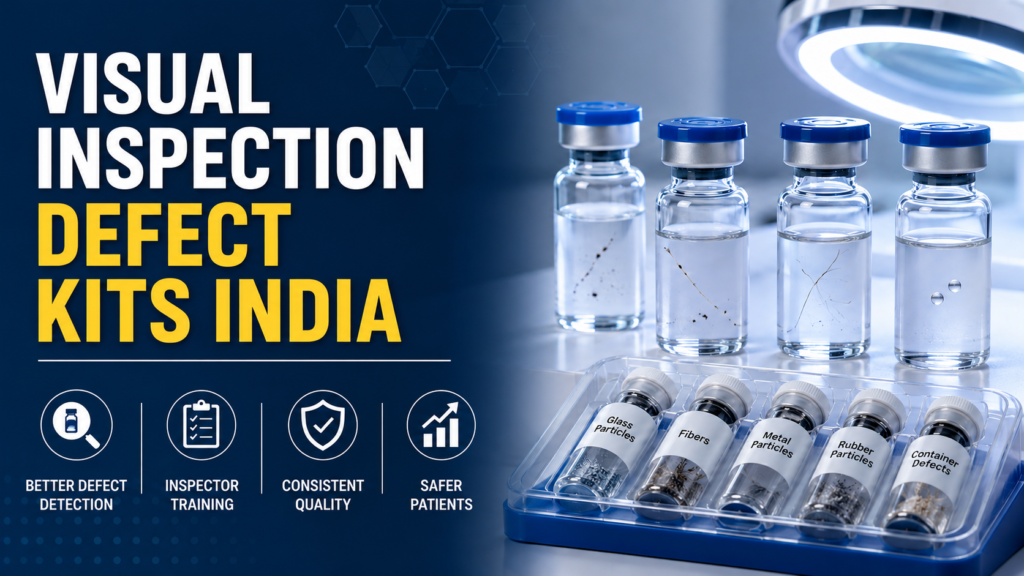
For pharmaceutical manufacturers, injectable product quality cannot depend only on a final laboratory test.
A vial, cartridge, or prefilled syringe may meet its formulation specifications and still contain a visible defect that needs to be detected before the product reaches a patient. Foreign particles, fibers, glass fragments, metal particles, elastomeric materials, cosmetic defects, container defects, and other abnormalities can create significant quality and patient-safety concerns.
This is why visual inspection is such an important part of injectable manufacturing.
But there is an important question:
How do you know that your visual inspection process and inspectors can actually detect the defects they are expected to find?
That is where Visual Inspection Defect Kits India become valuable.
A properly designed defect kit gives pharmaceutical manufacturers controlled, known examples that can be used for inspector training, qualification exercises, inspection-system evaluation, and ongoing competency assessment. Instead of relying only on theoretical training or random production defects, teams can work with defined challenge samples representing different defect types and inspection conditions.
The objective isn’t simply to “find particles.” It is to build a repeatable and scientifically supported visual inspection process.
For Indian pharmaceutical companies manufacturing sterile injectables, this becomes particularly important as manufacturers supply both domestic and highly regulated international markets.
USP <790> states that products intended for parenteral administration must be visually inspected for particulate matter, while USP <1790> provides guidance on the visual inspection of injections. USP also emphasizes that visual inspection is a probabilistic process, meaning detection can vary according to factors such as particle characteristics, product formulation, and container design.
Let’s understand how defect kits can strengthen this process.
What Are Visual Inspection Defect Kits?
A visual inspection defect kit is a controlled set of samples containing known defects or challenge conditions designed to evaluate the ability of an inspector or inspection system to detect specific abnormalities.
Depending on the application, kits can contain different types of pharmaceutical containers and defects.
For example:
- Vials
- Cartridges
- Prefilled syringes
- Liquid formulations
- Lyophilized formulations
- Particles
- Fibers
- Other representative visual defects
The purpose is not to imitate every possible production defect.
Instead, a well-designed kit provides representative and controlled challenges that can be incorporated into an organization’s visual inspection training and qualification program.
Confianca Pharmazon’s current product page describes manual visual inspection kits for liquid and lyophilized formulations in vial, cartridge, and prefilled-syringe formats, as well as Knapp kits for manual and automatic visual inspection machines and particulate matter in different micron-size ranges.
Why Injectable Products Require Strong Visual Inspection
Injectable Visual Inspection Kitare administered through routes that make product quality particularly critical.
Visible particles may include materials such as:
- Glass
- Metal
- Fibers
- Elastomeric material
- Precipitates
- Other extraneous matter
USP <790> specifically lists fibers, glass, metal, elastomeric materials, and precipitates among examples of visible particulate matter.
However, visual inspection isn’t limited to particles.
Depending on the product and inspection process, manufacturers may also evaluate:
- Container defects
- Cracks
- Cosmetic abnormalities
- Fill-related issues
- Foreign material
- Closure-related defects
- Product appearance
- Abnormal coloration
A comprehensive inspection program therefore needs people, procedures, equipment, lighting, inspection conditions, defect standards, and documented qualification.
The Human Factor in Visual Inspection
One of the biggest challenges in manual inspection is human variability.
Two trained inspectors may not always detect the same defect under identical conditions.
Why?
Because detection can be influenced by:
- Inspector experience
- Fatigue
- Lighting
- Background
- Inspection speed
- Particle size
- Particle color
- Particle shape
- Container geometry
- Product opacity
- Product movement
USP <1790> explicitly recognizes that visual inspection is probabilistic and that detection probability varies with the characteristics of the product, particle, and container.
This is an important point for pharmaceutical manufacturers.
Training an inspector once is not the same as demonstrating ongoing inspection capability.
Defect kits provide a practical mechanism for structured training and assessment.
7 Ways Visual Inspection Defect Kits Improve Injectable Product Quality
1. They Make Training More Practical
Reading an SOP is important.
Understanding a defect classification procedure is important.
But seeing and handling a representative defect is different.
A visual inspection defect kit allows inspectors to interact with controlled examples rather than learning only from photographs or theoretical explanations.
For example, an inspector may be trained to identify:
- Dark particles
- Light-colored particles
- Fibers
- Glass-like defects
- Different particle sizes
- Container-related abnormalities
This practical exposure helps connect written procedures with real inspection decisions.
2. They Improve Defect Recognition Skills
Not all particles look the same.
A dark particle may be relatively easy to recognize against a clear liquid, while a translucent or low-contrast particle may be significantly harder.
Similarly, a fiber can behave differently from a compact particle when the container is moved.
This is why Visual Inspection Defect Kits India can be useful for building exposure to different defect characteristics.
Training can be structured around variables such as:
- Size
- Shape
- Color
- Contrast
- Movement
- Container type
- Formulation type
The objective is to make inspectors familiar with the range of visual challenges they may encounter.
3. They Support Inspector Qualification
A pharmaceutical company should be able to demonstrate that personnel performing visual inspection have received appropriate training and have demonstrated competency according to the company’s approved procedure.
A Visual Inspection Defect Kits can be incorporated into a qualification program where defined challenge samples are presented to inspectors under controlled inspection conditions.
A typical workflow could look like this:
Step 1: Training
Explain inspection procedures, defect categories, lighting conditions, handling requirements, and acceptance criteria.
Step 2: Demonstration
Show representative defects and explain how they should be classified.
Step 3: Practice
Allow inspectors to inspect controlled challenge samples.
Step 4: Qualification
Present samples according to a predefined qualification protocol.
Step 5: Documentation
Record results and evaluate performance according to established acceptance criteria.
Step 6: Requalification or Periodic Assessment
Repeat evaluation according to the company’s approved lifecycle strategy.
The exact qualification protocol and acceptance criteria should be scientifically justified and defined by the manufacturer’s quality system rather than assumed from the existence of a particular kit.
4. They Help Standardize Training Across Multiple Inspectors
Imagine a facility with 20 inspectors.
If each person is trained using different examples, different defect photographs, and different informal explanations, training consistency becomes difficult.
A standardized defect kit provides a common reference.
All inspectors can be exposed to the same type of challenge.
This can help organizations establish greater consistency in:
- Training
- Defect recognition
- Terminology
- Classification
- Qualification
- Documentation
This is particularly useful for large Indian pharmaceutical manufacturing facilities operating multiple shifts.
5. They Help Evaluate Difficult-to-Detect Defects
One of the most important concepts in visual inspection is that some defects are inherently more difficult to detect than others.
A large, dark particle moving through a clear solution may be relatively easy to identify.
A smaller, transparent, low-contrast particle may be much more challenging.
The same particle can also appear differently depending on:
- Container geometry
- Liquid characteristics
- Lighting
- Background
- Inspection motion
USP <1790> discusses difficult-to-inspect products and explains that product and packaging characteristics can limit particle detection compared with clear solutions in transparent containers.
Therefore, training programs should not focus only on obvious defects.
6. They Can Support Manual and Automated Inspection Programs
Modern pharmaceutical facilities increasingly use automated inspection systems.
However, automation doesn’t eliminate the need for inspection qualification and appropriate challenge strategies.
Automated visual inspection systems may need to be evaluated against representative defects to determine whether the system can detect the intended defect classes under defined conditions.
Confianca Pharmazon’s product offering specifically includes Knapp kits for both manual and automatic visual inspection machines.
This makes defect kits relevant to manufacturers operating:
- Manual inspection stations
- Semi-automated inspection systems
- Automated inspection machines
- Hybrid inspection processes
The challenge samples and test protocol should always be appropriate to the specific machine, product, container and inspection process.
7. They Support a More Robust Visual Inspection Lifecycle
Visual inspection shouldn’t be treated as a one-time training event.
A mature program considers the entire lifecycle:
Process Design → Training → Qualification → Routine Inspection → Monitoring → Investigation → Continuous Improvement
Defect kits can contribute at multiple stages.
For example:
During onboarding
New inspectors can learn defect recognition.
During qualification
Inspectors can be challenged using defined samples.
During periodic competency assessment
Existing inspectors can be evaluated again.
During process improvement
Manufacturers can identify difficult defect categories.
During equipment evaluation
Representative defects can be incorporated into appropriate testing strategies.
This lifecycle approach is consistent with the broader philosophy behind USP <1790>, which addresses inspection processes and lifecycle considerations.
Knapp Kits vs Generic Training Samples
A common mistake is to assume that any particle placed inside a vial can function as a proper visual inspection challenge.
That isn’t necessarily the case.
A useful defect kit should be considered in relation to:
- Defect identity
- Container type
- Formulation
- Particle characteristics
- Defect size
- Documentation
- Intended inspection application
- Traceability
- Qualification protocol
For Indian pharmaceutical manufacturers, selecting a Knapp Kit India supplier should therefore involve more than comparing the price of individual containers.
Ask:
- What defect categories are available?
- Which container formats are supported?
- Are liquid and lyophilized products covered?
- Can the kit support manual inspection?
- Can it support automated inspection applications?
- Is documentation provided?
- Can the kit be customized?
- Are particle sizes or characteristics specified?
- Is technical support available?
- Can the supplier support your inspection-training requirements?
How to Select the Right Injectable Visual Inspection Kit
Consider Your Product
Start with the actual product you manufacture.
For example:
- Liquid injection
- Lyophilized vial
- Cartridge
- Prefilled syringe
A defect kit should be relevant to the container and formulation being inspected.
Consider Your Defect Categories
Identify which defects your inspection process is designed to detect.
These may include:
- Particulate defects
- Fibers
- Container defects
- Cosmetic abnormalities
- Other product-specific defects
Consider Inspection Method
Determine whether you are qualifying:
- Manual inspectors
- Automated inspection equipment
- Both
Your challenge strategy should correspond to the inspection technology.
India’s GMP Environment and Visual Inspection
For Indian pharmaceutical manufacturers, visual inspection sits within a broader GMP framework.
CDSCO’s GMP documentation for sterile products emphasizes the need to minimize particulate and microbial contamination in sterile manufacturing environments. The Indian requirements also address specific controls for sterile products and parenteral preparations.
CDSCO’s GMP inspection checklist for sterile products and parenteral preparations also evaluates quality and manufacturing controls as part of inspection readiness.
This means visual inspection should not operate as an isolated activity.
It should connect with:
- Contamination control
- Personnel qualification
- Quality assurance
- Environmental controls
- Deviation management
- CAPA
- Batch release
- Process monitoring
USP <790> and USP <1790>: What Manufacturers Should Understand
These two USP chapters are particularly relevant when developing visual inspection programs.
USP <790>
USP <790> addresses visible particulates in injections and requires applicable parenteral products to be visually inspected for particulate matter.
USP <1790>
USP <1790> provides guidance on visual inspection of injections, including inspection processes, particle characteristics, difficult-to-inspect products, and lifecycle considerations.
However, manufacturers should avoid treating a defect kit as a standalone “compliance certificate.”
A kit is a tool that can support a scientifically designed training, qualification, and inspection-control program.
The overall system—including SOPs, inspection conditions, training, qualification, equipment, procedures and quality oversight—determines whether the process is appropriate.
FDA has similarly described visible particulate control as a holistic, risk-based process involving manufacturing controls, visual inspection techniques, particulate identification, investigation and corrective actions.
A Practical Example for an Indian Injectable Manufacturer
Consider a manufacturer producing liquid-filled glass vials.
The company notices inconsistent results between inspectors during routine visual inspection.
Instead of simply retraining inspectors using a presentation, the quality team develops a structured program.
Stage 1: Identify the problem
The company identifies several defect categories where detection appears inconsistent.
Stage 2: Introduce controlled challenges
Representative defect samples are incorporated into training.
Stage 3: Standardize training
Inspectors are trained using the same controlled examples and inspection procedure.
Stage 4: Qualification
Inspectors are assessed against a predefined protocol.
Stage 5: Analyze results
The QA team identifies which defect categories are most challenging.
Stage 6: Improve
Training and inspection procedures are updated based on documented findings.
This creates a much stronger feedback loop than simply telling inspectors to “be more careful.”
8 Practical Tips for Pharmaceutical Manufacturers
To get more value from a visual inspection defect kit:
1. Build a written training program
Don’t rely on informal demonstrations.
2. Define defect categories
Make classification terminology consistent.
3. Use product-relevant containers
Training should reflect actual manufacturing conditions where appropriate.
4. Control inspection conditions
Lighting, background and inspection technique matter.
5. Document qualification results
Maintain appropriate quality records.
6. Monitor recurring errors
Use qualification results to identify training gaps.
7. Periodically review the program
Defect libraries should support continuous improvement rather than becoming a “box on the shelf.”
Frequently Asked Questions
What is a visual inspection defect kit?
A visual inspection defect kit is a collection of controlled samples containing known defects or challenge conditions used to train and evaluate pharmaceutical visual inspectors or inspection systems.
What is a Knapp Kit used for?
Knapp Kits are used in pharmaceutical visual inspection applications to provide controlled challenge samples for inspection training and qualification activities. Product configurations can vary by supplier and application.
Are visual inspection defect kits required by USP <790>?
USP <790> establishes requirements for visual inspection of applicable injectable products, but it does not mean that a particular commercial defect kit itself is universally mandated. Manufacturers should develop appropriate inspection and qualification procedures based on applicable requirements and risk.
Can defect kits be used for automated inspection machines?
Yes, appropriate challenge kits can support automated visual inspection applications. The challenge strategy should be suitable for the specific automated inspection system and product.
What types of injectable products can be used with visual inspection kits?
Depending on the kit design, applications can include liquid formulations, lyophilized products, vials, cartridges and prefilled syringes.
Why is visual inspection training important?
Visual inspection is influenced by human and product-related factors. Structured training and qualification help demonstrate that personnel can perform inspection according to the organization’s established procedure.
Conclusion
For injectable pharmaceutical manufacturers in India, visual inspection should be much more than a final manual check.
It is an important quality-control activity that depends on trained personnel, suitable inspection conditions, defined procedures, appropriate qualification strategies and continuous monitoring.
Visual Inspection Defect Kits India can strengthen this system by providing controlled, representative challenges for training and evaluation. They help inspectors gain practical exposure to different defect characteristics while giving pharmaceutical organizations a more standardized approach to visual inspection qualification.
The value of a defect kit ultimately depends on how it is integrated into the overall quality system.
A high-quality kit combined with a scientifically justified protocol, trained personnel, appropriate inspection conditions and proper documentation can create a stronger foundation for injectable product quality.
For Indian pharmaceutical manufacturers producing vials, cartridges, prefilled syringes, liquid injections or lyophilized products, choosing the right Knapp Kits India solution can therefore be an important part of building a robust visual inspection program.
Strengthen Your Pharmaceutical Visual Inspection Program
Confianca Pharmazon provides manual visual inspection kits and Knapp kits designed for pharmaceutical visual inspection applications, including liquid and lyophilized formulations across vial, cartridge and prefilled-syringe formats, as well as particulate matter in different micron-size ranges. The company’s product page also lists applications for both manual and automatic visual inspection machines.
If your pharmaceutical facility is looking to improve inspector training, visual inspection qualification or defect detection capability, explore the available Knapp Kits and Visual Inspection Defect Kits and discuss the appropriate configuration for your product and inspection process.
Your trusted partner for pharma skills, systems, and solutions.