
No products in the cart.
Achieve Flawless Quality in 2026: Visual Inspection Qualification Kits India Manual vs Automatic
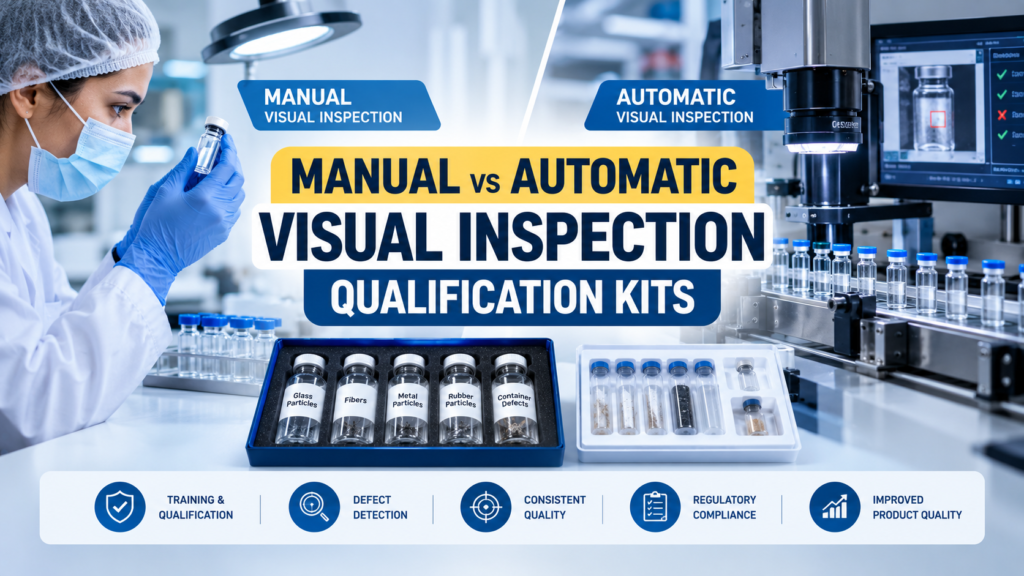
Visual inspection is one of those pharmaceutical quality activities that can look simple from the outside.
A vial moves under controlled lighting. An inspector—or a machine—looks for visible defects. Units that fail the inspection are rejected.
But behind this apparently simple step is a much more important question:
How do you know that your visual inspection process can actually detect the defects it is expected to find?
For Indian pharmaceutical manufacturers, this question becomes particularly important when producing injectable products for domestic and export markets. India’s Schedule M framework identifies a dedicated visual inspection area for parenteral preparations and recommends visual inspection units supported by appropriate illumination.
At the same time, USP <790> requires products intended for parenteral administration to be visually inspected for particulate matter, while USP <1790> explains that visual inspection is a probabilistic process whose detection capability can vary with particle characteristics, dosage form and container design.
This is where visual inspection qualification kits India become valuable.
A qualification kit provides known and controlled challenge samples that can be used to evaluate inspection performance. Confianca Pharmazon’s Knapp Kit offering, for example, is described for manual and automatic visual inspection applications and includes kits for liquid and lyophilized formulations in formats such as vials, cartridges and prefilled syringes.
But should a pharmaceutical company use a manual kit, an automatic-machine kit, or both?
The answer depends on what you are qualifying.
Let’s compare the two approaches.
What Are Visual Inspection Qualification Kits?
Before comparing manual and automatic systems, it is useful to understand what a qualification kit actually does.
A visual inspection qualification kit is a controlled set of good and defective units designed to challenge an inspection process.
Depending on its intended application, a kit can contain representative defects such as:
- Glass particles
- Metal particles
- Fibers
- Black or white particles
- Container defects
- Cracks
- Closure-related defects
- Other product- or process-specific challenges
Confianca Pharmazon’s product information describes Knapp Kits for manual and automatic visual inspection, with different formulations and container formats available for inspection applications.
The basic principle is straightforward:
Known challenge → controlled inspection → recorded result → evaluation of performance
This is different from simply giving an operator a vial and asking them to inspect it.
The purpose of a qualification kit is to introduce known challenges into the inspection process so that the organization can assess whether its inspection method is performing as intended.
Why Visual Inspection Qualification Matters in India
India has a large and highly diverse pharmaceutical manufacturing sector, including manufacturers of sterile injectables, vaccines, biologics and other parenteral products.
For these manufacturers, visual inspection is not simply a cosmetic quality check.
It can be an important part of particulate and defect-control strategy.
USP <790> states that products intended for parenteral administration must be visually inspected for particulate matter. Examples of visible particulate matter include fibers, glass, metal, elastomeric materials and precipitates.
Indian GMP requirements also recognize the importance of visual inspection infrastructure. Schedule M identifies a visual inspection area for parenteral preparations and recommends visual inspection units with composite black-and-white assemblies supported by illumination.
The challenge is that visual inspection isn’t perfectly predictable.
USP <1790> explains that detection probability can vary depending on:
- Particle size
- Particle shape
- Particle color
- Particle density
- Dosage form
- Container design
Some products and packages are inherently more difficult to inspect than clear solutions in transparent containers.
That is why qualification should be based on actual inspection challenges rather than assumptions.
Manual vs Automatic Visual Inspection: The Fundamental Difference
The simplest distinction is:
Manual visual inspection
A trained human inspector examines the product under controlled conditions.
Automatic visual inspection
A machine uses cameras, lighting, image-processing algorithms and defined inspection parameters to detect specified defects.
Both methods have strengths.
Both have limitations.
And both require appropriate qualification.
The mistake is assuming that one type of qualification kit can automatically be substituted for the other.
Manual Visual Inspection Qualification Kits
Manual inspection depends heavily on the ability of the human inspector to consistently detect relevant defects.
A manual visual inspection qualification kit therefore focuses primarily on human performance.
What Does Manual Qualification Test?
A typical program may assess whether an inspector can correctly identify known challenge units under defined conditions.
Depending on the company’s approved procedure, factors may include:
- Inspection environment
- Lighting
- Background
- Inspection time
- Container movement
- Product presentation
- Defect type
- Defect visibility
- Inspector response
- Acceptance/rejection criteria
The goal is not simply to test eyesight.
It is to evaluate whether the inspector can perform the defined inspection task consistently.
Why Defect Variety Matters
Imagine an inspector is trained only with large, dark particles.
They may perform extremely well during training.
But actual manufacturing defects could include:
- Fine glass particles
- White particles
- Transparent particles
- Fibers
- Metal fragments
- Irregular particles
These may present very different visual challenges.
USP <1790> recognizes that particle characteristics influence detection probability.
Therefore, a useful manual qualification program should consider the types of defects that are meaningful for the product and process.
Automatic Visual Inspection Qualification Kits
Automatic inspection changes the qualification question.
Instead of asking:
“Can the inspector detect this defect?”
the organization asks:
“Can the automated inspection system detect this defect under defined operating conditions?”
That requires a different challenge strategy.
An automatic visual inspection machine may have multiple cameras, lighting arrangements, algorithms and inspection parameters.
A defect that is easy for a human to see may not necessarily be easy for a machine to classify.
Similarly, a machine may be highly sensitive to certain defects while requiring optimization for others.
This is why automatic visual inspection machine qualification should use representative challenge samples.
Confianca Pharmazon specifically describes its Knapp Kits as suitable for qualification of automatic visual inspection machines.
Manual vs Automatic: Key Differences
| Factor | Manual Qualification | Automatic Qualification |
|---|---|---|
| Primary subject | Human inspector | Inspection machine |
| Main objective | Evaluate inspector capability | Evaluate machine detection capability |
| Key variable | Human response | System response |
| Training requirement | High | Machine/operator training |
| Defect challenge | Known visual defects | Known defects appropriate for machine |
| Environment | Controlled inspection booth/area | Defined machine configuration |
| Result | Inspector qualification | Machine performance/qualification evidence |
| Reassessment | Periodic inspector qualification | Periodic/defined equipment performance checks |
| Main risk | Human variability | Algorithm/configuration limitations |
| Useful kit type | Manual qualification/training kit | Automatic machine qualification kit |
The important point is that both require controlled challenge material, but the qualification objective is different.
What Are the Advantages of Manual Visual Inspection?
Manual inspection continues to have an important place in pharmaceutical manufacturing.
1. Human judgment
Experienced inspectors can recognize unusual or unexpected visual defects.
2. Flexibility
Humans can adapt to unusual presentations without requiring an algorithm to be specifically programmed.
3. Lower automation investment
For some operations, manual inspection may be more practical than installing an automated inspection system.
4. Useful for smaller or specialized operations
Certain product types, batch sizes or manufacturing configurations may make manual inspection appropriate.
But manual inspection has one major challenge:
Human performance varies.
Fatigue, experience, attention, visual acuity and environmental conditions can all affect performance.
That is why structured training and qualification are important.
What Are the Advantages of Automatic Visual Inspection?
Automatic inspection can provide greater process consistency and speed in high-volume operations.
Potential advantages include:
- Repeatable machine parameters
- High throughput
- Automated rejection
- Reduced dependence on individual operator judgment
- Electronic data generation
- Consistent inspection sequence
- Integration with production lines
However, automation doesn’t eliminate the need for qualification.
It changes the qualification problem.
An automated system must be demonstrated to perform adequately for the defects and operating conditions relevant to the process.
Why Knapp Kits Can Support Both Approaches
The advantage of a versatile Knapp Kit for pharma is that the same overall concept—known, controlled challenge defects—can support different stages of the inspection lifecycle.
For manual systems, the kit can support:
- Inspector training
- Qualification
- Requalification
- Defect recognition
- Training refreshers
For automated systems, challenge samples can support:
- Machine qualification
- Detection studies
- Parameter evaluation
- Performance verification
- Defect detection challenges
Confianca Pharmazon describes its Knapp Kit offering as covering manual and automatic visual inspection applications, including particulate defects and different container/formulation formats.
Liquid vs Lyophilized Products: Another Important Consideration
Not every injectable behaves the same way during inspection.
A clear liquid product may allow particles to move when the container is rotated or swirled.
A lyophilized product presents a different visual inspection challenge because the physical presentation of the product is different.
The container itself can also affect inspection.
USP <1790> emphasizes that dosage form and container design influence visible-particle detection.
This means Indian pharmaceutical manufacturers should avoid selecting a generic qualification kit without considering their actual product configuration.
Ask:
- Is the product liquid or lyophilized?
- What container is used?
- Is the container transparent or amber?
- What defects are relevant?
- Is the process manual or automated?
- What inspection conditions are used?
- What defects are expected from the manufacturing process?
How to Choose the Right Visual Inspection Qualification Kits in India
Choosing a kit should start with the qualification objective, not the product catalogue.
Step 1: Define the inspection method
First determine whether you need:
- Manual inspector qualification
- Manual training
- Automatic machine qualification
- Both
If your facility operates both manual and automated inspection, you may need separate challenge strategies.
Step 2: Identify the relevant defects
Create a defect-risk list.
For injectable products, this could include:
- Glass
- Metal
- Fibers
- Elastomeric material
- Other foreign particulate matter
- Container damage
- Closure defects
USP <790> specifically identifies fibers, glass, metal and elastomeric materials among examples of visible particulate matter.
Step 3: Match the container
Your qualification sample should make sense for your actual inspection application.
Possible formats include:
- Vials
- Cartridges
- Prefilled syringes
Confianca Pharmazon’s product page describes manual visual inspection kits covering liquid and lyophilized formulations with vial, cartridge and PFS pack styles.
Step 4: Consider defect characteristics
Don’t look only at nominal particle size.
Consider:
- Material
- Shape
- Color
- Density
- Appearance
- Movement
- Location within the container
USP <1790> confirms that these characteristics can influence detection probability.
Step 5: Review documentation
A pharmaceutical quality team should establish what documentation is needed to support the intended use.
Depending on the kit and supplier, documentation may include:
- Defect identification
- Particle information
- Certificates
- Sample identification
- Qualification records
- POD-related documentation
- Traceability information
The specific documentation should be evaluated against your internal SOP and qualification protocol.
What Is Probability of Detection (POD)?
Probability of Detection, or POD, is an important concept in visual inspection.
Simply finding a defect once doesn’t necessarily tell you how reliably the system detects it.
POD studies can be used to evaluate detection performance under defined conditions.
For example, if a challenge sample is presented repeatedly under a defined protocol, the organization can evaluate how consistently the inspection process identifies it.
This concept is especially useful because USP <1790> describes visual inspection as probabilistic.
For pharmaceutical manufacturers, POD thinking encourages a better question:
“How reliably can we detect this defect?”
rather than:
“Did we detect it once?”
That distinction can significantly improve the quality of a qualification program.
A Practical Qualification Workflow
Whether you operate manually or automatically, a structured workflow is useful.
1. Define the objective
Training, qualification, requalification or machine qualification.
2. Define the defect set
Select representative challenges.
3. Verify sample documentation
Confirm identification and traceability.
4. Establish inspection conditions
Define lighting, background, speed and other relevant parameters.
5. Conduct the challenge
Present good and defective units according to the approved protocol.
6. Record results
Capture detection and rejection outcomes.
7. Evaluate performance
Compare results with predefined acceptance criteria.
8. Investigate failures
Determine whether failures are associated with:
- Inspector capability
- Defect characteristics
- Inspection conditions
- Equipment settings
- Machine performance
- Procedure design
9. Document the conclusion
Maintain the qualification evidence according to the site’s quality system.
Common Mistakes in Manual and Automatic Qualification
Mistake 1: Using the Same Qualification Strategy for Both
Manual and automatic systems have different failure modes.
A human inspector may miss a defect because of fatigue or inconsistent technique.
A machine may miss a defect because of lighting, camera configuration, software parameters or algorithm limitations.
The qualification strategy should reflect those differences.
Mistake 2: Selecting Only Easy Defects
If every challenge sample is obvious, the test may provide limited information about the actual capability of the system.
The challenge set should be scientifically justified and relevant to the inspection process.
Mistake 3: Ignoring Product and Container Differences
A kit designed around one container or formulation may not automatically represent another.
Container design and dosage form affect detection probability.
Mistake 4: Treating Certification as a Substitute for Qualification
A certificate associated with a sample does not, by itself, prove that your inspection process is qualified.
The sample is a tool used within your qualification system.
Your protocol, conditions, acceptance criteria and documented results remain important.
Which Is Better: Manual or Automatic?
There is no universal answer.
The better method depends on your manufacturing operation.
Manual inspection may be appropriate when:
- Production volume is manageable
- Product presentation is suitable
- Trained inspectors are available
- The process is appropriately controlled
- Human inspection is supported by qualification
Automatic inspection may be preferable when:
- Production volume is high
- Consistent high-speed inspection is required
- Automation is integrated into the manufacturing line
- The relevant defects can be reliably detected by the system
- The organization can maintain and qualify the equipment
Many facilities benefit from both
A modern pharmaceutical operation may use automated inspection for primary high-throughput inspection while maintaining trained personnel and appropriate manual inspection capability for specific activities, investigations or additional checks.
The key is not choosing automation simply because it is newer.
The key is demonstrating that the selected inspection process is fit for purpose and effectively qualified.
Why This Matters for Indian Pharma Exporters
Indian pharmaceutical manufacturers often supply products to multiple regulatory markets.
That creates another reason to build a robust visual inspection qualification strategy.
A process designed only around minimum local expectations may not provide the same confidence when customers or regulators from other markets review the facility.
A stronger approach is to establish a scientifically justified inspection system with:
- Controlled challenge defects
- Defined inspection conditions
- Trained personnel
- Machine qualification where applicable
- Documented procedures
- Traceable qualification records
- Periodic review
- Defect investigation
- Continuous improvement
This can make the visual inspection program easier to explain during customer audits and regulatory inspections.
FAQ
What are visual inspection qualification kits?
They are controlled challenge sets containing good and/or defective pharmaceutical units used to assess the performance of manual inspectors or automated visual inspection systems.
Are manual and automatic qualification kits the same?
Not necessarily. The appropriate kit depends on the qualification objective, inspection system, container, formulation and defect types being evaluated.
What is a Knapp Kit?
A Knapp Kit is a visual inspection challenge and qualification tool containing known defects and/or challenge units. Confianca Pharmazon describes its Knapp Kits for both manual and automatic visual inspection applications.
Can Knapp Kits be used for injectable products?
Yes. Confianca Pharmazon’s product information describes manual inspection kits for liquid and lyophilized formulations in vial, cartridge and prefilled-syringe formats.
Why are known particle defects important?
Known challenge defects make it possible to evaluate inspection performance against defined conditions rather than relying only on random or uncontrolled samples.
Does USP <790> require a specific Knapp Kit?
No. USP <790> establishes the visible-particulate inspection requirement; it does not mandate a particular commercial qualification-kit brand.
Does India have specific visual inspection requirements?
India’s Schedule M includes a visual inspection area for parenteral preparations and recommends visual inspection units with suitable illumination.
Should a facility use manual and automatic qualification kits?
If the facility operates both manual and automated inspection processes, separate qualification strategies may be appropriate because the systems have different performance characteristics and failure modes.
Conclusion: Choose the Qualification Kit Around Your Process
The debate between manual and automatic visual inspection is not really about which technology is universally better.
It is about choosing the right inspection approach—and then proving that it performs effectively.
For Indian pharmaceutical manufacturers, visual inspection qualification kits India can provide controlled challenge material for building a more structured qualification program.
Manual inspection requires confidence in human performance.
Automatic inspection requires confidence in machine detection.
Both require relevant defects, appropriate inspection conditions and documented evaluation.
Knapp Kits can support these activities by providing known challenge defects for manual training and qualification as well as automatic visual inspection machine applications. Confianca Pharmazon’s current product offering includes manual visual inspection kits and Knapp Kits for automatic visual inspection machines, with options covering different formulations and container formats.
The most effective strategy is therefore to start with your product, container, defect profile and inspection method, then select the qualification kit that matches those requirements.
For pharmaceutical companies in India, this approach can help create a visual inspection program that is more consistent, measurable, documented and audit-ready.
Strengthen Your Visual Inspection Qualification Program
If your facility is evaluating manual visual inspection qualification, automatic visual inspection machine qualification, or both, explore Confianca Pharmazon’s Knapp Kits and visual inspection defect kits for pharmaceutical applications.
The right challenge samples can help your team move beyond theoretical training toward practical, documented evaluation of inspection capability.
Your trusted partner for pharma skills, systems, and solutions.