No products in the cart.
Ultimate Steps for Unknown Particle Identification in Injectable Products: A Guide to Particle Characterization Analysis in India
An unexpected particle in an injectable product immediately raises an important question:
Where did it come from?
Finding a visible particle is only the beginning. For pharmaceutical manufacturers, the more important challenge is determining whether that particle originated from a product-contact component, equipment, packaging material, process environment or another source.
This is where unknown particle identification in injectable products becomes an important part of pharmaceutical quality investigations.
A particle may be visible in a vial, syringe or other injectable container, but visual appearance alone rarely provides enough information to establish its source. A dark particle could be metallic, carbonaceous, polymeric or another material. A fiber could originate from several possible sources. A transparent or translucent particle may be even more challenging to characterize.
A structured particle characterization analysis can provide the scientific information needed to move from observation to identification.
For Indian pharmaceutical manufacturers, this capability can be particularly valuable during deviation investigations, complaint investigations, contamination assessments, process troubleshooting and root-cause analysis.
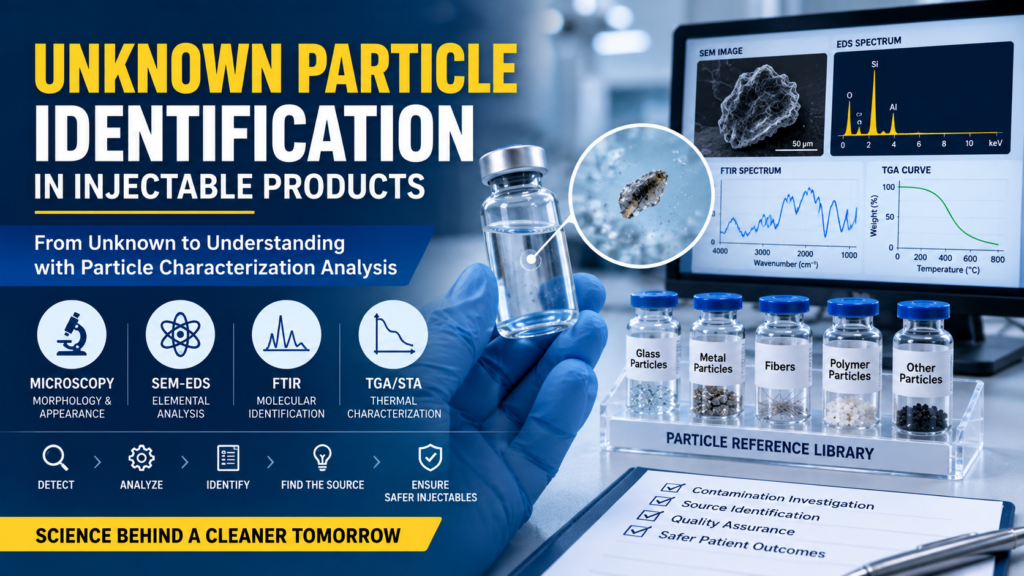
The process can combine several analytical technologies, including Scanning Electron Microscopy with Energy Dispersive X-ray Spectroscopy (SEM-EDS), Fourier Transform Infrared Spectroscopy (FTIR), Thermogravimetric Analysis/Simultaneous Thermal Analysis (TGA/STA), and microscopic analysis.
In this guide, we will explain how unknown particles can be investigated, why a component library can make identification more powerful, and how pharmaceutical teams can build a systematic approach to particle contamination investigations.
What Is Unknown Particle Identification in Injectable Products?
Unknown particle identification in injectable products is the analytical process of determining the likely composition and potential source of an unexpected particle found in a pharmaceutical product.
The investigation generally has two connected objectives:
- Characterize the unknown particle
- Compare its characteristics with potential source materials
This distinction is important.
Simply determining that a particle contains a particular element does not necessarily prove where it came from.
For example, detecting an element commonly found in stainless steel may indicate a metallic particle, but the investigation may still need to determine which equipment or component could have generated it.
Similarly, identifying a polymeric particle does not automatically establish the exact source.
The strongest investigations therefore combine analytical findings with information about the manufacturing process.
Why Particle Identification Matters for Injectable Products
Injectable medicines require particularly careful control of visible and foreign particulate matter because the product is intended for administration directly into the body.
An unexpected particle can trigger:
- A batch investigation
- A deviation
- A market complaint investigation
- A manufacturing investigation
- A supplier investigation
- A contamination assessment
- A CAPA
- Additional inspection or testing
- A broader risk assessment
The key question is not simply:
“Is there a particle?”
It is:
“What is the particle, where could it have originated, and what does its presence tell us about the manufacturing process?”
That is why particle identification should be integrated into the pharmaceutical quality system.
Particle Characterization vs Particle Detection
These terms are sometimes used interchangeably, but they represent different activities.
Particle detection
Detection answers:
Is particulate matter present?
Particle characterization
Characterization asks:
What are the physical and chemical characteristics of that particulate matter?
Particle identification
Identification goes further:
What material is the particle likely to be, and can it be linked to a potential source?
For example, microscopy may show that a particle has a particular shape and morphology.
SEM can provide high-resolution information about its morphology, while EDS can provide elemental information.
FTIR can provide molecular or bonding-related information for suitable materials.
TGA/STA can provide thermal behavior that may help distinguish or support identification of certain materials.
Together, these techniques can create a much stronger evidence base than visual observation alone.
The Importance of a Product-Contact Component Library
One of the most valuable strategies for unknown particle identification in injectable products is to understand the materials that could potentially contribute particles to the product.
This is where library preparation becomes important.
A component library establishes analytical reference information for relevant product-contact and, where appropriate, non-product-contact components.
The objective is to know what the manufacturing system looks like from a materials perspective before an unknown particle appears.
This can make a subsequent investigation faster and more scientifically informed.
How Library Preparation Works
A structured library preparation exercise can begin with a walkthrough of the manufacturing process.
Step 1: Perform a Gemba Walk
A Gemba walk can be conducted with the client as an optional part of the investigation and preparation process.
The purpose is to understand the actual manufacturing environment rather than relying only on documentation.
During this exercise, the team can identify:
- Product-contact components
- Potentially relevant non-contact components
- Equipment interfaces
- Processing materials
- Tubing and hoses
- Seals and gaskets
- Filters
- Elastomeric components
- Packaging-related materials
- Other potential contamination sources
The precise scope should be defined according to the individual manufacturing process.
Step 2: Identify Potential Source Components
Once the manufacturing process has been reviewed, relevant components can be mapped.
This creates a practical question:
If a particle appeared in the product, which materials could potentially generate it?
The answer can include both obvious and less obvious sources.
For example, an investigation might consider:
- Stainless-steel surfaces
- Polymer components
- Elastomers
- Filters
- Tubing
- Gaskets
- Seals
- Glass-contact areas
- Equipment surfaces
The goal is not to assume that one of these materials is the source.
The goal is to create a scientifically useful list of candidates.
Step 3: Collect Representative Coupons
After relevant components have been identified, representative material samples or coupons can be collected from the client.
These coupons become reference materials for laboratory analysis.
This step is extremely important because a library is only useful when it represents the materials actually present in the manufacturing process.
The resulting reference data can include information about:
- Morphology
- Elemental composition
- Molecular characteristics
- Thermal behavior
- Microscopic appearance
That information can later be compared with an unknown particle.
Step 4: Analyze Coupons Using Multiple Technologies
A comprehensive library preparation approach can use four complementary analytical technologies:
- SEM with EDS
- FTIR
- TGA/STA
- Microscopic analysis
Each technology provides a different type of information.
SEM with EDS for Particle Characterization
Scanning Electron Microscopy provides high-resolution imaging of a particle or material surface.
It can help assess:
- Particle morphology
- Surface structure
- Shape
- Size-related characteristics
- Physical appearance
When combined with Energy Dispersive X-ray Spectroscopy, elemental information can also be obtained.
Why SEM-EDS is useful
Suppose an unknown particle is suspected to be metallic.
SEM can provide detailed morphology while EDS can provide elemental information.
This can help distinguish materials that may appear similar during ordinary visual inspection.
For unknown particles, the resulting data can then be compared against the reference library.
FTIR for Molecular and Material Identification
Fourier Transform Infrared Spectroscopy is particularly useful for characterizing many organic and polymeric materials.
FTIR can provide information related to molecular structure and chemical bonding.
This can be valuable when investigating particles associated with:
- Polymers
- Elastomers
- Organic materials
- Certain coatings
- Other infrared-active materials
For example, if an unknown particle is suspected to have originated from a polymeric component, FTIR analysis may provide information that supports comparison with candidate source materials.
FTIR does not replace other techniques.
Instead, it can complement elemental and microscopic information.
TGA/STA for Thermal Characterization
Thermogravimetric Analysis and Simultaneous Thermal Analysis can provide information about how a material behaves when subjected to controlled temperature changes.
This can be useful for certain materials where thermal behavior helps distinguish between potential sources.
Depending on the material, analysis may provide information associated with:
- Weight loss
- Thermal stability
- Decomposition behavior
- Residual inorganic content
- Thermal transitions
For library preparation, this creates another layer of reference information.
Microscopic Analysis: The First-Level Visual Evidence
Microscopic analysis remains an important part of particle characterization.
It can provide information about:
- Morphology
- Shape
- Color
- Surface appearance
- Fiber structure
- Particle dimensions
- Agglomeration
Although microscopy may not always identify the chemical composition of an unknown particle, it can provide valuable evidence.
For example, a fiber-like particle and a compact metallic particle may require completely different investigation pathways.
Microscopy can therefore help establish the initial characterization profile before advanced analytical techniques are applied.
The Unknown Particle Investigation Process
Once a reference library has been established, the workflow for an unknown particle becomes more structured.
A typical investigation can follow these stages.
1. Particle is detected
An unexpected particle is identified in the injectable product.
2. Particle is recovered
The particle must be carefully recovered using a suitable procedure.
Recovery is critical because the objective is to preserve the particle for subsequent analysis.
3. Initial microscopic assessment
The recovered material can be examined to understand its morphology and general characteristics.
4. SEM-EDS analysis
SEM-EDS can then be used to obtain detailed morphology and elemental information where appropriate.
5. Comparison with reference materials
The analytical results can be compared against the established component library.
6. Source assessment
Potential source materials can be evaluated using the combined evidence.
7. Manufacturing investigation
The analytical conclusion can then be considered alongside manufacturing records, equipment history, maintenance information, deviations and other process data.
This final step is essential.
Laboratory identification and manufacturing root-cause determination are related, but they are not always identical.
Why One Analytical Technology May Not Be Enough
Imagine an unknown particle that appears dark under a microscope.
Is it:
- Metal?
- Polymer?
- Carbonaceous material?
- A composite?
- Process residue?
- Another material?
A single observation may not answer the question.
This is why multi-technique characterization can be powerful.
Consider the information flow:
Microscopy → morphology
SEM → high-resolution structure
EDS → elemental composition
FTIR → molecular/material information
TGA/STA → thermal behavior
When these findings are evaluated together, the investigation can build a more comprehensive characterization profile.
Example: Investigating an Unknown Particle in a Vial
Consider a hypothetical injectable manufacturing scenario.
During inspection, an operator notices an unusual particle inside a vial.
The first reaction might be to reject the unit.
That may be appropriate according to the site’s approved procedure.
But the quality investigation has a second question:
What is the particle?
The particle is carefully recovered and submitted for analysis.
Microscopy shows an irregular morphology.
SEM provides detailed imaging.
EDS indicates elemental characteristics consistent with a particular material category.
The result is then compared with materials from the component library.
Suppose one manufacturing component shows a highly similar analytical profile.
That does not automatically prove causality.
The investigation team would then examine:
- Equipment history
- Component condition
- Maintenance activity
- Batch records
- Cleaning procedures
- Process interventions
- Supplier information
- Previous deviations
- Previous particle findings
The analytical data becomes one important piece of the root-cause investigation.
Common Mistakes in Particle Contamination Investigations
Mistake 1: Assuming the particle source from appearance alone
A black particle is not necessarily carbon or burnt material.
Appearance is evidence, not proof.
Mistake 2: Analyzing only the unknown particle
Without reference materials, it may be difficult to establish which manufacturing component has the closest match.
Mistake 3: Ignoring non-contact components
Although product-contact components are obvious candidates, the investigation should consider other potential contamination pathways based on the actual process.
Mistake 4: Using only one analytical technique
Different materials require different types of analytical evidence.
Mistake 5: Treating analytical identification as the complete root cause
Finding a material match does not automatically establish how that material entered the product.
The manufacturing investigation still matters.
How Indian Pharma Companies Can Build a Strong Particle Investigation Strategy
Indian pharmaceutical manufacturers can strengthen their approach by establishing a predefined particle investigation framework.
A practical strategy includes:
Before an incident
- Map product-contact materials.
- Identify relevant non-contact materials.
- Prepare representative coupons.
- Establish reference data.
- Maintain controlled library records.
- Define particle recovery procedures.
- Establish laboratory investigation pathways.
During an investigation
- Preserve the particle carefully.
- Document its initial appearance.
- Recover the particle using an appropriate method.
- Perform suitable analytical characterization.
- Compare against library materials.
- Review manufacturing history.
- Assess potential contamination pathways.
After the investigation
- Document the conclusion.
- Evaluate whether additional batches are affected.
- Determine whether CAPA is required.
- Review component or equipment controls.
- Update risk assessments where appropriate.
- Add relevant findings to the knowledge base.
When Should a Company Consider Third-Party Particle Characterization?
Not every facility has access to every analytical technology internally.
Advanced equipment can require:
- Specialized instrumentation
- Trained analysts
- Method expertise
- Sample preparation capability
- Controlled laboratory procedures
- Interpretation expertise
Third-party particle characterization services in India can therefore provide access to specialized capabilities when an internal laboratory does not have the necessary resources.
This can be particularly useful when:
- An unknown particle has been detected.
- The source cannot be established visually.
- A complaint requires investigation.
- A recurring contamination issue needs deeper analysis.
- A manufacturing deviation involves particulate matter.
- A component library needs to be developed.
- An independent analytical assessment is valuable.
What to Look for in a Particle Characterization Service
Before selecting a laboratory or service provider, pharmaceutical quality teams should evaluate several factors.
1. Analytical capabilities
Can the laboratory perform the technologies relevant to the investigation?
2. Sample handling
How will the unknown particle be received, documented, preserved and recovered?
3. Reference library capability
Can the laboratory support characterization of relevant manufacturing components?
4. Scientific interpretation
Will the laboratory provide analytical results that can be meaningfully interpreted?
5. Documentation
Are results presented in a format suitable for quality investigations?
6. Pharmaceutical understanding
Does the provider understand the context of pharmaceutical manufacturing and contamination investigations?
The best service is not necessarily the one offering the largest number of instruments.
It is the one capable of matching the analytical strategy to the investigation question.
A Practical Checklist for Unknown Particle Investigations
When an unknown particle is discovered, ask:
- Was the particle properly documented?
- Was the sample recovered appropriately?
- Was its morphology recorded?
- Was the manufacturing process reviewed?
- Were potential source components identified?
- Is a component library available?
- Were relevant reference coupons analyzed?
- Was SEM-EDS considered?
- Was FTIR considered where appropriate?
- Was TGA/STA considered where appropriate?
- Was microscopic analysis performed?
- Were analytical results compared with candidate materials?
- Was the manufacturing history reviewed?
- Were potential contamination pathways assessed?
- Was the conclusion documented with appropriate evidence?
- Was CAPA or further action considered?
This checklist can help prevent an investigation from stopping at the first plausible explanation.
FAQ: Unknown Particle Identification in Injectable Products
What is unknown particle identification in injectable products?
It is the systematic analysis of an unexpected particle found in an injectable product to determine its physical and chemical characteristics and assess potential sources.
Why is particle characterization important?
Particle characterization provides evidence about the morphology, elemental composition, molecular characteristics or thermal behavior of a material. This information can support contamination investigations and root-cause assessments.
What techniques are used for particle characterization?
Depending on the material and investigation requirements, techniques can include SEM-EDS, FTIR, TGA/STA and microscopic analysis.
What is a particle library?
A particle or component library is a collection of analytical reference information for materials that could potentially contribute particles to a pharmaceutical product.
Why prepare coupons from manufacturing components?
Coupons provide representative reference materials that can be analyzed and compared with an unknown particle discovered in a product.
Can SEM-EDS identify every unknown particle?
No single analytical technique should be considered universally sufficient. SEM-EDS provides valuable morphology and elemental information, but other techniques may be needed depending on the particle’s composition and the investigation objective.
Can particle identification prove the root cause?
Not necessarily. Analytical characterization can identify or characterize a material and potentially establish similarity to a source component. Determining the actual root cause generally requires combining laboratory findings with manufacturing and process investigation data.
When should pharmaceutical companies use third-party particle characterization?
Third-party analysis can be valuable when specialized analytical technologies, independent expertise or a structured component-library investigation are required.
Conclusion: Turn an Unknown Particle Into Actionable Evidence
An unknown particle in an injectable product is more than an isolated visual defect.
It can be a clue pointing toward a component, equipment condition, process activity or contamination pathway that deserves investigation.
The objective of unknown particle identification in injectable products is therefore not simply to give the particle a name. It is to generate reliable analytical evidence that can support a broader pharmaceutical quality investigation.
A structured approach can begin with library preparation.
By conducting a Gemba review with the client where appropriate, identifying product-contact and relevant non-contact components, collecting representative coupons and analyzing those materials using complementary technologies, manufacturers can establish a valuable reference database.
When an unknown particle is subsequently discovered, the investigation can then move systematically through:
Particle recovery → Microscopy → SEM-EDS → Comparison with library → FTIR/TGA/STA where appropriate → Source assessment → Manufacturing investigation
For Indian pharmaceutical manufacturers, this approach can strengthen contamination investigations, support scientifically informed root-cause analysis and create a better understanding of potential particulate sources.
If your organization needs specialized particle characterization analysis for unknown particles, component-library preparation or injectable contamination investigations, explore Confianca Pharma Zone’s particle characterization services.
Explore Particle Characterization & Analysis Services
Your trusted partner for pharma skills, systems, and solutions.