
No products in the cart.
Expert SEM EDS Analysis Saudi Arabia: 5 Advanced Particle Characterization Methods
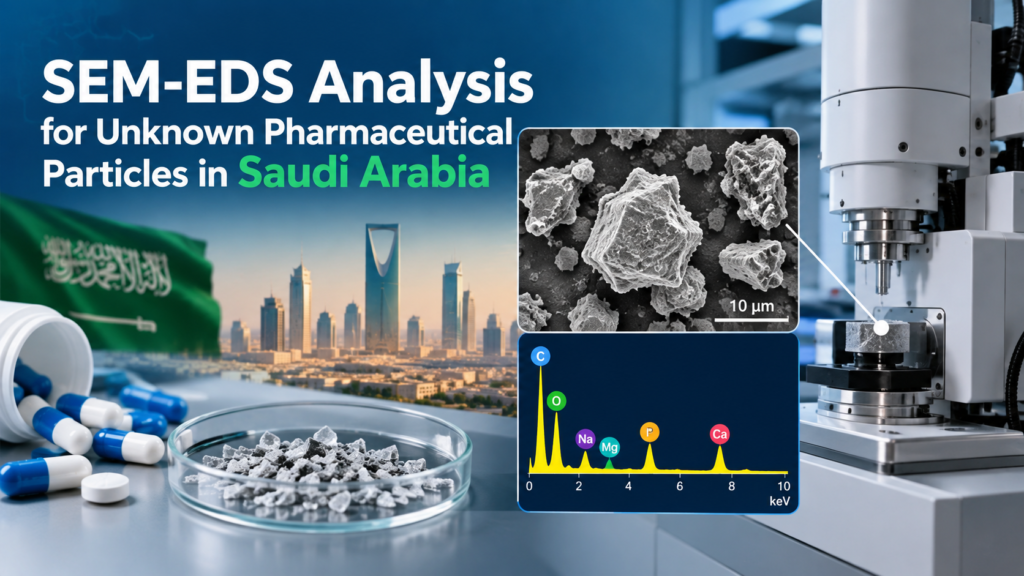
Finding an unknown particle in a pharmaceutical product can quickly turn a routine quality investigation into a critical scientific question.
What is the particle? Where did it come from? Is it related to manufacturing equipment, packaging, raw materials, environmental contamination, or another source?
Visual inspection can confirm that a particle exists, but appearance alone is rarely enough to establish its composition. This is where SEM EDS analysis Saudi Arabia can provide valuable analytical evidence.
Scanning Electron Microscopy (SEM) provides high-resolution information about a particle’s morphology, surface characteristics, and structure. Energy Dispersive X-ray Spectroscopy (EDS), also called EDX, complements SEM by providing information about the elemental composition of the area being examined.
Together, SEM and EDS can help pharmaceutical quality teams move from simply observing an unknown particle to developing a scientifically supported understanding of its characteristics and possible origin.
This is particularly relevant to pharmaceutical manufacturers, quality-control laboratories, contract testing organizations, formulation teams, and regulatory-facing quality departments in Saudi Arabia.
Saudi Arabia’s pharmaceutical sector operates within an increasingly structured regulatory environment. The Saudi Food and Drug Authority (SFDA) oversees medicines and related products in the Kingdom, while its GMP framework supports controls intended to protect pharmaceutical quality and safety. SFDA has also reported extensive inspections of pharmaceutical manufacturers; in 2023, its inspectors made 1,713 observations during visits to 113 pharmaceutical factories.
That makes scientifically defensible particle investigations an important part of a robust pharmaceutical quality system.
What Is SEM-EDS Analysis?
This analysis combines two analytical capabilities:
1. Scanning Electron Microscopy
SEM uses a focused electron beam to examine a sample surface and generate highly magnified images.
For pharmaceutical particles, SEM can help laboratories examine:
- Particle morphology
- Surface texture
- Particle shape
- Surface defects
- Fractures and cracks
- Agglomeration
- Relative particle size
- Differences between particles
SEM is widely used for studying pharmaceutical materials and excipients. Research has also demonstrated the use of SEM imaging to characterize and analyze pharmaceutical particle morphology.
2. Energy Dispersive X-ray Spectroscopy
EDS detects characteristic X-rays generated when the electron beam interacts with elements within the sample.
This can provide information about elements such as:
- Silicon
- Iron
- Chromium
- Nickel
- Aluminum
- Calcium
- Magnesium
- Sodium
- Potassium
- Sulfur
- Phosphorus
The exact elements detected depend on the particle and analytical conditions.
For example, if an unknown particle shows significant iron, chromium, and nickel signals, the result could provide evidence for investigating a potential metallic source. However, elemental results should be interpreted alongside morphology, manufacturing knowledge, reference samples, and complementary analytical techniques rather than being treated as automatic proof of a specific source.
Why Pharmaceutical Particle Characterization Analysis Matters
An unexpected particle can create several quality questions.
A pharmaceutical manufacturer may need to determine:
- What is the particle made of?
- How large is it?
- What does its morphology indicate?
- Could it have originated from manufacturing equipment?
- Could it be associated with packaging components?
- Is it consistent with a known raw material or excipient?
- Does it resemble previously observed contamination?
- What additional testing is necessary?
A proper particle characterization analysis can help organize the investigation around evidence rather than assumptions.
Scientific literature on pharmaceutical foreign-matter investigations highlights the importance of identifying foreign material and determining its possible source to prevent recurring contamination. SEM/EDS may be used alongside techniques such as FTIR and other spectroscopic methods depending on the nature of the sample.
Common Sources of Unknown Pharmaceutical Particles
Unknown particles can potentially originate from many stages of pharmaceutical production.
Manufacturing equipment
Possible sources include:
- Stainless-steel components
- Equipment wear
- Milling equipment
- Mixing systems
- Pumps
- Filling equipment
- Filters
- Valves
- Coating equipment
A metallic particle with characteristic elemental signals can provide useful evidence for further equipment-source investigation.
Packaging components
Particles may potentially be associated with:
- Glass containers
- Rubber closures
- Plastic components
- Elastomeric materials
- Metal components
- Packaging machinery
When particles are found inside or associated with containers, understanding their elemental characteristics can help narrow the investigation.
Raw materials and excipients
Raw materials can contain particles with different morphology or elemental signatures.
For example, an unexpected inorganic particle may require comparison with:
- Incoming raw materials
- Excipients
- Processing aids
- Reference standards
- Environmental samples
Environmental sources
Particles can also potentially originate from:
- Dust
- Building materials
- Filters
- Cleaning activities
- Personnel-related sources
- HVAC-related sources
The objective is not simply to identify a particle but to establish a scientifically supported pathway for understanding how it may have entered the product or process.
How SEM EDS Analysis Saudi Arabia Supports Pharmaceutical Investigations
The practical value of SEM EDS analysis Saudi Arabia lies in combining visual information with elemental evidence.
Consider a hypothetical investigation.
A manufacturer discovers a small dark particle during inspection of a pharmaceutical product.
Step 1: Visual observation
The particle is documented photographically.
Its appearance might suggest that it is:
- Metallic
- Mineral-like
- Fibrous
- Glass-like
- Organic
- Unknown
However, appearance is only the starting point.
Step 2: SEM examination
SEM produces high-resolution images that reveal morphology and surface characteristics.
The laboratory may observe:
- Irregular morphology
- Smooth surfaces
- Crystalline structures
- Fractures
- Agglomerated material
Step 3: EDS analysis
EDS is then performed on selected areas.
The resulting spectrum may show the presence of particular elements.
Step 4: Comparison
The analytical findings can be compared with suitable reference materials or potential sources.
Step 5: Investigation
The quality team can use the evidence to determine what additional investigation is appropriate.
This could include:
- Equipment inspection
- Batch-record review
- Raw-material comparison
- Packaging investigation
- Environmental assessment
- Additional spectroscopy
- Supplier investigation
The result is a more structured root-cause investigation.
What Information Can SEM-EDS Provide?
A good pharmaceutical particle analysis should consider both morphology and composition.
| Analytical Question | SEM-EDS Contribution |
|---|---|
| What does the particle look like? | High-resolution SEM imaging |
| What is its surface morphology? | SEM examination |
| Which elements are present? | EDS spectrum |
| Where are elements located? | EDS elemental mapping |
| Are different areas compositionally different? | Point analysis/mapping |
| Could it be metallic or inorganic? | Elemental evidence can assist classification |
| Does it resemble a reference particle? | Comparative morphology and elemental data |
Elemental mapping can be especially useful when a particle contains multiple regions or materials. Research has demonstrated SEM-EDS elemental mapping in pharmaceutical applications, including investigation of material distribution on tablets and drug crystals.
SEM-EDS vs. Other Particle Characterization Techniques
SEM-EDS is powerful, but it is not necessarily the only technique required.
Different analytical methods answer different questions.
SEM-EDS
Useful for:
- Morphology
- Surface imaging
- Elemental composition
- Elemental mapping
- Inorganic and metallic particle investigations
FTIR
Often useful for:
- Organic materials
- Polymers
- Certain excipients
- Chemical functional groups
Raman Spectroscopy
Can help with:
- Molecular identification
- Pharmaceutical ingredients
- Organic and inorganic materials
- Certain foreign particles
Optical Microscopy
Useful for:
- Initial visual assessment
- Particle morphology
- Larger particles
- Preliminary classification
Other analytical techniques
Depending on the investigation, laboratories may consider techniques such as:
- X-ray diffraction
- ICP-based elemental analysis
- XPS
- ToF-SIMS
- Thermal analysis
Published pharmaceutical investigations have used combinations of microscopy and spectroscopic techniques because no single method necessarily answers every particle-identification question.
When Should Pharmaceutical Manufacturers Consider SEM-EDS?
SEM-EDS may be considered when an investigation involves an unknown particle where morphology and elemental information could help answer the quality question.
Typical scenarios include:
1. Unexpected foreign particles
A visible or isolated particle has been detected and its composition is unknown.
2. Equipment-related contamination investigations
A particle appears potentially metallic or inorganic and equipment wear is being investigated.
3. Packaging investigations
Particles are discovered in or around pharmaceutical containers or closures.
4. Raw-material investigations
An unexpected particle is detected in a raw material or excipient.
5. Recurring contamination
Similar particles appear repeatedly across batches or manufacturing areas.
6. Deviation and CAPA investigations
Analytical evidence is needed to support a deviation investigation and subsequent corrective/preventive actions.
7. Comparative particle analysis
A manufacturer wants to compare an unknown particle against potential reference sources.
7 Practical Tips for a Successful SEM-EDS Investigation
1. Preserve the original particle
Particle loss can compromise an investigation.
Handle and store the particle carefully to minimize:
- Contamination
- Physical damage
- Material transfer
- Sample loss
2. Document the original observation
Record:
- Product
- Batch
- Location
- Date
- Particle appearance
- Approximate size
- Sampling method
- Packaging condition
Good documentation creates context for the laboratory result.
3. Avoid unnecessary sample manipulation
Sample preparation should be designed around the analytical objective.
Unnecessary handling can introduce foreign material or alter the particle.
4. Consider reference samples
Potential source materials can be valuable for comparative analysis.
For example:
- Equipment material
- Packaging material
- Raw material
- Filter material
- Environmental dust
5. Use more than one analytical point
A heterogeneous particle may not have uniform composition.
Analyzing multiple locations can reveal differences within the particle.
6. Interpret EDS results carefully
EDS identifies elements, not necessarily a complete chemical compound.
For example, detecting carbon and oxygen does not automatically establish a specific polymer or organic compound.
7. Integrate the result into the investigation
The laboratory report should support the broader quality investigation rather than exist as an isolated test result.
Choosing a Particle Characterization Analysis Service in Saudi Arabia
When selecting a laboratory or analytical partner, pharmaceutical companies should look beyond the availability of an SEM instrument.
Consider the following:
Technical capability
Ask whether the laboratory can perform:
- SEM imaging
- EDS/EDX analysis
- Elemental mapping
- Point analysis
- Comparative particle analysis
Pharmaceutical experience
Experience with pharmaceutical samples can be important because pharmaceutical particle investigations may involve sensitive samples, contamination-control considerations, and strict documentation requirements.
Sample handling
Ask how the laboratory:
- Receives samples
- Documents samples
- Prevents cross-contamination
- Stores samples
- Handles extremely small particles
Reporting
A useful report should clearly communicate:
- Sample identification
- Analytical method
- SEM images
- EDS spectra
- Elemental findings
- Analytical observations
- Limitations
- Supporting interpretation
Quality systems
For regulated pharmaceutical work, organizations should evaluate the laboratory’s applicable quality systems, competence, validation/verification practices, and accreditation status as appropriate for the intended use.
SFDA states that its National Drug and Cosmetics Control Laboratory performs analysis of imported and locally manufactured medicines against relevant standards and is accredited to ISO/IEC 17025:2017.
Why This Matters for Saudi Pharmaceutical Manufacturers
Saudi Arabia has a substantial regulatory focus on pharmaceutical manufacturing quality.
SFDA reported that its 2023 inspections included 113 pharmaceutical factories and resulted in 1,713 observations. The authority has also emphasized international alignment through its membership in the Pharmaceutical Inspection Co-operation Scheme (PIC/S), which supports harmonized GMP inspection practices.
For manufacturers, this reinforces the importance of having structured processes for investigating unexpected product observations.
A scientifically supported particle characterization workflow can help quality teams:
- Understand unexpected contamination
- Support deviation investigations
- Evaluate potential sources
- Compare unknown and reference particles
- Strengthen technical documentation
- Support root-cause investigations
- Develop appropriate CAPA strategies
Importantly, SEM-EDS results should be interpreted within the full investigation and applicable GMP framework. An elemental match by itself does not prove the source of contamination.
Example: Investigating a Metallic Particle
Imagine a manufacturer discovers an unknown dark particle during pharmaceutical product inspection.
The initial observation indicates that the particle appears metallic.
Instead of immediately attributing it to equipment, the investigation follows a structured approach:
Unknown particle → SEM imaging → EDS elemental analysis → Reference comparison → Equipment/source investigation → Root-cause assessment
Suppose EDS detects iron, chromium, and nickel.
That finding may support investigation of stainless-steel-related sources, but the quality team should still compare the result with actual equipment materials and consider particle morphology and process history.
If the particle’s morphology and elemental profile are consistent with a specific potential source, investigators have stronger evidence for directing the next stage of the investigation.
This illustrates an important principle:
Particle characterization provides evidence; root-cause investigation establishes the broader conclusion.
Frequently Asked Questions About SEM-EDS Analysis
What is SEM EDS analysis used for in pharmaceuticals?
SEM-EDS can be used to examine the morphology and elemental composition of unknown particles. It can support investigations involving foreign matter, contamination, equipment-related particles, packaging materials, raw materials, and other unexpected particulate observations.
Can SEM-EDS identify an unknown pharmaceutical particle?
It can provide valuable morphological and elemental information that helps classify or investigate an unknown particle. However, SEM-EDS does not always provide complete molecular identification. Additional techniques such as FTIR or Raman spectroscopy may be appropriate depending on the material.
What is the difference between SEM and EDS?
SEM primarily provides high-resolution imaging and morphological information. EDS analyzes characteristic X-rays generated from the sample to provide information about elemental composition. They are often used together.
Is SEM-EDS suitable for pharmaceutical contamination investigations?
Yes, SEM-EDS can be a valuable analytical tool for pharmaceutical contamination and foreign-matter investigations, particularly when elemental information and high-resolution morphology are relevant.
Can SEM-EDS determine where a particle came from?
Not by itself. SEM-EDS can provide evidence about composition and morphology. Determining the source requires comparison with potential source materials and consideration of manufacturing processes, equipment, packaging, environmental conditions, and other investigation data.
Is SEM-EDS better than FTIR for particle identification?
Neither technique is universally better. They provide different types of information. SEM-EDS is particularly useful for morphology and elemental composition, while FTIR can be valuable for identifying chemical functional groups and many organic materials. In difficult investigations, complementary techniques may provide a stronger overall characterization.
What should a pharmaceutical laboratory provide in an SEM-EDS report?
A report may include sample identification, analytical methodology, SEM images, EDS spectra, elemental findings, observations, interpretation, and relevant limitations. The exact report content should match the investigation requirements.
How can Saudi pharmaceutical companies benefit from particle characterization analysis?
A structured particle characterization analysis can help Saudi pharmaceutical manufacturers investigate unknown particles, support quality investigations, compare potential contamination sources, and generate technical evidence for decision-making within their quality systems.
Conclusion: Turn Unknown Particles Into Actionable Analytical Evidence
An unexpected pharmaceutical particle should never be treated as simply a visual nuisance.
The right analytical approach can transform an unknown particle into useful scientific evidence.
SEM EDS analysis Saudi Arabia provides two important perspectives: SEM helps reveal the particle’s morphology and surface characteristics, while EDS provides information about its elemental composition. When combined with appropriate reference samples and complementary analytical techniques, this information can support pharmaceutical contamination investigations and particle characterization workflows.
For pharmaceutical manufacturers in Saudi Arabia, selecting an experienced analytical partner is therefore an important part of building a reliable investigation process.
Whether the objective is unknown particle identification, pharmaceutical contamination analysis, foreign matter investigation, or advanced particle characterization analysis, the analytical strategy should always be designed around the specific quality question.
Need reliable particle characterization analysis for an unknown pharmaceutical particle? Contact an experienced pharmaceutical analytical partner to discuss your sample, investigation requirements, and appropriate testing approach.
Your trusted partner for pharma skills, systems, and solutions.