No products in the cart.
Particle Characterization Service India: What QA & QC Teams Should Expect for Reliable Results
A particle found in a pharmaceutical product can raise a deceptively simple question:
“What is this particle, and where did it come from?”
For QA and QC teams, answering that question often requires much more than looking at the particle under a microscope. The investigation may involve understanding its morphology, elemental composition, molecular structure, thermal behavior, and possible source within the manufacturing process.
This is where a structured particle characterization service India can support pharmaceutical investigations.
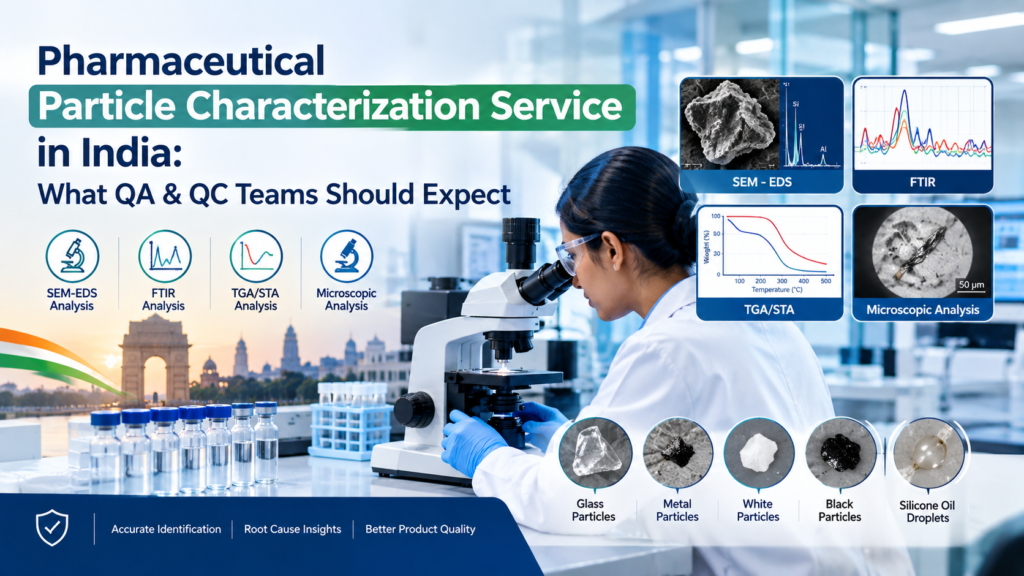
Instead of relying on a single analytical technique, a comprehensive approach can combine Scanning Electron Microscopy with Energy Dispersive Spectroscopy (SEM-EDS), Fourier Transform Infrared Spectroscopy (FTIR), Thermogravimetric Analysis/Differential Thermal Analysis (TGA/STA), and microscopic analysis.
For pharmaceutical manufacturers, the objective is not simply to generate an analytical image. The objective is to create useful evidence that helps QA and QC teams understand an unknown particle, compare it with potential sources, and support a scientifically documented investigation.
According to the Confianca Pharmazon particle characterization service material, its Ahmedabad laboratory supports library preparation and particle characterization testing, including analysis of product-contact and non-contact parts and investigation of unknown particles or fibers recovered from products.
Let’s look at what QA and QC teams should actually expect from such a service.
H2: What Is Pharmaceutical Particle Characterization?
Pharmaceutical particle characterization is the systematic examination of a particle or particulate contaminant to understand its physical and chemical characteristics.
Depending on the investigation, characterization can involve:
- Particle morphology
- Surface characteristics
- Elemental composition
- Molecular structure
- Thermal behavior
- Microscopic appearance
- Comparison with potential manufacturing sources
- Identification of possible contamination sources
A particle may originate from a variety of materials used around pharmaceutical manufacturing, including components, equipment, packaging materials, filters, fibers, or other process-related sources.
The important point is that particle characterization is an investigation process rather than simply a particle-counting exercise.
For QA and QC teams, the final objective is generally to obtain analytical evidence that can be evaluated alongside manufacturing records, process information, environmental data, equipment history, and other investigation findings.
H2: Why QA & QC Teams Need Particle Characterization
When an unknown particle or fiber is identified in a pharmaceutical product, visual observation alone may not provide enough information to determine its source.
For example, a particle may visually appear to be:
- Metallic
- Transparent
- Black
- White
- Fibrous
- Polymer-like
- Glass-like
- Organic
However, visual appearance alone may not establish its actual composition or source.
This is where analytical characterization becomes valuable.
A structured particle characterization service India can provide multiple analytical perspectives on the same sample.
H3: Typical Questions QA Teams May Need to Answer
An investigation may need to address questions such as:
- What is the particle made of?
- What elements are present?
- What does its morphology indicate?
- Does it resemble a material used in product-contact equipment?
- Could it originate from a packaging component?
- Is it consistent with a filter or machine component?
- Is the particle organic, inorganic, metallic, polymeric, or a combination?
- Does the unknown particle match a previously prepared source library?
- What additional investigation should be performed?
The analytical service does not replace the pharmaceutical company’s investigation process. Instead, it provides characterization data that can become one part of the investigation.
H2: What Should a Particle Characterization Service Include?
One of the most important considerations for QA and QC teams is the scope of the analytical workflow.
A service based on only one analytical technique may answer one question while leaving other questions unresolved.
The Confianca Pharmazon service model describes an integrated approach using four technologies:
- SEM with EDS
- FTIR
- TGA/STA
- Microscopic analysis
The service material describes these techniques as part of library preparation and particle characterization analysis.
Let’s understand how each can contribute.
H2: 1. Scanning Electron Microscopy with EDS
H3: Understanding Particle Morphology
SEM can provide high-resolution images of a particle’s surface and morphology.
According to the service brochure, the SEM system can provide imaging up to 300,000× magnification, with analysis at micro- and nanoscale levels. The brochure also describes the use of SE, BSE, UVD and STEM detectors.
For QA and QC investigations, morphology can provide useful information such as:
- Particle shape
- Surface texture
- Fracture characteristics
- Fibrous structure
- Surface deposits
- Differences between particles from different sources
H3: Understanding Elemental Composition
The EDS component complements SEM imaging by providing elemental composition information.
For example, if an unknown particle appears metallic, SEM-EDS can help determine which elements are associated with the particle.
This information can then be compared against known materials used in the manufacturing environment.
The important distinction is:
SEM shows what the particle looks like; EDS helps characterize what elements are associated with it.
Together, they can provide significantly more information than visual examination alone.
H2: 2. FTIR Analysis for Molecular Characterization
Fourier Transform Infrared Spectroscopy, or FTIR, can be used to characterize molecular structures in suitable materials.
The Confianca brochure describes FTIR as suitable for analysis of materials including powders, thin films, polymers, ceramics, liquids, and other solid-state materials, excluding gases. It also states a signal-to-noise ratio of 35000:1 for the referenced instrument.
For pharmaceutical investigations, FTIR can be particularly relevant when the suspected contamination may be associated with an organic or polymeric material.
Potential applications can include characterization of:
- Polymers
- Organic materials
- Certain fibers
- Films
- Coatings
- Other suitable solid materials
Practical QA Tip
Before sending an unknown sample for FTIR analysis, discuss the sample size, physical condition, suspected material, and available quantity with the analytical laboratory.
Small or limited samples may require a carefully planned analytical sequence.
H2: 3. TGA/STA for Thermal Behavior
Thermal analysis can provide another layer of characterization.
The service brochure describes the Simultaneous Thermal Analyzer as combining Thermogravimetric Analysis (TGA) and Differential Thermal Analysis (DTA), with DSC conversion capability. It can be used to study weight changes and thermal events as a function of temperature and time.
This can be useful when investigating materials such as:
- Polymers
- Composites
- Nanomaterials
- Metals
- Ceramics
- Inorganic materials
For QA and QC teams, thermal behavior can become another comparison point when evaluating an unknown material against known source materials.
H2: 4. Microscopic Analysis
Microscopy remains an important part of particle characterization.
According to the service material, microscopic analysis can help detect microscopic contaminants on transparent surfaces such as filters and slides, while improving visibility of organic and biological particles.
Microscopy can support the initial characterization process by documenting:
- Particle shape
- Fiber morphology
- Color
- Transparency
- Surface appearance
- Particle distribution
- Visible structural characteristics
It can also help establish whether a sample is suitable for additional analytical techniques.
H2: What Is Library Preparation in Particle Characterization?
One of the more important concepts for pharmaceutical contamination investigations is library preparation.
Instead of waiting for an unknown particle to appear and then attempting to identify it without reference material, a company can proactively characterize relevant materials from its manufacturing process.
The Confianca model describes performing a Gemba with the client, optionally, to identify product-contact and non-contact parts. Coupons are then collected from the identified parts and analyzed using SEM-EDS, FTIR, TGA/STA, and microscopic analysis.
This creates a reference library of materials.
H3: A Typical Library Preparation Workflow
Step 1: Identify relevant areas
Review the manufacturing process and identify:
- Product-contact components
- Non-contact components
- Equipment parts
- Filters
- Relevant packaging components
- Other potential contamination sources
Step 2: Collect representative coupons
Samples or coupons are collected from selected components.
Step 3: Characterize the materials
The coupons can be evaluated using the selected analytical technologies.
Step 4: Build reference data
The resulting morphology, elemental and other analytical information becomes part of the reference library.
Step 5: Compare future unknowns
When an unknown particle is subsequently recovered, its analytical characteristics can be compared against the established reference information.
This approach can make future investigations more structured.
H2: Unknown Particle Characterization: What Happens When a Particle Is Found?
A particularly important application of a particle characterization service India is investigation of an unknown particle or fiber recovered from a product.
The service material describes a workflow in which, after the library has been prepared, the available data includes morphology and bonding information for product-contact components. When an unknown particle or fiber is identified in the product, the particle is first recovered and then analyzed using SEM-EDS to investigate its possible contamination source.
H3: Simplified Investigation Flow
Unknown particle detected
↓
Particle recovery
↓
Microscopic examination
↓
SEM-EDS analysis
↓
Comparison with reference library
↓
Source investigation
This workflow can help QA teams move from the broad question:
“What is this?”
toward a more specific investigation:
“Does this particle have characteristics consistent with one of our known process materials?”
That distinction is important when building a scientifically documented contamination investigation.
H2: What QA Teams Should Expect From the Final Output
Choosing a particle characterization service India should not be based only on the availability of sophisticated instruments.
QA teams should also understand what information will be provided after testing.
Before initiating an investigation, clarify:
H3: Sample Information
Ask the laboratory to confirm:
- Sample identification requirements
- Required sample quantity
- Sample condition
- Packaging requirements
- Particle recovery requirements
- Sample handling limitations
H3: Analytical Scope
Confirm which techniques are proposed and why.
For example:
| Investigation Question | Potential Analytical Approach |
|---|---|
| What does the particle look like? | Microscopy / SEM |
| What elements are present? | SEM-EDS |
| What molecular structure is indicated? | FTIR |
| How does the material behave thermally? | TGA/STA |
| Could it match a known process source? | Reference library comparison |
The exact technique combination should depend on the sample and investigation objective.
H2: QA vs QC: How Different Teams Can Use the Data
Particle characterization can support both QA and QC, although their responsibilities may differ.
H3: QC Perspective
QC teams may focus on:
- Sample analysis
- Analytical data
- Particle morphology
- Elemental composition
- Material identification
- Analytical comparison
H3: QA Perspective
QA teams may focus more broadly on:
- Investigation documentation
- Potential contamination source
- Impact assessment
- Corrective and preventive actions
- Trend evaluation
- Manufacturing process review
- Evidence supporting the investigation
The strongest workflow connects analytical data with the broader quality investigation rather than treating the laboratory report as an isolated document.
H2: 7 Questions to Ask Before Selecting a Particle Characterization Laboratory
If you are evaluating a particle characterization service India, ask these questions before submitting samples.
1. Can the laboratory investigate unknown particles?
Confirm that the laboratory has experience with recovered particles or fibers rather than only routine material testing.
2. Which analytical techniques are available?
Ask whether the laboratory can combine SEM-EDS, FTIR, TGA/STA and microscopy when appropriate.
3. Can the laboratory prepare a source library?
A reference library can be useful for future contamination investigations.
4. Can you provide manufacturing coupons?
Ask whether the laboratory can support characterization of samples from relevant product-contact and non-contact components.
5. How are unknown particles recovered?
Particle recovery can be an important part of the investigation, particularly when the sample is small.
6. How is the data documented?
Clarify the expected analytical report, images, spectra, elemental data and comparison information.
7. Can the service support an investigation workflow?
A technically strong laboratory should be able to clearly explain the relationship between the analytical method and the investigation question.
H2: Common Mistakes When Investigating Pharmaceutical Particles
H3: Mistake 1 — Using Only Visual Inspection
Visual appearance provides useful information, but it may not establish composition or source.
H3: Mistake 2 — Selecting One Technique for Every Sample
Different materials can require different analytical approaches.
H3: Mistake 3 — Waiting Until an Incident to Build a Reference Library
Proactive library preparation can provide comparative information before an unknown particle investigation occurs.
H3: Mistake 4 — Collecting Too Little Source Information
If relevant equipment, component and packaging materials are not represented in the reference set, comparison may be limited.
H3: Mistake 5 — Treating Instrument Data as the Complete Investigation
Analytical findings should be evaluated alongside manufacturing and quality-system information.
H2: How Confianca Pharmazon Supports Particle Characterization
Confianca Pharmazon’s particle characterization material describes a laboratory in Ahmedabad developed for library preparation and particle characterization testing. The described workflow includes optional client Gemba activities, identification of product-contact and non-contact parts, coupon collection, and analysis using four technologies: SEM-EDS, FTIR, TGA/STA and microscopic analysis.
The service also describes unknown particle characterization after library preparation. Recovered unknown particles or fibers can be analyzed using SEM-EDS to investigate potential contamination sources.
This creates a connected approach:
Manufacturing process → Source identification → Coupon collection → Material library → Unknown particle recovery → Characterization → Source comparison
For pharmaceutical organizations, this can help establish a more systematic approach to particle investigations.
H2: Practical Checklist for QA & QC Teams
Before starting a particle characterization project, prepare the following information:
- Product and batch information
- Description of the unknown particle
- Particle recovery details
- Available sample quantity
- Manufacturing process information
- Product-contact component list
- Relevant non-contact component list
- Packaging material information
- Suspected contamination sources
- Existing investigation findings
- Required analytical techniques
- Reference samples or coupons
- Reporting requirements
- QA review requirements
Having this information ready can make communication with the analytical laboratory more efficient.
H2: FAQ About Particle Characterization Service in India
H3: What is a particle characterization service?
It is an analytical service used to investigate the physical and chemical characteristics of particles or fibers. Depending on the sample, techniques can include SEM-EDS, FTIR, TGA/STA and microscopy.
H3: Why is SEM-EDS useful for pharmaceutical particle analysis?
SEM provides high-resolution information about particle morphology, while EDS provides elemental composition information. The combination can help characterize unknown particulate material.
H3: What is a particle library?
A particle or material library is a reference collection created by characterizing relevant manufacturing components or materials. It can provide comparative information when an unknown particle is later identified.
H3: Can product-contact parts be characterized?
Yes. The described Confianca workflow includes identification of product-contact and non-contact parts, collection of coupons and analysis of those coupons using multiple analytical technologies.
H3: What happens when an unknown particle is found in a product?
The described workflow includes particle recovery followed by SEM-EDS analysis, with the results evaluated against information developed during library preparation.
H3: Is microscopy enough to identify an unknown particle?
Microscopy can provide valuable information about morphology and appearance, but the appropriate analytical method depends on the investigation. Additional techniques such as SEM-EDS, FTIR or TGA/STA may provide complementary information.
H3: Where is the particle characterization facility described by Confianca located?
The service material identifies a Confianca Pharmazon laboratory in Ahmedabad, Gujarat, for library preparation and particle characterization testing.
H2: Conclusion: Build Evidence, Not Just Data
A pharmaceutical particle investigation is rarely solved by one image or one instrument result.
QA and QC teams need a structured way to understand what the particle is, what characteristics it has, and whether those characteristics can be associated with a potential manufacturing source.
A comprehensive particle characterization service India can support that process through a combination of:
- Library preparation
- Product-contact and non-contact component assessment
- Coupon characterization
- Microscopic analysis
- SEM-EDS
- FTIR
- TGA/STA
- Unknown particle recovery
- Source comparison
The biggest opportunity is to move from a reactive investigation model toward a more organized reference-library approach. By characterizing relevant materials before an incident occurs, pharmaceutical teams can create useful baseline information for future investigations.
If your QA or QC team is evaluating unknown particles, fibers, product-contact materials, or contamination sources, discuss your sample and investigation objective with an experienced analytical service provider to determine the appropriate characterization strategy.
Explore Confianca Pharmazon’s Particle Characterization Analysis Services:
Particle Characterization Analysis Services
Your trusted partner for pharma skills, systems, and solutions.