No products in the cart.
Unknown Particle Identification India: A Complete Pharmaceutical Investigation Workflow
A particle discovered in a pharmaceutical product can create a much bigger question than its physical size suggests.
What is it? Where did it come from? And can its source be linked to a material used during manufacturing?
For pharmaceutical QA and QC teams, answering these questions requires more than simply looking at the particle.
An unknown particle may be metallic, polymeric, glass-like, organic, fibrous, or another material. Its visual appearance can provide an initial clue, but a meaningful investigation may require particle recovery, microscopic examination, elemental analysis, and comparison with known manufacturing materials.
This is where a structured unknown particle identification India workflow becomes valuable.
Confianca Pharmazon’s particle characterization material describes a specific workflow for unknown particles or fibers identified in pharmaceutical products: once a reference library has been prepared, the available information on the morphology and bonding structure of product-contact components can be used during investigation. The unknown particle is first recovered and then analyzed using SEM with EDS to investigate its potential contamination source.
This article explains that workflow in practical terms and shows how pharmaceutical manufacturers can organize an unknown-particle investigation from initial detection through analytical characterization and source comparison.
H2: What Is Unknown Particle Identification?
Unknown particle identification is the analytical investigation of a particle or fiber whose identity or source has not yet been established.
The investigation can involve several questions:
- What does the particle look like?
- What is its morphology?
- What elements are present?
- Is it consistent with a known manufacturing material?
- Could it have originated from a product-contact component?
- Is it associated with a filter, equipment part, packaging material, or another source?
- Does it resemble any material already characterized in a reference library?
The objective is not necessarily to answer every question using one instrument.
Instead, the investigation should use an appropriate sequence of analytical techniques based on the particle and the question being asked.
H2: Why Pharmaceutical Manufacturers Need a Structured Particle Investigation
An unknown particle found during pharmaceutical manufacturing can create uncertainty for several teams.
QA may need to understand:
- The investigation scope
- Potential contamination sources
- Analytical evidence
- Impact on the investigation
- Corrective and preventive action considerations
QC may need to determine:
- Particle morphology
- Elemental composition
- Material characteristics
- Suitable analytical methods
- Comparison with reference materials
Manufacturing teams may need to investigate:
- Equipment
- Product-contact components
- Filters
- Packaging
- Process steps
- Other potential sources
A structured investigation connects these activities.
Instead of treating the laboratory analysis as an isolated test, the analytical results become part of a broader contamination investigation.
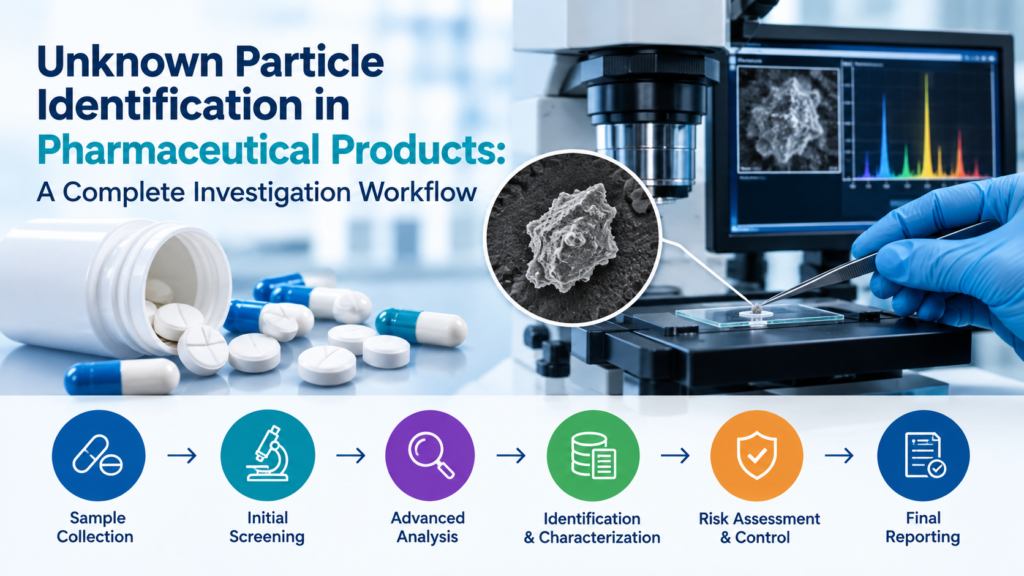
H2: Complete Workflow for Unknown Particle Identification
A practical unknown particle identification India workflow can be organized into the following stages:
- Detect and document the unknown particle
- Preserve and recover the particle
- Perform initial microscopic examination
- Review potential contamination sources
- Compare against an existing material library
- Perform SEM-EDS analysis
- Use complementary analytical techniques when appropriate
- Evaluate the potential source
- Document the analytical evidence
- Integrate the findings into the QA investigation
Let’s examine each stage.
H2: Step 1 — Detect and Document the Unknown Particle
The investigation begins when an unexpected particle or fiber is observed.
Before analytical testing begins, document as much information as possible.
Record information such as:
- Product name
- Batch or lot information
- Manufacturing stage
- Location where the particle was observed
- Particle appearance
- Approximate size
- Color
- Shape
- Whether it appears to be a fiber or particulate
- Recovery conditions
- Available quantity
Photographs or microscopic images may also be useful for establishing the initial appearance.
Why documentation matters
A small particle can be difficult to handle repeatedly.
Creating a record at the beginning of the investigation helps preserve information about its original appearance and context.
H2: Step 2 — Particle Recovery
Particle recovery is an important stage of the investigation.
The Confianca particle characterization workflow specifically describes performing particle recovery first, followed by SEM with EDS analysis of the recovered material.
The exact recovery approach will depend on:
- Where the particle was found
- The type of sample
- Particle size
- Particle quantity
- Sample condition
- Required downstream analysis
For very small particles, unnecessary handling can potentially compromise the available sample.
Practical Tip
Before recovering a limited particle, coordinate with the analytical laboratory whenever possible.
The goal is to preserve the sample so that enough material remains available for the planned characterization sequence.
H2: Step 3 — Perform Initial Microscopic Examination
Microscopy can provide the first analytical layer of information.
The supplied particle characterization material describes microscopic analysis as a technique for rapid detection of microscopic contaminants on transparent surfaces such as filters and slides. It also notes its role in improving visibility of organic and biological particles.
Microscopy can help document:
- Particle shape
- Color
- Surface appearance
- Fiber structure
- Transparency
- General morphology
- Distribution or location
This information can help determine which analytical techniques may be appropriate next.
Important distinction
Microscopy can show what the particle looks like.
It may not, by itself, establish the complete chemical or elemental identity of the material.
H2: Step 4 — Identify Potential Contamination Sources
The next question is:
Where could this particle have come from?
A pharmaceutical manufacturing process can contain many potential sources.
Depending on the process, the investigation may consider:
- Product-contact parts
- Non-contact components
- Equipment materials
- Filters
- Packaging components
- Processing materials
- Fibers
- Other materials present in the manufacturing environment
This is why source mapping is important.
If the manufacturer has already established a reference material library, the investigation becomes more structured.
H2: Step 5 — Build or Use a Particle Reference Library
A reference library can provide a valuable foundation for unknown particle identification India investigations.
The supplied Confianca material describes a library-preparation process in which a Gemba can be performed with the client, optionally, to identify product-contact and non-contact parts.
Based on the identified parts, coupons are collected from the client and analyzed using four technologies:
- SEM with EDS
- FTIR
- TGA/STA
- Microscopic Analysis
The resulting information provides reference data for the characterized materials.
H3: Why Build the Library Before an Investigation?
Imagine a manufacturer has 20 potentially relevant product-contact components.
Without a reference library, an unknown particle found in the product may require the investigation team to determine which materials should be characterized after the event.
With a prepared library, reference information for relevant components is already available.
This can make subsequent comparison more organized.
H2: Step 6 — SEM-EDS Analysis of the Unknown Particle
Once the particle has been recovered, SEM-EDS can be used for characterization.
H3: What Does SEM Provide?
Scanning Electron Microscopy provides high-resolution imaging and information about particle surface morphology.
The supplied material describes SEM capability for micro- and nanoscale surface morphology analysis and states that the referenced system can provide imaging up to 300,000× magnification.
This can help examine:
- Particle shape
- Surface structure
- Fracture characteristics
- Morphological features
- Fine surface details
H3: What Does EDS Add?
Energy Dispersive Spectroscopy provides elemental composition information.
When SEM and EDS are combined, the laboratory can examine both:
Morphology + elemental information
This can be particularly useful when investigating unknown particulate contamination.
For example, if a particle is suspected to originate from a metallic component, elemental information can provide a comparison point against known source materials.
H2: Step 7 — Use Complementary Analytical Techniques When Appropriate
SEM-EDS is central to the specific unknown-particle workflow described in the supplied Confianca library material. However, the broader particle characterization capability includes additional analytical techniques.
These can provide complementary information depending on the material.
H3: FTIR Analysis
Fourier Transform Infrared Spectroscopy can characterize molecular structures in suitable materials.
The supplied material describes FTIR applications for:
- Powders
- Thin films
- Polymers
- Ceramics
- Liquids
- Other solid-state materials
It also describes a signal-to-noise ratio of 35000:1 for the referenced instrument.
FTIR can therefore be considered when the investigation involves a suitable polymeric, organic, or other material for which molecular characterization is relevant.
H3: TGA/STA Analysis
The supplied material describes the Simultaneous Thermal Analyzer as combining:
- Thermogravimetric Analysis
- Differential Thermal Analysis
- DSC conversion capability
The system is described for studying weight changes and thermal events as a function of temperature and time.
The material identifies applications including:
- Polymers
- Composites
- Nanomaterials
- Metals
- Ceramics
- Inorganic materials
Thermal behavior can provide another comparison characteristic when investigating appropriate unknown materials.
H2: Step 8 — Compare the Unknown Particle With Known Materials
This is where reference-library information becomes particularly useful.
Suppose an unknown particle has been characterized using SEM-EDS.
The investigation team may have reference information for:
- A product-contact metallic component
- A polymer component
- A filter
- Another manufacturing material
The unknown particle’s analytical characteristics can then be compared against those known materials.
Comparison may consider:
- Morphology
- Elemental characteristics
- Molecular characteristics where applicable
- Thermal behavior where applicable
- Physical appearance
The purpose is to determine whether the analytical characteristics are consistent with a potential source.
The comparison should be interpreted within the broader investigation rather than treated as an isolated conclusion.
H2: Step 9 — Investigate the Potential Contamination Source
The supplied Confianca material specifically describes the objective of using SEM with EDS after particle recovery to analyze the source of contamination.
At this stage, QA and QC teams can bring together:
- Analytical results
- Reference-library data
- Manufacturing information
- Equipment information
- Product-contact material information
- Process history
- Other investigation evidence
This creates a more complete picture.
Example Investigation
Suppose an unknown particle is recovered from a pharmaceutical product.
The investigation identifies three possible sources:
Source A: metallic product-contact component
Source B: polymeric component
Source C: filter material
SEM-EDS provides elemental information from the unknown particle.
The result is then compared with the reference information for the three source materials.
If the characteristics are consistent with one candidate and inconsistent with others, that analytical information can become part of the source investigation.
The final assessment should consider all available evidence rather than analytical data alone.
H2: Step 10 — Document the Investigation
A strong particle investigation should be traceable.
Documentation can include:
Sample information
- Sample identification
- Recovery location
- Recovery date
- Sample condition
- Available quantity
Analytical information
- Analytical technique
- Instrument information
- Microscopic images
- SEM images
- EDS data
- Other applicable analytical results
Reference information
- Source material
- Component identification
- Coupon information
- Reference analytical results
Investigation information
- Potential contamination sources
- Comparison findings
- Relevant manufacturing information
- QA investigation conclusions
The exact documentation requirements should follow the manufacturer’s quality system and applicable procedures.
H2: Common Challenges in Unknown Particle Investigations
H3: Challenge 1 — Very Limited Sample Quantity
An unknown particle may be extremely small.
Solution: Plan recovery and analytical sequencing before consuming or dividing the sample.
H3: Challenge 2 — No Reference Library
Without characterized source materials, comparison may be more difficult.
Solution: Consider proactively characterizing relevant product-contact and non-contact components.
H3: Challenge 3 — Relying Only on Appearance
Two particles can have similar visual characteristics but different compositions.
Solution: Use appropriate analytical characterization based on the investigation question.
H3: Challenge 4 — Too Many Potential Sources
Complex manufacturing environments can contain many materials.
Solution: Map product-contact and relevant non-contact components and prioritize realistic sources for characterization.
H3: Challenge 5 — Treating One Analytical Result as the Entire Investigation
Laboratory analysis provides evidence, but source investigation may require additional manufacturing and quality information.
Solution: Integrate analytical findings with the wider investigation.
H2: A Practical Unknown Particle Investigation Checklist
When an unknown particle is discovered, QA and QC teams can use this checklist.
Initial assessment
- Document the particle
- Record product and batch information
- Record where it was found
- Photograph or microscopically document it
- Estimate available sample quantity
Recovery
- Establish an appropriate recovery approach
- Protect the sample from unnecessary contamination
- Coordinate sample handling with the analytical laboratory
Source assessment
- Identify product-contact parts
- Identify relevant non-contact parts
- Review filters and equipment
- Review packaging materials
- Check existing reference libraries
Characterization
- Microscopic analysis
- SEM-EDS
- FTIR where appropriate
- TGA/STA where appropriate
Investigation
- Compare against reference materials
- Evaluate potential contamination sources
- Document analytical evidence
- Integrate results into the QA investigation
H2: Why Choose a Specialized Particle Characterization Service?
Developing every analytical capability internally may not be practical for every pharmaceutical organization.
A specialized particle characterization analysis India service can provide access to multiple analytical technologies and technical expertise.
Confianca Pharmazon’s supplied material states that it has developed a laboratory in Ahmedabad for library preparation and particle characterization testing. The described workflow includes client Gemba activities, coupon collection, and analysis using SEM-EDS, FTIR, TGA/STA and microscopic analysis.
A separate Confianca/Umed Labs particle characterization document describes additional capabilities including SEM, inverted fluorescence microscopy, UV fluorescence imaging, EDXRF and stereo microscopy. It describes the contamination-analysis workflow as supporting routine quality assurance and complex investigative studies.
This type of multi-technique capability can be useful when the identity or source of an unknown particle cannot be adequately understood through visual examination alone.
H2: How to Select an Unknown Particle Analysis Laboratory in India
When selecting a laboratory for unknown particle identification India, consider more than the availability of one instrument.
Ask:
1. Can the laboratory handle very small particles?
Sample quantity can be limited, so sample-handling experience matters.
2. Does the laboratory offer SEM-EDS?
This is particularly relevant to the unknown particle workflow described in the supplied source material.
3. Can the laboratory characterize reference materials?
Reference-library preparation can help with future source comparison.
4. Can the laboratory provide complementary techniques?
Ask about FTIR, TGA/STA, microscopy and other relevant capabilities.
5. Can the laboratory understand the investigation context?
A useful analytical service should understand what question the QA/QC team is trying to answer.
H2: FAQ — Unknown Particle Identification in Pharmaceutical Products
H3: What is unknown particle identification?
It is the analytical investigation of a particle or fiber found in a pharmaceutical product when its identity or potential source has not yet been established.
H3: What is the first step in unknown particle identification?
The specific Confianca workflow describes particle recovery first, followed by SEM with EDS analysis to investigate the contamination source.
H3: Why is SEM-EDS useful for unknown particle analysis?
SEM provides high-resolution morphological information, while EDS provides elemental composition information. Together, they can provide complementary information about an unknown particle.
H3: What is a particle reference library?
It is a collection of analytical information generated from known manufacturing materials or components. The supplied Confianca workflow describes identifying product-contact and non-contact parts, collecting coupons, and characterizing them using SEM-EDS, FTIR, TGA/STA and microscopy.
H3: Can fibers also be investigated?
Yes. The supplied material specifically refers to unknown particles/fibers identified in products and describes particle recovery followed by SEM-EDS analysis.
H3: Is microscopy enough to identify an unknown particle?
Microscopy can provide valuable morphological information, but the appropriate analytical approach depends on the investigation. Additional techniques may provide elemental, molecular or thermal information.
H3: Can FTIR be used for particle characterization?
Yes, for suitable materials. The supplied material describes FTIR analysis for powders, thin films, polymers, ceramics, liquids and other solid-state materials, excluding gases.
H3: Why should manufacturers characterize product-contact components?
Characterizing relevant components in advance can create reference information that may be used when an unknown particle is subsequently investigated.
H2: Conclusion: Turn an Unknown Particle Into Investigable Evidence
An unknown particle may be tiny, but the investigation surrounding it can be complex.
A reliable approach starts with preserving and recovering the particle, documenting its characteristics, understanding potential manufacturing sources, and applying suitable analytical techniques.
The workflow can be summarized as:
Detection → Documentation → Particle Recovery → Microscopy → Source Mapping → Reference-Library Comparison → SEM-EDS → Complementary Analysis → Source Investigation → QA Documentation
The key advantage of a reference-library approach is that pharmaceutical manufacturers do not have to approach every unknown particle investigation without baseline information.
By characterizing relevant product-contact and non-contact components in advance, teams can establish reference information that can support future investigations.
For organizations looking for unknown particle identification India, a specialized particle characterization service can provide access to analytical technologies such as SEM-EDS, FTIR, TGA/STA and microscopy, depending on the sample and investigation objective. Confianca’s supplied service material specifically describes library preparation and unknown particle characterization workflows based on these capabilities.
Ready to investigate an unknown particle or fiber?
Explore Particle Characterization Analysis Services
If your QA or QC team has recovered an unknown particle, fiber, or suspected contamination material, share the available sample information and investigation objective with the analytical team to determine an appropriate characterization workflow.
Your trusted partner for pharma skills, systems, and solutions.