No products in the cart.
Particle Characterization Laboratory Saudi Arabia: Proven Benefits of Outsourcing Particle Analysis
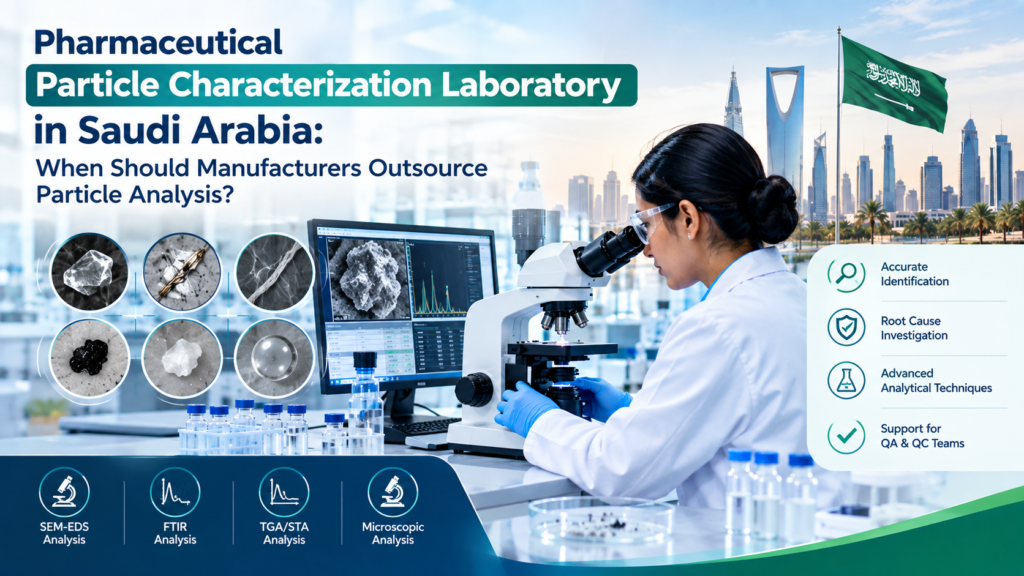
Finding an unexpected particle in a pharmaceutical product can quickly turn a routine quality investigation into a complex technical exercise.
The first question may be simple: “What is this particle?”
But QA and QC teams often need to answer much more:
- What is the particle made of?
- What is its morphology?
- Is it metallic, polymeric, glass-like, organic, or another material?
- Could it have originated from a product-contact component?
- Could it be associated with packaging, filtration, equipment, or another manufacturing source?
- Can the particle be compared with known materials from the manufacturing process?
- What analytical evidence can support the investigation?
These questions are where specialized particle characterization becomes valuable.
For pharmaceutical manufacturers operating in Saudi Arabia, maintaining every advanced analytical capability internally may not always be practical. Depending on the investigation, sample type, equipment requirements, frequency of testing, and available expertise, outsourcing can provide access to specialized characterization techniques and analytical knowledge.
A particle characterization laboratory Saudi Arabia search, however, should not be limited to finding a laboratory with a single sophisticated instrument. Manufacturers should evaluate the complete analytical workflow—from sample recovery and reference-library preparation through characterization and interpretation.
This article explains when outsourcing particle analysis may make sense, what technologies may be involved, how a reference library can support investigations, and what Saudi pharmaceutical manufacturers should consider before selecting an external service provider.
Why Pharmaceutical Particle Characterization Matters
Particles in pharmaceutical manufacturing can come from many potential sources.
Depending on the manufacturing process, possible sources may include:
- Product-contact equipment
- Non-contact equipment components
- Primary packaging materials
- Filters
- Processing components
- Fibers
- Polymers
- Metallic materials
- Glass
- Other manufacturing-related materials
Simply observing a particle under standard lighting may provide an initial indication of its appearance, but it may not establish its composition or source.
For example, two particles can look visually similar but have very different chemical or elemental compositions.
This is why a structured pharmaceutical particle investigation may require several complementary analytical techniques.
The objective is not merely to produce a microscope image. The objective is to generate useful analytical evidence that can help the manufacturer investigate the potential source of contamination.
When Should Pharmaceutical Manufacturers Consider Outsourcing?
There is no single rule that says every particle investigation should be outsourced.
Instead, manufacturers can evaluate the investigation based on its technical requirements and internal capabilities.
Here are several situations where outsourcing may be considered.
1. When Advanced Analytical Equipment Is Not Available Internally
One of the clearest reasons to outsource is access to specialized instrumentation.
Particle characterization can involve technologies such as:
- Scanning Electron Microscopy
- Energy Dispersive Spectroscopy
- FTIR
- TGA/STA
- Microscopy
- Fluorescence-based techniques
- Other specialized analytical methods depending on the sample
Purchasing and maintaining every possible analytical platform can require significant investment in:
- Equipment
- Laboratory infrastructure
- Maintenance
- Calibration
- Trained personnel
- Method development
- Data interpretation
- Quality systems
If particle investigations are occasional rather than routine, an external laboratory may provide access to the required capability without requiring the manufacturer to establish every technology internally.
2. When the Unknown Particle Is Very Small or Limited in Quantity
Sample quantity can become a major consideration during particle investigations.
An unknown particle recovered from a pharmaceutical product may be extremely small. There may be very little material available for testing.
This makes sample handling and analytical planning important.
A suitable external laboratory should discuss:
- Available sample quantity
- Particle recovery method
- Sample condition
- Sample preparation
- Appropriate analytical technique
- Whether the sample can be preserved for additional testing
Practical Tip
Do not automatically divide a limited particle sample among several laboratories.
First discuss the sample with the analytical team and establish a testing sequence. An unnecessarily fragmented sample can make subsequent characterization more difficult.
3. When the Particle’s Source Is Unknown
Sometimes the manufacturing team already has a strong hypothesis about the source.
In other cases, there may be several possible sources.
For example, an unknown particle might potentially be associated with:
- A metallic component
- A polymeric component
- A filter
- Packaging
- A processing material
- A fiber source
In such cases, analytical characterization can help create a more evidence-based comparison.
The service material provided by Confianca describes a workflow in which unknown particles or fibers are recovered and then analyzed using SEM with EDS after a reference library has been prepared.
This can help connect an unknown particle investigation with previously characterized manufacturing materials.
4. When You Need Multiple Analytical Techniques
A particle may require more than one analytical perspective.
For example:
| Question | Potential Technique |
|---|---|
| What does the particle look like? | Microscopy / SEM |
| What elements are present? | SEM-EDS |
| What molecular characteristics are present? | FTIR |
| What happens to the material with temperature? | TGA/STA |
| Could it correspond to a known process material? | Reference-library comparison |
The exact analytical combination should be selected according to the sample and investigation objective.
The Confianca particle characterization material describes an integrated library-preparation workflow using SEM with EDS, FTIR, TGA/STA and microscopic analysis.
Understanding the Technologies Used in Particle Analysis
SEM-EDS: Morphology and Elemental Information
Scanning Electron Microscopy can provide high-resolution information about particle morphology.
The service material describes SEM capability for micro- and nanoscale surface morphology analysis and states that the referenced system can provide imaging up to 300,000× magnification. When combined with EDS, elemental composition information can also be obtained.
For a pharmaceutical investigation, SEM-EDS may help evaluate:
- Particle shape
- Surface morphology
- Surface characteristics
- Elemental composition
- Differences between potential source materials
Example
Suppose an unknown particle is suspected to have originated from a metallic manufacturing component.
SEM can document the particle morphology, while EDS can provide elemental information that can be compared with candidate materials.
This does not automatically establish causation, but it can provide important analytical evidence for the broader investigation.
FTIR: Characterizing Suitable Molecular Materials
Fourier Transform Infrared Spectroscopy can provide information about molecular structure in suitable samples.
The supplied service material describes FTIR applications involving materials such as:
- Powders
- Thin films
- Polymers
- Ceramics
- Liquids
- Other solid-state materials
The brochure specifies that the referenced FTIR system is intended for materials other than gases.
FTIR can therefore be particularly useful when investigating suspected polymeric or organic materials.
For example, if a particle appears to be associated with a polymeric component, FTIR may provide complementary molecular information alongside microscopy and other techniques.
TGA/STA: Understanding Thermal Behavior
Thermal analysis provides another analytical dimension.
The supplied Confianca material describes STA as combining Thermogravimetric Analysis (TGA) and Differential Thermal Analysis (DTA), with DSC conversion capability. It is described for studying weight changes and thermal events as a function of temperature and time.
The referenced application areas include:
- Polymers
- Composites
- Nanomaterials
- Metals
- Ceramics
- Inorganic materials
For QA and QC teams, thermal behavior can provide additional information when comparing an unknown material with known reference samples.
Microscopic Analysis: The First Layer of Characterization
Microscopy remains an important component of particle investigation.
The supplied material describes microscopic analysis for detecting microscopic contaminants on transparent surfaces such as filters and slides and improving visibility of organic and biological particles.
Microscopic examination can provide information about:
- Shape
- Color
- Transparency
- Fiber structure
- Surface appearance
- General morphology
It can also help determine which subsequent analytical technique may be appropriate.
The Importance of Building a Reference Material Library
One of the most useful concepts for recurring contamination investigations is library preparation.
Instead of trying to identify every unknown particle from scratch, pharmaceutical manufacturers can characterize relevant manufacturing materials in advance.
The supplied Confianca material describes conducting an optional Gemba with the client to identify product-contact and non-contact parts. Coupons are then collected and analyzed using SEM-EDS, FTIR, TGA/STA and microscopic analysis.
This creates a reference database of characterized materials.
A Typical Library Preparation Process
Step 1: Map the manufacturing process
Identify areas and components that could potentially contribute particulate contamination.
Step 2: Identify product-contact parts
Document materials that directly interact with the product.
Step 3: Identify relevant non-contact parts
Include other materials that could potentially contribute particles to the manufacturing environment.
Step 4: Collect representative coupons
Appropriate samples can be collected from identified components.
Step 5: Characterize the coupons
Use appropriate analytical technologies to establish their characteristics.
Step 6: Create reference information
Document the analytical results for future comparison.
This means that when an unknown particle is subsequently detected, the manufacturer has reference information available rather than starting from zero.
How Outsourced Particle Analysis Can Support a Contamination Investigation
Consider a hypothetical example.
A pharmaceutical manufacturer detects an unknown dark particle during an investigation.
The internal team confirms that the particle is not expected in the product.
Several potential sources are identified:
- A metallic equipment component
- A polymeric component
- A filter
- A packaging-related material
Instead of relying solely on visual appearance, the manufacturer submits the recovered particle for characterization.
The investigation could proceed as follows:
Unknown particle
↓
Particle recovery
↓
Microscopic examination
↓
SEM-EDS characterization
↓
Comparison with reference materials
↓
Additional FTIR/TGA analysis where appropriate
↓
Potential source assessment
↓
QA investigation and corrective action assessment
This is an example of where outsourcing can add specialized analytical capability to the manufacturer’s internal investigation.
What Should Saudi Manufacturers Look for in an External Laboratory?
Searching for a particle characterization laboratory Saudi Arabia is only the first step.
Before selecting a service provider, manufacturers should evaluate the complete service offering.
1. Analytical Capability
Ask which technologies are actually available for the type of sample being investigated.
Look beyond a single instrument.
2. Sample Recovery Capability
Particle recovery can be critical when dealing with very small or limited samples.
Ask how the laboratory handles:
- Particles
- Fibers
- Filters
- Slides
- Product samples
- Limited quantities
3. Reference-Library Capability
Ask whether the laboratory can characterize coupons from manufacturing components and create reference information.
This can be especially valuable for recurring investigations.
4. Data and Documentation
QA teams should understand what the final report will contain.
Potential deliverables may include:
- Microscopic images
- SEM images
- EDS information
- FTIR spectra
- Thermal-analysis data
- Sample identification
- Analytical observations
- Comparison information
The precise deliverables should be agreed upon before testing.
When Is Outsourcing More Practical Than Building the Capability Internally?
The answer depends on each manufacturer’s situation.
However, outsourcing can be considered when:
- Particle investigations are relatively infrequent.
- Advanced instruments are not available internally.
- Specialist analytical expertise is limited.
- The investigation requires several analytical techniques.
- The available sample is very small.
- An independent analytical assessment is useful.
- The organization wants to establish a reference material library.
- Internal laboratory capacity is temporarily unavailable.
- A complex contamination investigation requires specialized support.
On the other hand, organizations performing frequent particle investigations may evaluate whether some analytical capabilities should be developed internally.
A hybrid model can also be considered, where routine internal activities are complemented by specialized external characterization.
What QA Teams Should Prepare Before Outsourcing
A well-prepared sample submission can make the analytical process more efficient.
Before contacting a particle characterization laboratory Saudi Arabia, prepare as much relevant information as possible.
Sample Information
- Product name
- Batch or lot information
- Sample identification
- Approximate particle size
- Particle appearance
- Recovery location
- Recovery method
- Available quantity
Manufacturing Information
- Relevant process step
- Product-contact components
- Potential contamination sources
- Equipment involved
- Packaging components
- Filters or filtration steps
- Previous investigation findings
Analytical Requirements
Clearly communicate:
- What is already known
- What remains unknown
- What questions QA needs answered
- Whether a reference library exists
- Whether source-comparison samples are available
- Any reporting requirements
This helps the laboratory propose an analytical strategy rather than simply performing an isolated test.
Common Mistakes When Outsourcing Particle Analysis
Mistake 1: Choosing a Laboratory Based Only on Instrument Availability
Having SEM or FTIR does not automatically mean the laboratory has the right workflow for a pharmaceutical particle investigation.
Consider the complete process.
Mistake 2: Sending an Unidentified Sample Without Context
Analytical results can be more useful when the laboratory understands the investigation question and potential source materials.
Mistake 3: Ignoring Reference Samples
Known manufacturing materials can be extremely useful for comparison.
Mistake 4: Requesting Every Technique Without a Defined Objective
More testing is not automatically better.
The analytical plan should be driven by the question being investigated and the characteristics of the sample.
Mistake 5: Treating the Laboratory Report as the Complete Root-Cause Investigation
The analytical report is one component of a broader pharmaceutical investigation.
Manufacturing records, equipment history, process information, environmental information and other evidence may also be relevant.
Outsourcing Particle Characterization: A Practical Decision Checklist
Use this checklist when evaluating whether external support is appropriate.
Internal capability
- Do we have the required analytical instruments?
- Do we have trained personnel?
- Can we handle very small particles?
- Can we perform multiple characterization techniques?
Investigation complexity
- Is the source unknown?
- Are there multiple potential contamination sources?
- Is the particle extremely small?
- Do we need reference-material comparison?
Documentation
- Do we need detailed analytical images?
- Do we require elemental information?
- Is molecular characterization relevant?
- Is thermal characterization relevant?
- Does QA require structured analytical documentation?
If several answers are “yes,” discussing the investigation with a specialized external analytical service may be worthwhile.
How Confianca Pharmazon Supports Particle Characterization
Confianca Pharmazon’s supplied particle characterization material describes a laboratory in Ahmedabad for library preparation and particle characterization testing. The workflow includes optional Gemba activities with clients, identification of product-contact and non-contact parts, coupon collection, and analysis using SEM-EDS, FTIR, TGA/STA and microscopic analysis.
The material also describes unknown particle and fiber characterization after library preparation. The workflow includes particle recovery followed by SEM-EDS analysis to investigate the potential source of contamination.
In addition, a separate Confianca/Umed Labs service document describes particle characterization capabilities including SEM/EDS, inverted fluorescence microscopy, UV fluorescence imaging, EDXRF and stereo microscopy. It states that the contamination-analysis workflow is designed to support routine quality assurance and complex investigative studies.
For a Saudi pharmaceutical manufacturer, this type of external capability can be considered when specialized analytical support is required and the appropriate testing cannot be efficiently performed internally.
FAQ: Particle Characterization in Saudi Arabia
What is a particle characterization laboratory?
A particle characterization laboratory performs analytical testing to investigate the physical, morphological and chemical characteristics of particles or fibers.
Depending on the sample, techniques may include microscopy, SEM-EDS, FTIR and TGA/STA.
When should a pharmaceutical company outsource particle analysis?
Outsourcing may be considered when specialized equipment or expertise is not available internally, when an investigation involves an unknown particle, when sample quantities are limited, or when multiple analytical techniques are required.
What is SEM-EDS particle analysis?
SEM provides high-resolution imaging and morphology information, while EDS provides elemental composition information. The combination can help characterize unknown particulate materials.
Why is a particle reference library useful?
A reference library provides characterization information for known materials from relevant manufacturing components. Unknown particles can subsequently be compared with those reference materials as part of an investigation.
Can product-contact parts be characterized?
Yes. The supplied Confianca workflow specifically describes identifying product-contact and non-contact components, collecting coupons and analyzing them using multiple characterization technologies.
What should I send to a particle analysis laboratory?
Provide the recovered particle or sample along with relevant information about its source, product, manufacturing stage, appearance, recovery method and suspected contamination sources. The laboratory should confirm appropriate sample-handling requirements before submission.
Can one technique identify every unknown particle?
Not necessarily. The appropriate analytical technique depends on the sample and investigation objective. Multiple complementary techniques may sometimes be appropriate.
Conclusion: When Should Saudi Pharmaceutical Manufacturers Outsource Particle Analysis?
The decision to outsource particle characterization should be based on the technical requirements of the investigation, internal laboratory capability, sample characteristics and information required by the QA/QC team.
A specialized external service can be particularly useful when a manufacturer needs access to advanced instrumentation, experienced analytical personnel, multiple characterization techniques, or reference-library development.
A structured approach can look like this:
Identify the investigation question → Recover the particle → Characterize the particle → Compare with known materials → Evaluate potential sources → Integrate the analytical evidence into the QA investigation.
For pharmaceutical manufacturers searching for a particle characterization laboratory Saudi Arabia, it is important to evaluate more than equipment availability. Look at sample handling, analytical breadth, reference-library capabilities, reporting, technical communication and the laboratory’s ability to support the investigation objective.
Confianca Pharmazon provides particle characterization-related capabilities through its described laboratory and collaboration model, including library preparation, SEM-EDS, FTIR, TGA/STA and microscopic analysis.
Ready to discuss a particle investigation?
Explore Particle Characterization Analysis Services
If your pharmaceutical manufacturing facility is dealing with an unknown particle, fiber, suspected contamination source, or product-contact material, share the sample details and investigation objective with the technical team to determine an appropriate characterization strategy.
Your trusted partner for pharma skills, systems, and solutions.