
Knapp Kit vs Defect Kit: What Is the Difference in Pharmaceutical Visual Inspection?
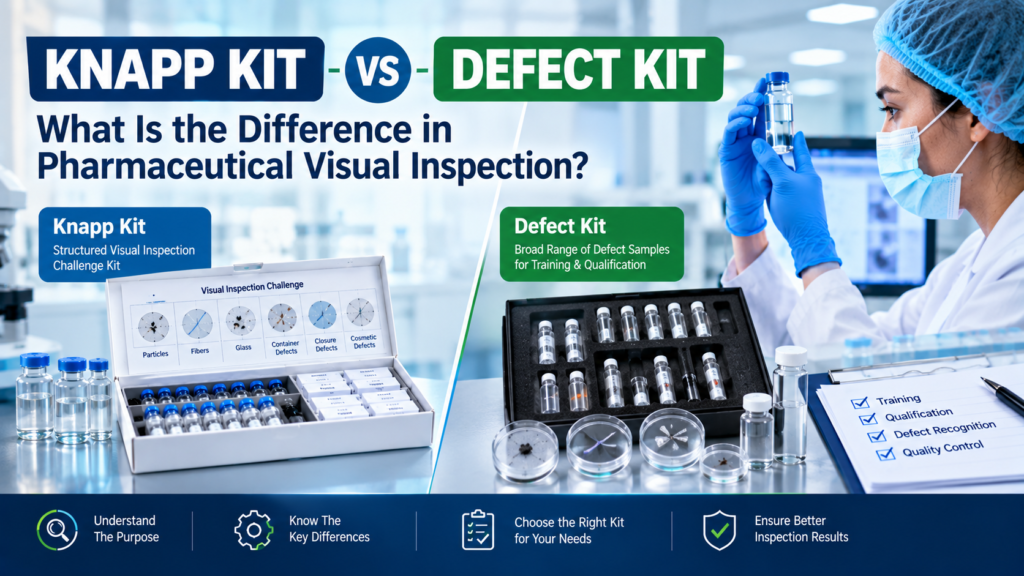
When pharmaceutical manufacturers discuss visual inspection qualification, two terms often appear together: Knapp Kit and defect kit.
At first glance, they may sound like two completely different products. In practice, however, the terminology can overlap.
A defect kit is generally a broad description for a collection of known or representative defects used for visual inspection training, qualification, or evaluation. A Knapp Kit, meanwhile, is a specific type or configuration of visual inspection challenge kit used to assess inspection performance.
This distinction matters when pharmaceutical manufacturers in India are selecting equipment and samples for visual inspection programs.
The wrong terminology can lead to the wrong purchasing specification.
More importantly, selecting a kit simply because it contains “defects” does not necessarily mean that it is appropriate for your particular inspection process.
USP <790> establishes expectations around visual inspection of parenteral products for visible particulate matter, while USP <1790> provides broader guidance on visual inspection and notes that detection is probabilistic and influenced by particle characteristics, product dosage form, and container design.
So, Knapp kit vs defect kit—what is the actual difference?
Let’s explore it step by step.
What Is a Defect Kit in Pharmaceutical Visual Inspection?
The term defect kit is generally used to describe a set of samples containing known, representative, or deliberately introduced defects.
The purpose is to give inspectors or inspection systems a controlled challenge.
Depending on the application, a visual inspection defect kit may contain examples of:
- Glass particles
- Metal particles
- Black particles
- White particles
- Fibers
- Container defects
- Cracks
- Closure defects
- Cosmetic defects
- Other product-specific abnormalities
USP <790> identifies examples of visible particulate matter such as fibers, glass, metal, elastomeric materials, and precipitates.
A defect kit can therefore become part of a structured visual inspection training or qualification program.
The basic concept is simple:
Known defect → controlled inspection → recorded result → performance evaluation
This is much more useful than relying only on naturally rejected production samples, because the manufacturer has greater control over what the inspector is challenged with.
What Is a Knapp Kit?
A Knapp Kit is a more specific term used in pharmaceutical visual inspection for controlled inspection challenges.
Confianca Pharmazon describes its Knapp Kit offering for both manual and automatic visual inspection applications, including liquid and lyophilized formulations in vial, cartridge, and prefilled syringe formats. Its product information also identifies particulate matter in different micron-size ranges.
The kit can be used as part of activities such as:
- Visual inspection training
- Inspector qualification
- Defect recognition
- Inspection performance assessment
- Automated visual inspection challenges
- Probability of Detection studies, where applicable
The exact configuration is important.
A Knapp Kit is not necessarily one universal standardized kit with exactly the same contents for every pharmaceutical manufacturer. The application, container format, formulation, defect type, and inspection method all matter.
Knapp Kit vs Defect Kit: The Main Difference
The easiest way to understand Knapp kit vs defect kit is this:
“Defect kit” is a broader descriptive term, while “Knapp Kit” refers to a specific type or configuration of visual inspection challenge kit.
Think of it this way:
Defect kit = category
Knapp Kit = specific visual inspection kit/application
This is particularly important during procurement.
If a pharmaceutical company tells a supplier, “We need a defect kit,” the supplier may need additional information before recommending the appropriate product.
For example:
- Is it for manual inspection?
- Is it for an automated inspection machine?
- What product is being inspected?
- What container format is used?
- What defects need to be challenged?
- What particle sizes are relevant?
- Is the kit for training or qualification?
- Is POD assessment required?
Without these details, the term “defect kit” may be too broad.
Knapp Kit vs Defect Kit: Comparison Table
| Factor | Defect Kit | Knapp Kit |
|---|---|---|
| Meaning | Broad term for defect-containing inspection samples | Specific visual inspection challenge kit/configuration |
| Primary purpose | Training, qualification, defect recognition, evaluation | Structured visual inspection challenge and qualification |
| Defect types | Depends on supplier and application | Depends on specific Knapp Kit configuration |
| Manual inspection | Can be used | Specific configurations available |
| Automated inspection | Depends on design | Configurations can support automatic inspection applications |
| Particle challenges | May be included | Particulate challenges can be specified |
| Container formats | Supplier-dependent | Configurations can include vials, cartridges and PFS |
| Qualification use | Possible when appropriately designed | Common application |
| Documentation | Depends on supplier | Should be evaluated according to specific kit |
| Selection approach | Define requirements first | Select the appropriate configuration for the application |
The key point is that not every defect kit should automatically be treated as a Knapp Kit, and not every Knapp Kit should be assumed to have the same configuration.
Why Visual Inspection Qualification Needs Controlled Defects
Visual inspection is not simply a matter of asking an operator whether a vial “looks okay.”
USP <1790> describes visual inspection as a probabilistic process. Detection probability can vary according to particle size, shape, color, density, dosage form, and container design.
That has an important implication for pharmaceutical manufacturers:
The inspection process needs to be challenged under defined conditions.
Suppose an inspector successfully identifies a large black particle during training.
That result alone does not demonstrate the same detection capability for:
- A smaller particle
- A transparent fiber
- A glass particle
- A low-contrast defect
- A defect in a different container
- A defect in a different product background
This is why representative and controlled challenge samples can be valuable.
When Should a Pharmaceutical Company Use a Defect Kit?
A pharmaceutical defect kit may be useful across several stages of the visual inspection lifecycle.
1. Initial Inspector Training
New inspectors need practical experience identifying relevant defects.
A controlled kit allows trainers to introduce known challenges instead of relying entirely on naturally occurring defects.
Training can include:
- Explanation of defect categories
- Demonstration of inspection technique
- Controlled sample inspection
- Defect identification
- Recording of results
- Feedback and retraining
2. Inspector Qualification
After training, inspectors may need formal qualification according to the company’s approved procedure.
The challenge samples should be appropriate to the product and inspection process.
The goal is not merely to prove that an employee can identify an obvious defect.
The objective is to evaluate inspection performance against defined and relevant challenges.
3. Periodic Requalification
Inspection performance can be affected by changes in personnel, process conditions, inspection equipment, or procedures.
A controlled defect set can support periodic assessment according to the company’s established qualification program.
For Indian manufacturers, this can form part of a broader GMP-based quality system. India’s Schedule M includes specific requirements for sterile products, parenteral preparations, and sterile ophthalmic preparations, reinforcing the importance of controlled manufacturing and quality systems for these products.
When Is a Knapp Kit More Appropriate?
A Knapp Kit becomes particularly relevant when the manufacturer needs a more specifically defined visual inspection challenge set.
For example, consider an injectable manufacturer operating:
- Manual visual inspection
- Automated inspection
- Vials
- Liquid products
- Lyophilized products
- Multiple particle challenges
The company may need different challenge configurations for different inspection activities.
Confianca Pharmazon’s current product information identifies Knapp Kits for manual and automatic visual inspection machines and lists liquid and lyophilized formulations in vial, cartridge, and PFS formats.
That means the manufacturer can start with the inspection application rather than simply asking for “a defect kit.”
Particles Are Only One Part of Visual Inspection
One common misunderstanding is that visual inspection qualification is exclusively about particulate matter.
Particles are certainly important.
USP <790> specifically addresses visible particulates in injections and includes examples such as fibers, glass, metal, elastomeric materials, and precipitates.
But a comprehensive visual inspection process can involve other defects as well.
Potential inspection challenges include:
Particulate defects
- Glass
- Metal
- Black particles
- White particles
- Fibers
Container defects
- Cracks
- Breakage
- Surface defects
Closure defects
- Stopper problems
- Seal abnormalities
- Closure damage
Cosmetic defects
- Cap abnormalities
- Surface imperfections
- Other appearance-related defects
USP materials also note that the visual inspection framework can apply to other visible defects beyond the visible-particle requirements of USP <790>.
This is why the manufacturer’s defect library and risk assessment should influence kit selection.
Manual Inspection vs Automated Inspection
Another important part of the Knapp kit vs defect kit discussion is the inspection method.
Manual Visual Inspection
Manual inspection depends significantly on trained human operators.
The qualification process may evaluate whether an inspector can identify predetermined defects under controlled inspection conditions.
A manual kit may therefore emphasize:
- Defect recognition
- Inspector training
- Qualification
- Requalification
- Visual acuity
- Consistent inspection technique
Automated Visual Inspection
Automated inspection uses cameras, lighting, image processing, and machine-specific detection parameters.
The challenge samples may therefore need to be compatible with the equipment and its qualification strategy.
A kit that works well for manual inspector training should not automatically be assumed to be appropriate for automated machine qualification.
Practical rule
Choose the challenge sample based on the inspection system being qualified.
This is one of the most important considerations when evaluating Knapp kit vs defect kit.
How to Choose the Right Kit for an Indian Pharmaceutical Manufacturer
Instead of asking, “Which kit is better?” use a requirements-based approach.
Step 1: Identify the product
Start with:
- Injectable or non-injectable product
- Liquid or lyophilized formulation
- Clear or difficult-to-inspect formulation
- Product-specific visual characteristics
USP <1790> notes that different dosage forms and container designs can influence the probability of detecting visible particles.
Step 2: Identify the container
Document:
- Vial
- Ampoule
- Cartridge
- Prefilled syringe
- Container material
- Container size
- Closure configuration
A challenge should represent the actual inspection environment whenever practical.
Step 3: Identify the inspection method
Determine whether you are qualifying:
- Manual inspection
- Semi-automated inspection
- Automated inspection
- Both manual and automated systems
This decision can significantly influence kit configuration.
Step 4: Define the defect library
Ask your QA/QC team:
What defects are realistically important for this product and process?
Create a list.
For example:
| Defect Category | Required? |
|---|---|
| Glass particles | Yes/No |
| Metal particles | Yes/No |
| Fibers | Yes/No |
| Black particles | Yes/No |
| White particles | Yes/No |
| Container cracks | Yes/No |
| Closure defects | Yes/No |
| Cosmetic defects | Yes/No |
This makes supplier discussions much more precise.
What Should You Ask a Kit Supplier?
Before purchasing, ask the supplier for specific technical information.
Product questions
- Which formulations are supported?
- Which container formats are available?
- Can the kit be used for manual inspection?
- Can it be used for automated inspection?
Defect questions
- Which particulate materials are available?
- What particle size ranges are available?
- Are fibers available?
- Are container defects available?
- Are closure defects available?
Documentation questions
- What certificates are supplied?
- Are individual samples traceable?
- Is particle information documented?
- Is qualification guidance provided?
- Is technical support available?
Qualification questions
- Can the kit support inspector qualification?
- Can it support requalification?
- Can it be incorporated into a POD study?
- Can the kit be configured around the manufacturer’s defect library?
These questions are much more useful than simply comparing the number of vials in two kits.
Example: A Pharma Company Comparing Two Kits
Imagine an Indian manufacturer produces a liquid injectable in transparent glass vials.
The company is comparing two options.
Kit A
Contains:
- General defect samples
- Several particle types
- Limited documentation
- No clear distinction between manual and automated applications
Kit B
Contains:
- Defined particulate challenges
- Appropriate container configuration
- Documentation
- Clear application for manual inspection
- Additional options for automated inspection
The decision should not be based simply on which kit contains more samples.
Instead, the company should evaluate:
Product relevance + defect relevance + inspection method + documentation + qualification objective.
This approach creates a much stronger technical purchasing decision.
Common Mistakes When Comparing Knapp Kits and Defect Kits
Mistake 1: Assuming the Terms Mean Exactly the Same Thing
“Defect kit” is a broad descriptive term. Knapp Kit is a more specific product/application term.
Always confirm what the supplier means.
Mistake 2: Selecting by Sample Quantity
Twenty relevant samples can be more useful than fifty irrelevant samples.
Mistake 3: Ignoring Container Configuration
A challenge designed for a vial may not directly represent a prefilled syringe inspection challenge.
Mistake 4: Using a Manual Kit for an Automated Qualification Without Verification
Always confirm the kit’s intended application.
Mistake 5: Focusing Only on Particle Size
Size matters, but shape, color, density, product background, and container design can also influence detection.
Mistake 6: Treating a Kit as the Entire Qualification Program
A kit is a tool.
It does not replace:
- SOPs
- Defined acceptance criteria
- Trained personnel
- Controlled inspection conditions
- Qualification protocols
- Appropriate documentation
- Quality oversight
A Simple Decision Framework
Use this five-step framework when comparing Knapp kit vs defect kit options.
1. What are you inspecting?
Identify the product and container.
2. What are you qualifying?
Choose between:
- Inspector
- Inspection process
- Automated machine
- Defect recognition capability
3. What defects matter?
Build your defect list from product and process risks.
4. What documentation is required?
Define certificate, traceability, identification, and qualification-record requirements.
5. Does the supplier’s configuration match your requirements?
Only after completing the first four steps should you compare products.
Frequently Asked Questions
Is a Knapp Kit the same as a defect kit?
Not necessarily.
A defect kit is a broad term for samples containing relevant visual inspection defects. A Knapp Kit is a specific visual inspection challenge kit or configuration. In practice, the terms may sometimes be used interchangeably, so manufacturers should confirm the exact contents and intended application with the supplier.
What is the primary purpose of a Knapp Kit?
A Knapp Kit can be used to provide controlled visual inspection challenges for activities such as training, qualification, performance assessment, and—in appropriate configurations—automated inspection applications. Confianca Pharmazon lists Knapp Kits for manual and automatic visual inspection applications.
Can a defect kit be used for inspector qualification?
Yes, if the samples, methodology, acceptance criteria, and documentation are appropriate for the company’s qualification procedure.
The kit itself should not be considered the complete qualification program.
Are Knapp Kits required by USP <790>?
USP <790> establishes requirements for visual inspection of injections for visible particulate matter, but it does not state that manufacturers must purchase a commercial product specifically called a “Knapp Kit.”
The important consideration is whether the manufacturer’s inspection and qualification approach appropriately addresses applicable requirements.
Can Knapp Kits be used for automated visual inspection?
Specific Knapp Kit configurations can be intended for automatic visual inspection applications. Confianca Pharmazon’s product information explicitly describes Knapp Kits for automatic visual inspection machines.
The exact kit should be selected based on the machine and qualification objective.
Which defects should be included in a pharmaceutical visual inspection kit?
The answer depends on the product and process. Potential challenges include glass, metal, fibers, black or white particles, cracks, container defects, closure defects, and other relevant visual abnormalities.
Why is defect characterization important?
USP <1790> explains that detection probability varies with particle characteristics such as size, shape, color, and density, as well as dosage form and container design.
Therefore, simply saying that a sample contains “a particle” may not provide enough information for a meaningful qualification strategy.
Conclusion: Knapp Kit vs Defect Kit—Focus on the Application
The key to understanding Knapp kit vs defect kit is recognizing that the terms describe related but not necessarily identical concepts.
A defect kit is a broad category of visual inspection challenge samples.
A Knapp Kit is a more specific visual inspection kit/configuration designed for defined qualification, training, or inspection-performance applications.
For pharmaceutical manufacturers in India, the right selection should be based on the actual inspection process rather than terminology alone.
Before purchasing, define:
- Product and formulation
- Container format
- Manual or automated inspection
- Relevant defect categories
- Particle characteristics
- Qualification objective
- Documentation requirements
- Supplier technical support
Confianca Pharmazon currently offers Knapp Kits and visual inspection kits covering manual and automatic inspection applications, with configurations described for liquid and lyophilized formulations and vial, cartridge, and prefilled syringe formats.
For manufacturers looking to strengthen their visual inspection training and qualification process, the next step is to map the kit configuration to the actual product, container, inspection system, and defect library.
Explore Knapp Kits for Pharmaceutical Visual Inspection
Knapp Kit, Manual Visual Inspection Kits, Particles & Particulate Matters
Knapp Kits for Pharmaceutical Visual Inspection
A properly specified visual inspection challenge kit can make training more practical, qualification more structured, and inspection performance easier to evaluate.
Your trusted partner for pharma skills, systems, and solutions.