No products in the cart.
Unknown Particle Investigation for Injectable Products: A Complete 4-Step Guide to Particle Characterization Analysis
- Document findings.
- Assess batch and product impact.
- Determine whether CAPA is required.
- Review process controls.
- Update risk assessments.
- Add relevant findings to the reference library where appropriate.
- Monitor for recurrence.
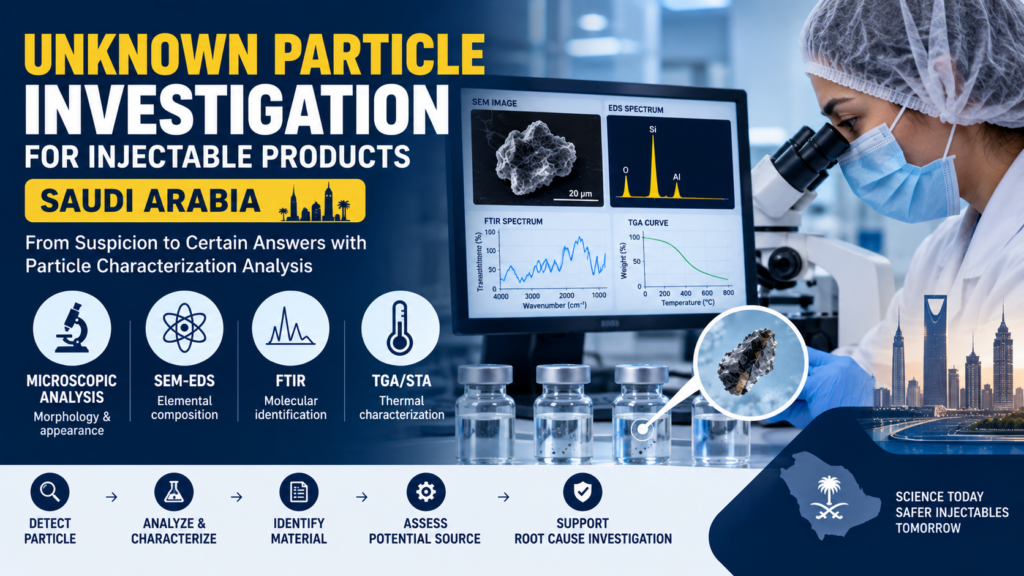
An unexpected particle in an injectable product can turn a routine quality observation into a complex investigation.
The first question is usually straightforward:
“What is this particle?”
But pharmaceutical quality teams quickly discover that the more important questions are:
- Where did the particle come from?
- Is it related to a product-contact component?
- Could it have originated from equipment?
- Is it glass, metal, polymer, elastomer, fiber or another material?
- Is the same material present elsewhere in the manufacturing process?
- Could the finding indicate a broader contamination risk?
- What corrective or preventive action should be considered?
This is where unknown particle investigation for injectable products becomes an important part of pharmaceutical quality and contamination-control programs.
Visual inspection can identify the presence of visible particulate matter, but visual appearance alone may not establish material identity or source. A structured particle characterization analysis can provide additional information about morphology, elemental composition, molecular characteristics and thermal behavior.
For pharmaceutical manufacturers in Saudi Arabia, this investigation should also be considered within the broader pharmaceutical quality system and applicable Saudi Food and Drug Authority (SFDA) GMP expectations. SFDA’s GMP guidance specifically emphasizes minimizing microbial, particulate and endotoxin/pyrogen contamination in sterile products and applying quality risk management throughout sterile manufacturing.
This guide explains how an unknown particle investigation can be structured, which analytical techniques can be used, why component-library preparation is valuable, and how analytical findings can support a root-cause investigation.
What Is an Unknown Particle Investigation?
An unknown particle investigation for injectable products is a systematic process used to characterize an unexpected particle found in a pharmaceutical product and assess its potential source.
The investigation generally involves two connected questions:
Question 1: What is the particle?
This involves analytical characterization.
Question 2: Where could the particle have come from?
This involves comparison against potential source materials and review of the manufacturing process.
These questions should not be confused.
For example, an analytical laboratory may determine that an unknown particle has characteristics consistent with a particular polymer.
That is valuable information.
However, it does not automatically prove that a particular piece of equipment or component generated the particle.
The analytical result needs to be combined with manufacturing evidence.
This distinction is critical when using particle analysis to support deviations, complaints, CAPA and root-cause investigations.
Why Unknown Particles Matter in Injectable Products
Injectable products are manufactured under stringent quality controls because particulate contamination is an important product-quality consideration.
USP describes particulate matter in injections as mobile, undissolved particles other than gas bubbles that are unintentionally present in solutions. USP also distinguishes visible and subvisible particulate matter and provides separate chapters covering these areas.
An unexpected particle can therefore become a trigger for further investigation.
Potential investigation scenarios include:
- A visible particle discovered during inspection
- A customer complaint involving foreign matter
- A recurring particulate observation
- A deviation associated with manufacturing equipment
- A component-related contamination concern
- A suspected glass, metal or polymer particle
- A fiber discovered in an injectable
- A particle detected during stability evaluation
- A suspected contamination event after maintenance or intervention
The goal should not simply be to remove or reject the affected unit.
The objective is to understand the event sufficiently to make an informed quality decision.
Particle Detection vs Particle Characterization vs Particle Identification
These three concepts are closely connected but have different purposes.
Particle Detection
Detection answers:
“Is particulate matter present?”
Visual inspection can play an important role here.
Particle Characterization
Characterization asks:
“What are the physical and chemical characteristics of this particle?”
It can involve microscopy, SEM-EDS, FTIR and thermal analysis.
Particle Identification
Identification asks:
“What material is this particle likely to be, and what potential source materials have similar characteristics?”
This is where comparison with a reference library becomes particularly valuable.
A useful investigation therefore follows a logical progression:
Detect → Recover → Characterize → Compare → Assess source → Investigate root cause
What Can Cause Particles in Injectable Manufacturing?
An unknown particle can potentially originate from many locations.
The actual sources depend on the manufacturing process, equipment design, materials and interventions.
Potential sources can include:
Product-contact components
- Stainless-steel components
- Tubing
- Filters
- Gaskets
- Seals
- Elastomeric components
- Polymer components
- Process-contact surfaces
Packaging components
- Glass containers
- Closures
- Other primary packaging materials
Manufacturing equipment
- Mechanical wear
- Equipment interfaces
- Moving parts
- Damaged surfaces
- Maintenance-related materials
Process environment
- Fibers
- Foreign materials
- Cleaning-related residues
- Other environmental contamination
This is why simply looking at the particle is rarely enough to determine its source.
Why a Particle Reference Library Is Valuable
One of the most effective ways to strengthen unknown particle investigation for injectable products is to prepare a reference library of relevant manufacturing materials.
The principle is simple.
Instead of waiting for an unknown particle to appear and then asking:
“What materials could this be?”
the manufacturer can proactively characterize materials that could potentially contribute particles.
This creates a reference database against which unknown particles can later be compared.
A library can be particularly useful for:
- Product-contact materials
- Relevant non-contact materials
- Equipment components
- Polymers
- Elastomers
- Metals
- Packaging materials
- Other process-specific materials
The exact scope should be determined using the facility’s process knowledge and risk assessment.
How Library Preparation Can Work
Step 1: Conduct a Manufacturing Gemba Review
A Gemba walk with the client can be used to understand the actual manufacturing process and identify potential particle sources.
The objective is to observe the process rather than relying only on equipment drawings or written procedures.
The review can identify:
- Product-contact components
- Potentially relevant non-contact components
- Equipment interfaces
- Tubing and hoses
- Filters
- Gaskets
- Seals
- Primary packaging components
- Other materials with potential contamination relevance
This creates the foundation for library preparation.
Step 2: Identify Relevant Components
After the process review, the components can be categorized according to their potential relevance.
A practical approach may divide materials into:
High-priority product-contact materials
and
Other materials that could reasonably contribute contamination.
This helps prevent the library from becoming unnecessarily broad while still covering meaningful contamination pathways.
Step 3: Collect Representative Coupons
Representative coupons from relevant components can then be collected from the client’s manufacturing environment.
These samples become reference materials for laboratory analysis.
The quality of the library depends heavily on representative sampling.
If the reference sample does not accurately represent the material used in production, comparison with an unknown particle may be less informative.
The Four Analytical Technologies Used in Particle Characterization
A comprehensive particle characterization analysis can combine multiple analytical techniques.
Each technique provides different information.
The four key technologies relevant to this investigation strategy are:
- Microscopic analysis
- SEM with EDS
- FTIR
- TGA/STA
Using complementary technologies can provide a more complete characterization profile.
1. Microscopic Analysis
Microscopy provides an important first level of information.
It can help assess:
- Shape
- Morphology
- Color
- Surface appearance
- Fiber structure
- Particle dimensions
- Agglomeration
For example, a long, thin fiber has a very different morphology from an irregular metallic fragment.
Microscopy can therefore help establish the initial classification of an unknown particle and guide subsequent analysis.
However, visual morphology alone may not establish chemical identity.
That is why advanced characterization techniques can be valuable.
2. SEM with EDS
Scanning Electron Microscopy (SEM) provides high-resolution imaging of a particle’s morphology.
Energy Dispersive X-ray Spectroscopy (EDS) can provide elemental information.
Together, SEM-EDS can help answer questions such as:
- What does the particle look like at high magnification?
- What elements are present?
- Is the material consistent with a metallic source?
- Does the particle have characteristics similar to a reference coupon?
For example, a particle suspected of being metallic can be examined using SEM for morphology and EDS for elemental composition.
The result can then be compared with reference materials.
SEM-EDS is particularly useful when elemental information is important to the investigation.
3. FTIR Analysis
Fourier Transform Infrared Spectroscopy (FTIR) provides information associated with molecular structure and chemical bonding for suitable materials.
This can be especially useful when investigating organic and polymeric materials.
Potential applications can include characterization of:
- Polymers
- Elastomers
- Organic materials
- Certain process residues
- Other infrared-active materials
If an unknown particle appears to be polymeric, FTIR data can potentially be compared with reference materials from the manufacturing process.
This adds another dimension to the investigation beyond morphology and elemental composition.
4. TGA/STA Analysis
Thermogravimetric Analysis (TGA) and Simultaneous Thermal Analysis (STA) provide information about material behavior under controlled temperature conditions.
Depending on the material, this can provide information related to:
- Weight loss
- Thermal stability
- Decomposition
- Thermal transitions
- Residual inorganic material
For reference-library preparation, thermal behavior can provide another characteristic that helps distinguish between candidate materials.
Again, the objective is not to rely on one result in isolation.
The strongest interpretation comes from evaluating the complete analytical profile.
The Unknown Particle Investigation Workflow
Once a particle is detected, the investigation can follow a structured sequence.
Step 1: Detect
The particle is observed during an approved inspection or investigation activity.
Step 2: Document
Record relevant information about:
- Product
- Batch
- Container
- Location
- Appearance
- Approximate size
- Color
- Shape
- Inspection conditions
Step 3: Recover
The particle should be recovered using a controlled and appropriate procedure designed to preserve the sample.
Step 4: Perform Microscopy
Initial morphology and physical characteristics are assessed.
Step 5: Perform SEM-EDS
Where appropriate, SEM-EDS can provide detailed morphology and elemental information.
Step 6: Compare With the Reference Library
Analytical characteristics are compared with reference coupons from potential source materials.
Step 7: Use Complementary Techniques
FTIR and/or TGA/STA can be considered depending on the particle’s characteristics and the investigation question.
Step 8: Assess Potential Source
The analytical findings are compared with potential manufacturing sources.
Step 9: Conduct the Manufacturing Investigation
Review:
- Batch records
- Equipment history
- Maintenance
- Component condition
- Cleaning
- Process interventions
- Deviations
- Supplier information
- Previous contamination events
Step 10: Establish the Investigation Conclusion
The final conclusion should clearly distinguish between:
What the laboratory data demonstrates
and
What the broader manufacturing investigation concludes.
Why One Analytical Technique Is Usually Not Enough
Consider a particle that appears black.
Can you identify it simply from its color?
No.
It could potentially be:
- A metallic particle
- A polymer
- A carbon-containing material
- Process residue
- A composite material
- Another foreign material
Now consider the information available from multiple techniques:
| Technique | Example Information |
|---|---|
| Microscopy | Shape, color, morphology |
| SEM | High-resolution morphology |
| EDS | Elemental composition |
| FTIR | Molecular/material characteristics |
| TGA/STA | Thermal behavior |
Each technique answers a different question.
That is why particle characterization analysis is best viewed as a complementary analytical strategy rather than a single test.
Example: Investigating an Unknown Particle in an Injectable Vial
Imagine a Saudi pharmaceutical manufacturer identifies an unexpected particle during inspection of an injectable vial.
The unit is appropriately segregated according to the site’s procedure.
The investigation team wants to determine the possible source.
Initial observation
The particle appears irregular and dark.
Microscopy
Microscopic examination confirms an irregular structure.
SEM
SEM provides higher-resolution morphological information.
EDS
EDS provides elemental information that helps classify the material.
Reference comparison
The result is compared with materials from the manufacturer’s component library.
Suppose one component shows similar analytical characteristics.
The investigation should not immediately conclude:
“This component caused the contamination.”
Instead, the team should ask:
- Was this component used during the batch?
- Was it in product contact?
- Was maintenance performed?
- Was there evidence of wear?
- Was the component damaged?
- Was there a process intervention?
- Have similar particles been observed previously?
The analytical finding becomes an important piece of evidence within the broader investigation.
How Particle Characterization Supports Root Cause Analysis
SFDA’s GMP guidance emphasizes root-cause analysis for procedural, process or equipment failures and expects risk management to be integrated into sterile product manufacturing.
This is where particle analysis can add significant value.
Suppose a manufacturer repeatedly observes particles.
Without characterization, the investigation may remain at:
“Foreign particle detected.”
With characterization, the investigation can potentially progress toward:
“Particle characteristics are consistent with material X, which is present in component Y; process and equipment records are now being reviewed to determine whether component Y could reasonably have contributed the particle.”
That is a much more actionable investigation pathway.
Common Mistakes During Unknown Particle Investigations
1. Relying only on visual appearance
Appearance is useful but generally insufficient for definitive material identification.
2. Waiting until an incident occurs to understand potential sources
A reference library prepared in advance can make future investigations more efficient.
3. Ignoring process knowledge
Analytical data should be interpreted alongside actual manufacturing conditions.
4. Using only one analytical technique
Different materials provide different analytical signatures.
5. Confusing material identification with root-cause confirmation
A laboratory match can support source assessment, but broader manufacturing evidence remains important.
6. Poor particle recovery
A small or fragile particle can be compromised during recovery or handling.
Controlled sample handling is therefore critical.
How Saudi Pharmaceutical Manufacturers Can Build a Strong Investigation Program
A proactive approach can be divided into three stages.
Before an Incident
- Map potential contamination sources.
- Identify product-contact materials.
- Review relevant non-contact materials.
- Collect representative coupons.
- Build a reference library.
- Establish particle recovery procedures.
- Define investigation responsibilities.
During an Incident
- Preserve the particle.
- Document its appearance.
- Recover it carefully.
- Perform appropriate analytical characterization.
- Compare results with reference materials.
- Review manufacturing history.
- Evaluate possible contamination pathways.
After the Investigation
This creates a continuous improvement cycle rather than treating every particle as an isolated event.
When Should You Consider Third-Party Particle Characterization Services?
Not every pharmaceutical facility maintains all the specialized instruments required for advanced particle characterization.
Some investigations may require access to:
- SEM-EDS
- FTIR
- TGA/STA
- Advanced microscopy
- Specialized sample preparation
- Experienced analytical interpretation
Third-party particle characterization services in Saudi Arabia can provide access to these capabilities when internal resources are limited or when an independent investigation is useful.
They may be considered for:
- Unknown particle investigations
- Injectable contamination investigations
- Customer complaints
- Deviations
- Recurring particulate findings
- Root-cause investigations
- Component-library preparation
- Manufacturing troubleshooting
The key is to select an analytical strategy based on the investigation question rather than simply ordering every available test.
Practical Checklist for an Unknown Particle Investigation
Use this checklist when establishing or reviewing your investigation process:
- Particle discovery is documented.
- Product and batch details are recorded.
- Particle recovery procedure is defined.
- Sample integrity is protected.
- Initial microscopic assessment is performed.
- Potential source materials are identified.
- Reference library is available where appropriate.
- SEM-EDS is considered.
- FTIR is considered where suitable.
- TGA/STA is considered where suitable.
- Analytical findings are compared with reference materials.
- Equipment and component history is reviewed.
- Manufacturing interventions are assessed.
- Previous contamination events are reviewed.
- Potential root causes are evaluated.
- Product impact is assessed.
- CAPA is considered where appropriate.
- The final conclusion distinguishes analytical evidence from root-cause determination.
FAQ: Unknown Particle Investigation for Injectable Products
What is an unknown particle investigation?
It is a structured investigation used to characterize an unexpected particle found in an injectable product and assess its possible source.
Why is particle characterization important?
It can provide information about the particle’s morphology, elemental composition, molecular characteristics and thermal behavior, supporting a more informed contamination investigation.
Which techniques are commonly used?
Depending on the material and investigation objective, techniques may include microscopic analysis, SEM-EDS, FTIR and TGA/STA.
What is a particle reference library?
It is a collection of analytical data generated from representative materials used in or around the manufacturing process. It provides reference information for comparison with unknown particles.
What is SEM-EDS used for?
SEM provides high-resolution morphological information, while EDS provides elemental information. Together they can help characterize many inorganic and metallic particles.
Can FTIR identify polymeric particles?
FTIR can provide useful molecular and chemical-bonding information for suitable organic and polymeric materials. Its suitability depends on the particle and sample characteristics.
Can particle characterization alone prove the root cause?
Not necessarily. Characterization can provide strong evidence about material identity and possible source relationships, but root-cause determination generally requires correlation with manufacturing, equipment, component and process information.
Is particle characterization relevant to SFDA GMP?
Particle contamination is explicitly addressed within SFDA’s GMP guidance for sterile manufacturing. The guidance emphasizes contamination prevention, quality risk management and appropriate root-cause analysis.
Is particle identification the same as visible particle inspection?
No. Visual inspection helps detect visible particles and other defects, while analytical characterization provides information about the material itself. USP <1790> focuses on visual inspection of injections, while other USP chapters address particulate matter and characterization-related considerations.
Conclusion: Make Unknown Particles Scientifically Actionable
An unknown particle in an injectable product should never be viewed simply as a visual defect.
It can provide valuable information about the manufacturing process.
A well-structured unknown particle investigation for injectable products moves beyond asking “What does the particle look like?” and instead builds an evidence-based understanding of:
What the particle is → What materials it resembles → Where those materials exist → How contamination could have occurred → What controls may need improvement
For Saudi pharmaceutical manufacturers, this approach fits naturally into the broader principles of contamination control, quality risk management and root-cause investigation emphasized in SFDA GMP guidance.
The most effective strategy can begin before an unknown particle is ever discovered.
By conducting a manufacturing Gemba review, identifying product-contact and relevant non-contact materials, collecting representative coupons and establishing a reference library, manufacturers can create a valuable analytical baseline.
When an unknown particle eventually appears, that baseline can make the investigation more systematic.
The combination of microscopic analysis, SEM-EDS, FTIR and TGA/STA can provide complementary information to help characterize potential contaminants. The results can then be evaluated alongside manufacturing and equipment history to support a scientifically informed investigation.
If your organization needs specialized particle characterization analysis, unknown particle identification, component-library preparation or injectable contamination investigation support, explore the particle characterization services available from Confianza Pharma Zone.
Explore Particle Characterization & Analysis Services
Your trusted partner for pharma skills, systems, and solutions.