
No products in the cart.
USP 790 vs USP 1790: Understanding Visual Inspection Requirements for Pharmaceutical Manufacturers in India
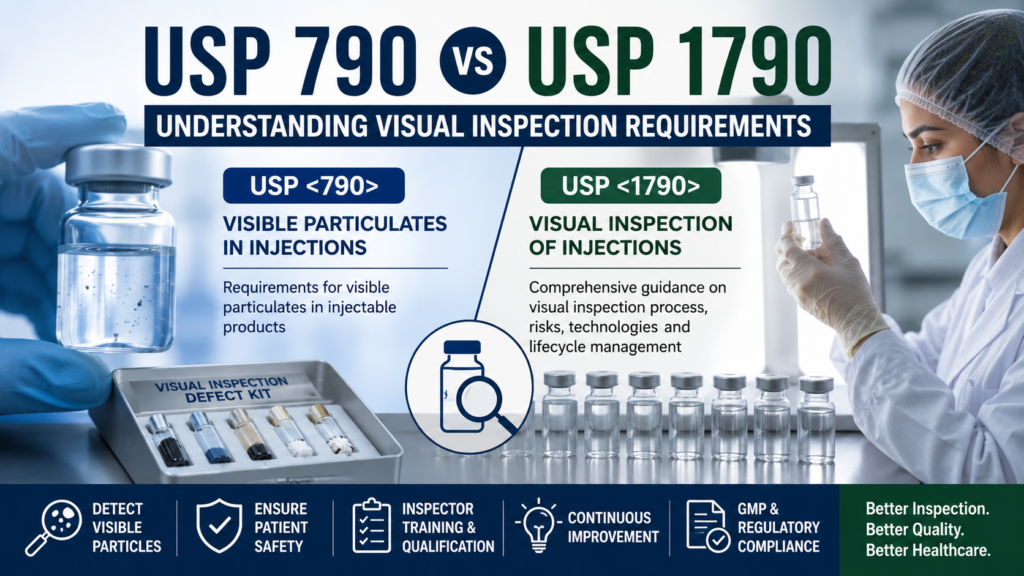
For pharmaceutical manufacturers, visual inspection of injectable products is far more than simply looking at a vial under a lamp.
It is a controlled quality process designed to detect visible particles and other defects before a product reaches the patient. The challenge is that visual inspection depends on several variables at the same time: the product, container, particle characteristics, lighting, background, inspection method and, in manual inspection, the capability of the inspector.
This is why USP 790 vs USP 1790 is an important topic for pharmaceutical quality, production, validation and regulatory teams.
The two USP chapters are closely related, but they serve different purposes.
USP <790> Visible Particulates in Injections establishes the compendial framework for visible particulate inspection of injections, including reference inspection conditions and acceptance concepts. USP <1790> Visual Inspection of Injections is an information chapter that provides broader guidance around the inspection process, including patient risk, defect types, inspection technologies and lifecycle improvement.
For Indian pharmaceutical companies, this distinction becomes even more relevant because visual inspection requirements also sit within the country’s GMP framework. India’s Schedule M states that filled parenteral containers should be individually inspected for extraneous contamination or other defects under suitably controlled illumination and background conditions. It also addresses eyesight checks, rest periods and recording of inspection results.
So, what exactly is the difference between USP <790> and USP <1790>? And how can pharmaceutical manufacturers use Knapp Kits and visual inspection defect kits to strengthen inspector training and qualification?
Let’s break it down.
What Is USP <790>?
USP <790> is titled Visible Particulates in Injections.
Its focus is relatively specific: visible particulate matter in injectable products.
USP explains that parenteral products should be visually inspected for particulate matter and defines particulate matter, through USP <788>, as extraneous mobile undissolved particles other than gas bubbles that are unintentionally present in solutions. Examples can include fibers, glass, metal, elastomeric materials and precipitates.
The chapter provides a reference approach for inspection and establishes the concept of an injectable product being “essentially free” from visible particulates under the specified inspection conditions.
In practical terms, USP <790> helps manufacturers answer:
How should injectable products be inspected for visible particles, and what acceptance approach should be applied?
What Is USP <1790>?
USP <1790> is titled Visual Inspection of Injections.
It goes beyond visible particles alone.
USP describes <1790> as guidance for inspection of injections for visible particles while also explaining the broader visual inspection process. It emphasizes that visual inspection is a probabilistic process: detection probability varies according to particle size, shape, color and density, as well as dosage form and container design.
This is a critical concept for pharmaceutical manufacturers.
A person may easily detect a large black particle in a clear glass vial but have considerably more difficulty detecting a small, transparent or low-contrast particle.
Similarly, inspection of a clear solution in a transparent vial is different from inspection of:
- Amber containers
- Colored solutions
- Suspensions
- Opaque packaging
- Complex container geometries
- Products containing inherent particles
USP <1790> therefore takes a broader lifecycle view of visual inspection.
USP 790 vs USP 1790: The Key Difference
The easiest way to understand USP 790 vs USP 1790 is to think about their roles.
| Area | USP <790> | USP <1790> |
|---|---|---|
| Chapter type | General chapter | Information chapter |
| Primary focus | Visible particulates in injections | Broader visual inspection process |
| Inspection conditions | Provides reference conditions | Provides broader guidance and context |
| Visible particles | Central focus | Central topic within broader inspection |
| Defect types | Primarily visible particulates | Particles plus other visible defects |
| Inspection lifecycle | More limited | Strong lifecycle/continuous-improvement focus |
| Patient risk | Less extensive | Discussed in greater depth |
| Inspection technologies | Limited scope | Manual, semi-automated and automated approaches discussed |
| Inspector qualification | Relevant to inspection process | Provides broader context for developing inspection programs |
| Defect prevention | Limited | More extensive discussion |
| Technology selection | Limited | Discussed as part of inspection strategy |
USP’s own descriptions support this distinction: <790> addresses visible particulates, while <1790> provides guidance covering the broader inspection process and recognizes that detection probability changes with product, particle and container characteristics.
Why Does This Difference Matter for Indian Pharma Companies?
Indian pharmaceutical manufacturers often operate across multiple regulatory and export markets.
A company may manufacture an injectable product for the Indian market while also supplying markets where USP, Ph. Eur., FDA or other international expectations are relevant.
This makes a structured visual inspection program particularly important.
India’s Schedule M already establishes specific expectations around parenteral inspection. It states that filled containers of parenteral products should be individually inspected for extraneous contamination or other defects, and that visual inspection should occur under suitably controlled illumination and background conditions. Operators should have regular eyesight checks and receive frequent rest from inspection.
Schedule M also specifically refers to individual examination of parenteral and ophthalmic containers against black/white backgrounds with diffused light after filling to ensure freedom from foreign matter.
Therefore, Indian manufacturers should not treat USP <790> as a standalone checklist.
Instead, the goal should be to build a visual inspection program that connects:
- Indian GMP requirements
- Applicable pharmacopoeial requirements
- Product-specific risks
- Inspector qualification
- Defect libraries
- Inspection equipment
- Routine monitoring
- Trending
- Continuous improvement
What Are the Typical USP <790> Inspection Conditions?
One of the reasons USP <790> is important is that it establishes reference conditions for visual inspection.
The commonly referenced manual inspection approach includes controlled illumination, contrasting backgrounds and movement of the container to help reveal mobile particulate matter. USP <790> is intended to create a consistent reference framework rather than allowing every manufacturer to define completely different inspection conditions.
For clear containers, commonly referenced conditions include:
- Controlled illumination
- Black and white backgrounds
- Unaided visual inspection
- Container movement through swirling or inversion where appropriate
- Defined viewing time
- Controlled inspection environment
The commonly cited illuminance range for the reference inspection is 2,000–3,750 lux.
The practical purpose of using contrasting backgrounds is straightforward.
A light-colored or reflective particle may be easier to see against a dark background, while a dark particle may be easier to see against white.
This is one reason a well-designed visual inspection booth or inspection station uses controlled backgrounds rather than relying on uncontrolled room conditions.
Does USP <790> Mean Every Particle Will Be Detected?
No.
This is one of the most important concepts in USP 790 vs USP 1790.
Visual inspection is not an absolute measurement method where every particle above a particular size is automatically detected.
USP <1790> explicitly describes visual inspection as probabilistic. Detection depends on particle characteristics, formulation and container design.
For example, consider two particles of approximately similar dimensions:
Particle A: dark, high-contrast and mobile
Particle B: transparent, low-contrast and difficult to distinguish from the solution
Their detection probabilities may be very different.
This is why inspector qualification should not rely exclusively on simple or obvious defects.
What Does USP <1790> Add to the Inspection Program?
USP <1790> helps manufacturers think beyond the inspection event itself.
It addresses concepts such as:
1. Patient Risk
Not every defect has identical potential significance.
Manufacturers should consider the potential patient impact of particulate and container defects.
2. Defect Classification
Visual inspection may identify different categories of defects, including extrinsic, intrinsic and inherent particles, as well as other visible container or product defects.
3. Inspection Capability
Manufacturers should understand the capability and limitations of their inspection method.
4. Inspection Technology
The chapter discusses manual, semi-automated and automated approaches.
5. Lifecycle Management
Inspection programs should evolve as manufacturers learn more about their processes, products and defects.
FDA educational material on visual inspection similarly presents <1790> around themes including patient risk, inspection-process elements, lifecycle/continuous improvement, visible defect types and inspection technologies.
Why Visual Inspection Defect Kits Matter
This brings us to an important practical question:
How can a pharmaceutical company demonstrate that inspectors can actually detect relevant defects?
This is where visual inspection defect kits and Knapp Kits can be useful.
A defect kit provides controlled physical samples that can be used for:
- Training
- Inspector qualification
- Requalification
- Defect recognition exercises
- Visual inspection demonstrations
- Process capability studies
- Investigation support
Instead of explaining “this is a glass particle” only through a presentation, trainers can show an actual representative challenge sample.
That creates a much more practical learning experience.
Using Knapp Kits for Inspector Training
A strong visual inspection training program should begin before formal qualification.
Step 1: Explain the Defect
The trainer explains:
- What the defect is
- Where it may originate
- Why it matters
- How it may appear
- Whether it is intrinsic, extrinsic or inherent
Step 2: Demonstrate the Defect
The inspector observes the defect under controlled inspection conditions.
Step 3: Practice Detection
The inspector examines a series of samples.
Step 4: Introduce Different Backgrounds
The same or similar defect can be evaluated against different backgrounds.
Step 5: Introduce Realistic Difficulty
Training should progressively include defects that are more difficult to detect.
Step 6: Conduct Qualification
Once training is complete, the inspector undergoes the site’s approved qualification procedure.
This separation between training and qualification is important.
Training teaches the person what to look for.
Qualification demonstrates whether the person can perform the inspection to the defined acceptance criteria.
USP 790 vs USP 1790 and Inspector Qualification
Neither chapter should be interpreted as simply saying “buy a defect kit and test operators.”
A compliant qualification program needs a documented procedure.
The manufacturer should define:
- Who must be qualified
- Which products are covered
- Which defect types are included
- Inspection conditions
- Number and type of challenge samples
- Acceptance criteria
- Qualification frequency
- Requalification requirements
- Handling of failures
- Documentation
- Training requirements
The actual acceptance criteria should be scientifically justified and approved within the manufacturer’s quality system.
A Knapp Kit becomes valuable when it is integrated into this controlled system.
Building a Product-Specific Defect Library
One common mistake is assuming that every pharmaceutical manufacturer needs exactly the same defect library.
In reality, defect selection should reflect the process.
For an injectable glass-vial manufacturer, relevant challenges might include:
- Glass particles
- Metal particles
- Fibers
- Elastomeric particles
- Black particles
- White particles
- Scratches
- Cracks
- Closure defects
For a manufacturer using a different container system, other defects may be more relevant.
USP <1790> emphasizes the influence of product and container characteristics on inspection capability.
Therefore, companies should consider:
- Historical deviations
- Batch rejection trends
- Customer complaints
- Component supplier issues
- Manufacturing equipment
- Product formulation
- Container-closure system
- Previous particulate investigations
This produces a more meaningful defect library.
The Role of Black and White Backgrounds
Background contrast is fundamental to visual inspection.
A dark background can improve visibility of certain light-colored or reflective particles.
A white background can improve visibility of dark particles.
This is why Indian Schedule M’s sterile-product requirements specifically refer to examination against black/white backgrounds with diffused light.
For a pharmaceutical company, this means the inspection environment should be:
- Controlled
- Qualified where appropriate
- Maintained
- Periodically checked
- Suitable for the container and product
A sophisticated inspection program therefore considers the inspection booth or station as part of the overall inspection process—not simply as furniture.
USP <790>, USP <1790> and Automated Inspection
Another important distinction is that modern pharmaceutical manufacturers increasingly use automated or semi-automated inspection systems.
USP <1790> discusses inspection technologies and recognizes manual, semi-automated and automated inspection approaches.
However, automation does not eliminate the need for a strong inspection strategy.
Automated systems need to be:
- Properly designed
- Qualified
- Validated where applicable
- Challenged with representative defects
- Monitored
- Periodically assessed
The underlying principle remains the same:
The manufacturer needs evidence that the inspection process is capable of detecting relevant defects.
How Indian Pharma Manufacturers Can Build a Strong USP-Based Program
A practical implementation roadmap can look like this:
1. Map Applicable Requirements
Identify:
- Schedule M requirements
- Applicable Indian Pharmacopoeia requirements
- USP requirements where applicable
- Customer requirements
- Export-market requirements
The Indian Pharmacopoeia is India’s official book of drug standards, and its standards are recognized as authoritative for drugs manufactured or marketed in India.
2. Perform a Product Risk Assessment
Identify potential:
- Particles
- Fibers
- Glass
- Metal
- Elastomeric contamination
- Container defects
3. Develop the Defect Library
Use actual process knowledge and historical data.
4. Establish Inspection Conditions
Control:
- Illumination
- Background
- Inspection time
- Container movement
- Inspection environment
5. Train Inspectors
Use practical samples and controlled exercises.
6. Qualify Inspectors
Use a documented protocol and predefined acceptance criteria.
7. Trend Results
Monitor defects and inspection performance.
8. Requalify
Establish a risk-based and procedurally defined requalification program.
9. Improve Continuously
Use inspection findings to reduce particulate sources upstream.
Common Mistakes When Interpreting USP <790> and <1790>
Mistake 1: Treating <1790> as a Mandatory Product Standard
USP <1790> is an information chapter providing guidance. It should not be treated as identical in status to the acceptance requirements in <790>.
Mistake 2: Focusing Only on Particles
Visual inspection can also identify container and closure defects.
Mistake 3: Using Only Easy Challenge Samples
An inspector should be challenged appropriately based on actual product risks.
Mistake 4: Ignoring India’s GMP Requirements
Indian manufacturers need to consider Schedule M and other applicable Indian requirements alongside international expectations.
Mistake 5: Treating Training as Qualification
Attendance does not demonstrate inspection competency.
Mistake 6: Forgetting Lifecycle Improvement
Inspection data should feed investigations, trend analysis and process improvement.
A Practical USP <790> vs USP <1790> Checklist
Before finalizing a visual inspection program, Indian pharmaceutical manufacturers can ask:
Regulatory
- Have applicable Indian GMP requirements been identified?
- Are applicable pharmacopoeial requirements mapped?
- Are international market requirements considered?
Inspection
- Is the inspection environment controlled?
- Are black and white backgrounds available?
- Is illumination appropriate?
- Is inspection time defined?
- Is container movement defined?
Personnel
- Are inspectors trained?
- Is visual acuity assessed?
- Are inspectors qualified?
- Are qualification records maintained?
Defect Management
- Is there a controlled defect library?
- Are representative particles included?
- Are container and closure defects considered?
- Are historical defects incorporated?
Continuous Improvement
- Are rejects trended?
- Are recurring defects investigated?
- Are defect sources identified?
- Is the inspection process periodically reviewed?
FAQ: USP 790 vs USP 1790
What is the main difference between USP <790> and USP <1790>?
USP <790> focuses on visible particulates in injections and establishes reference inspection and acceptance concepts. USP <1790> provides broader guidance on visual inspection of injections, including patient risk, defect types, inspection technologies and lifecycle considerations.
Is USP <1790> mandatory?
USP <1790> is an information chapter providing guidance. Whether a particular USP chapter applies to a product or process depends on the applicable regulatory and compendial framework, product requirements and market.
Does USP <790> require 100% visual inspection?
USP <790> establishes the expectation for inspection of injectable units, with acceptance sampling following the inspection as part of the batch-release framework.
Are Knapp Kits required by USP?
USP does not require a particular commercial brand of defect kit. A Knapp Kit or visual inspection defect kit can be used as a practical training and qualification tool within a scientifically justified and approved visual inspection program.
Why are black and white backgrounds used?
Different backgrounds improve contrast for different types of particles and defects. India’s Schedule M also specifically refers to black/white backgrounds with diffused light for examination of individual parenteral and ophthalmic containers.
Can Knapp Kits be used for inspector qualification in India?
Yes. A suitably designed defect kit can support practical training and qualification when incorporated into the manufacturer’s approved qualification procedure, with defined inspection conditions and acceptance criteria.
Does USP <1790> cover automated inspection?
Yes. USP <1790> discusses inspection technologies beyond traditional manual inspection, including semi-automated and automated approaches.
Conclusion: Understanding USP <790> vs USP <1790>
Understanding USP 790 vs USP 1790 is essential for pharmaceutical companies that want to develop a robust visual inspection strategy for injectable products.
The simplest way to remember the distinction is:
USP <790> = visible particulate inspection requirements and reference acceptance framework.
USP <1790> = broader guidance for designing, understanding, qualifying and improving the visual inspection process.
For Indian pharmaceutical manufacturers, neither chapter should be considered in isolation. India’s Schedule M already establishes expectations for individual inspection of parenteral containers, controlled illumination and background, eyesight checks, rest periods and recording of inspection results.
A strong inspection program therefore combines regulatory expectations with practical process controls.
That means having:
- Qualified inspectors
- Controlled inspection conditions
- Appropriate defect libraries
- Product-specific challenge samples
- Documented qualification procedures
- Appropriate Knapp Kits or visual inspection defect kits
- Ongoing defect trending
- Root-cause investigations
- Continuous improvement
The goal is not simply to say that visual inspection is being performed.
The goal is to demonstrate that the inspection process and personnel are capable of detecting relevant defects under defined conditions.
For Indian pharmaceutical manufacturers working with injectable products, a properly designed Visual Inspection Defect Kit / Knapp Kit can be an important practical component of this system.
Strengthen Your Visual Inspection Training & Qualification Program
Confianca Pharmazon provides Knapp Kits and visual inspection defect kits to support pharmaceutical visual inspection training, defect recognition and qualification activities.
Explore Knapp Kits – Visual Inspection Defect Kits
Your trusted partner for pharma skills, systems, and solutions.