
How Smart Visual Inspection Booths Improve Defect Detection Accuracy in Pharmaceutical Manufacturing
Introduction
In pharmaceutical manufacturing, especially in sterile injectable production, visual inspection is one of the most critical quality assurance processes. A single undetected particle, fiber, crack, or cosmetic defect can result in product recalls, regulatory observations, patient safety risks, and massive financial losses.
As regulatory expectations continue to increase under:
- USP <790>
- USP <1790>
- EU GMP Annex 1
- FDA aseptic processing guidance
pharmaceutical companies are rapidly upgrading from traditional inspection systems to Smart Visual Inspection Booths.
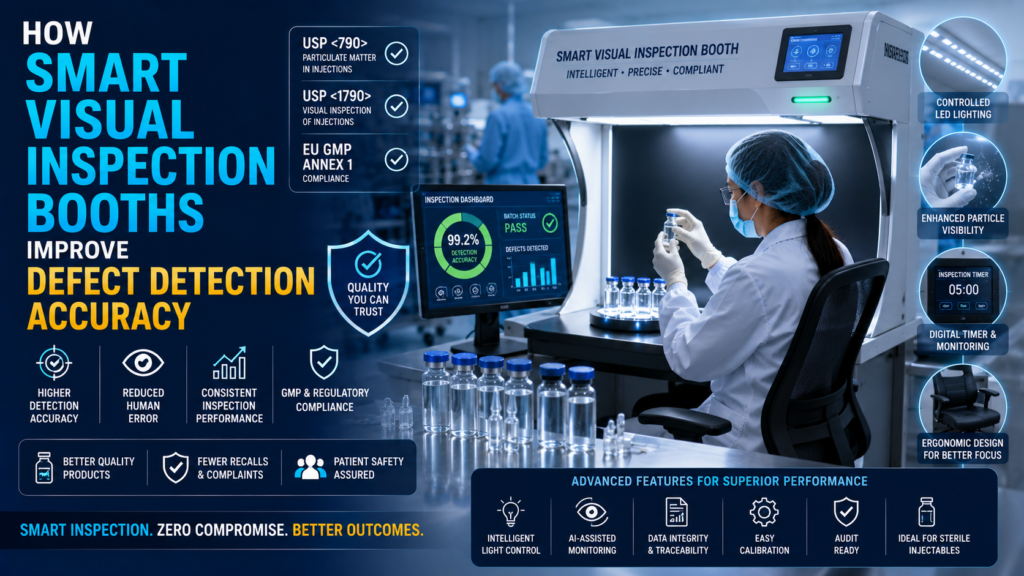
Modern smart booths combine:
- Controlled lighting systems
- Ergonomic operator design
- Digital monitoring
- Automated controls
- AI-assisted analytics
- Defect detection optimization
to significantly improve inspection consistency and reduce human error.
Today’s pharmaceutical manufacturers are realizing that manual inspection alone is no longer enough to maintain high levels of defect detection accuracy and regulatory compliance.
This blog explores how Smart Visual Inspection Booths improve inspection performance, enhance contamination control, support compliance, and transform pharmaceutical quality assurance systems.
What Are Smart Visual Inspection Booths?
Smart Visual Inspection Booths are advanced inspection environments designed to optimize pharmaceutical visual inspection performance through technology-driven features and automation support.
Unlike traditional booths, smart systems integrate:
- Automated lighting controls
- Tyndall lighting systems
- Adjustable lux intensity
- Ergonomic positioning
- Digital timers
- AI-supported monitoring
- Data logging systems
- 21 CFR Part 11 compatibility
These booths are specially designed for:
- Injectable product inspection
- Particulate matter detection
- Defect qualification
- Manual and semi-automated inspection systems
Pharmaceutical manufacturers use these systems to improve:
- Detection sensitivity
- Inspection repeatability
- Regulatory readiness
- Inspector performance
Why Visual Inspection Accuracy Matters
Visual inspection acts as the final quality checkpoint before pharmaceutical products reach patients.
The process helps identify:
- Glass particles
- Metal particles
- Fibers
- Rubber fragments
- Cracks
- Cosmetic defects
- Fill volume abnormalities
- Container closure defects
Missing a visible defect can result in:
- Product recalls
- FDA 483 observations
- Market complaints
- Patient safety risks
- Brand reputation damage
This makes defect detection accuracy one of the most important performance indicators in pharmaceutical manufacturing.
Challenges with Traditional Visual Inspection Booths
Traditional inspection systems often suffer from:
Poor Lighting Consistency
Uneven lighting reduces particle visibility.
Operator Fatigue
Long inspection cycles decrease focus and detection capability.
Lack of Ergonomics
Improper posture affects inspector performance.
Human Variability
Different inspectors detect defects differently.
Inconsistent Inspection Conditions
Manual setups create non-standardized environments.
Limited Data Traceability
Older systems may lack digital monitoring and reporting capabilities.
These limitations reduce overall inspection reliability.
How Smart Visual Inspection Booths Improve Defect Detection Accuracy
1. Advanced Controlled Lighting Systems
Lighting is one of the most important factors in visual inspection.
Smart Visual Inspection Booths use:
- Adjustable lux intensity
- Uniform LED illumination
- Tyndall lighting principles
- Glare reduction systems
This improves visibility of:
- Transparent particles
- Black particles
- White particles
- Fibers
- Floating particulate matter
Why Tyndall Lighting Matters
Tyndall lighting enhances light scattering, making fine particles easier to detect during vial inversion or swirling.
This dramatically improves defect detection accuracy.
2. Improved Ergonomics for Inspectors
Human fatigue is one of the biggest causes of missed defects.
Smart booths are designed with:
- Adjustable seating
- Proper hand positioning
- Eye-level alignment
- Comfortable viewing angles
- Arm support systems
These ergonomic improvements reduce:
- Eye strain
- Neck fatigue
- Mental stress
- Repetitive motion discomfort
As a result, inspectors remain more focused and consistent during long inspection shifts.
3. Standardized Inspection Conditions
Traditional inspection areas may vary between operators and shifts.
Smart Visual Inspection Booths standardize:
- Lighting intensity
- Inspection timing
- Background contrast
- Viewing distance
- Product rotation methods
This consistency improves:
- Repeatability
- Qualification reliability
- Inspection reproducibility
which is critical during regulatory audits.
4. Black and White Background Optimization
Different particles become visible under different background conditions.
White Background Helps Detect:
- Dark particles
- Black fibers
- Metal fragments
Black Background Helps Detect:
- Transparent particles
- White fibers
- Glass fragments
Smart booths optimize contrast dynamically to maximize visibility.
5. Digital Inspection Monitoring
Advanced booths now include:
- Digital timers
- Inspection counters
- Lux monitoring systems
- Electronic records
- Operator tracking
This supports:
- Data integrity
- Audit readiness
- Performance trending
- GMP documentation
Some systems are also compatible with:
- 21 CFR Part 11 requirements
- Electronic batch records
- MES integration
Role of Automation in Visual Inspection
Automation is transforming pharmaceutical quality systems.
Modern visual inspection booth automation helps reduce dependence on human judgment while improving consistency.
Automation features may include:
- Automatic vial rotation
- Digital defect logging
- AI-based defect recognition
- Motion-assisted inspection
- Integrated camera systems
These technologies improve:
- Speed
- Accuracy
- Traceability
- Process control
AI and Machine Learning in Smart Inspection Booths
Artificial intelligence is rapidly changing pharmaceutical inspection systems.
AI-enabled inspection systems can:
- Detect micro-defects
- Analyze particle movement
- Compare defect patterns
- Learn from historical data
- Reduce false rejects
This is especially useful for:
- High-speed production lines
- Sterile injectable products
- Biologics
- Ophthalmic products
However, human inspectors still remain essential for complex judgment-based decisions.
Importance of USP <790> and USP <1790>
USP <790>
Focuses on visible particulate matter in injectable products.
It requires products to be:
“Essentially free from visible particulates.”
USP <1790>
Provides guidance on:
- Visual inspection lifecycle
- Qualification programs
- Probability of Detection (POD)
- Inspection environment controls
Smart booths help pharmaceutical companies align their inspection systems with these standards.
Probability of Detection (POD) and Smart Booths
POD measures how effectively inspectors detect defects.
Smart inspection environments improve POD by:
- Enhancing visibility
- Reducing fatigue
- Standardizing workflows
- Improving qualification consistency
Companies using advanced inspection systems often achieve:
- Better defect detection rates
- Lower false rejects
- Improved audit readiness
Common Defects Detected Using Smart Visual Inspection Booths
Particulate Matter
- Glass particles
- Metal fragments
- Fibers
- Rubber particles
Cosmetic Defects
- Scratches
- Cracks
- Seal defects
- Label issues
Fill Defects
- Underfill
- Overfill
- Air bubbles
Container Closure Issues
- Stopper defects
- Cap alignment problems
Benefits of Smart Visual Inspection Booths
Improved Defect Detection Accuracy
Enhanced lighting and automation improve visibility.
Reduced Human Error
Automation minimizes variability.
Better Regulatory Compliance
Supports USP and GMP requirements.
Improved Productivity
Faster inspection cycles with fewer errors.
Enhanced Audit Readiness
Electronic monitoring supports traceability.
Better Operator Comfort
Ergonomic systems reduce fatigue.
Real-World Example
A sterile injectable manufacturer faced:
- High false reject rates
- Inspector inconsistency
- Regulatory observations
After upgrading to Smart Visual Inspection Booths, the company achieved:
- 40% improvement in detection accuracy
- Reduced operator fatigue
- Better POD scores
- Improved audit outcomes
- Faster batch release timelines
This demonstrates the operational value of modern inspection technologies.
How Smart Booths Support EU GMP Annex 1
The revised EU GMP Annex 1 strongly emphasizes:
- Contamination control strategy (CCS)
- Human factor management
- Continuous monitoring
- Lifecycle quality systems
Smart inspection booths support these requirements by improving:
- Environmental control
- Data monitoring
- Inspection consistency
- Human performance management
Best Practices for Implementing Smart Visual Inspection Booths
1. Validate Lighting Systems
Perform lux mapping and qualification.
2. Train Inspectors Regularly
Focus on:
- Defect recognition
- POD evaluation
- Visual fatigue management
3. Standardize SOPs
Ensure inspection consistency across operators.
4. Use Qualification Kits
Knapp Kits improve defect recognition training.
5. Monitor Inspection Performance
Track:
- Detection accuracy
- False reject trends
- Operator qualification scores
Integration with Pharmaceutical Industry 4.0
Modern pharmaceutical companies are integrating smart inspection booths into Industry 4.0 ecosystems.
Integration possibilities include:
- MES systems
- Electronic batch records
- AI analytics
- Digital quality management systems
- Predictive maintenance platforms
This enables:
- Real-time monitoring
- Centralized analytics
- Better quality decision-making
Why Pharma Companies Are Upgrading Their Inspection Systems
Pharmaceutical manufacturers are under pressure to:
- Reduce recalls
- Improve product quality
- Strengthen compliance
- Increase production efficiency
Traditional manual systems often struggle to meet modern expectations.
Smart Visual Inspection Booths offer a practical solution by combining:
- Human expertise
- Ergonomic design
- Advanced lighting
- Digital technologies
- Automation support
How Confianca Pharmazon Supports Visual Inspection Excellence
Confianca Pharmazon Visual Inspection Booth Automation provides advanced pharmaceutical visual inspection solutions designed for:
- Sterile manufacturing
- Injectable inspection
- Regulatory compliance
- Defect detection optimization
Their solutions support:
- USP <790>
- USP <1790>
- EU GMP Annex 1
- 21 CFR Part 11 expectations
The company also offers:
- Visual inspection qualification kits
- Knapp Kits
- POD evaluation support
- Inspector training programs
- Pharmaceutical automation solutions
Their Skillup to Scaleup mission focuses on empowering pharma professionals with practical industry knowledge and advanced GMP-focused training programs.
FAQs
What are Smart Visual Inspection Booths?
Smart Visual Inspection Booths are advanced pharmaceutical inspection systems designed to improve defect detection accuracy using controlled lighting, ergonomic design, automation, and digital monitoring.
Why are smart inspection booths important in pharma?
They improve:
- Particle detection accuracy
- Compliance readiness
- Inspector performance
- Audit traceability
What regulations apply to visual inspection?
Important regulations include:
- USP <790>
- USP <1790>
- EU GMP Annex 1
- FDA aseptic processing guidance
How do smart booths reduce human error?
They standardize lighting, ergonomics, timing, and inspection conditions while supporting automation and digital monitoring.
Can smart booths support automated inspection systems?
Yes. Many smart booths integrate with semi-automated and fully automated inspection systems.
Conclusion
As pharmaceutical manufacturing evolves toward smarter and more data-driven quality systems, visual inspection processes must also evolve.
Traditional inspection methods alone are no longer sufficient to meet increasing regulatory expectations and defect detection demands.
By implementing Smart Visual Inspection Booths, pharmaceutical companies can:
- Improve defect detection accuracy
- Reduce contamination risks
- Strengthen regulatory compliance
- Enhance operator performance
- Improve audit readiness
- Increase manufacturing efficiency
Modern smart inspection systems combine advanced lighting, ergonomic engineering, automation, AI-assisted monitoring, and digital traceability to create highly reliable pharmaceutical quality environments.
For organizations looking to modernize their inspection systems and strengthen GMP compliance, explore:
Confianca Pharmazon Visual Inspection Booth Automation Solutions
Your trusted partner for pharma skills, systems, and solutions.