
No products in the cart.
Mastering the Automatic Visual Inspection Machine Qualification Kit: A Proven Guide for Success in Indian Pharma Manufacturing
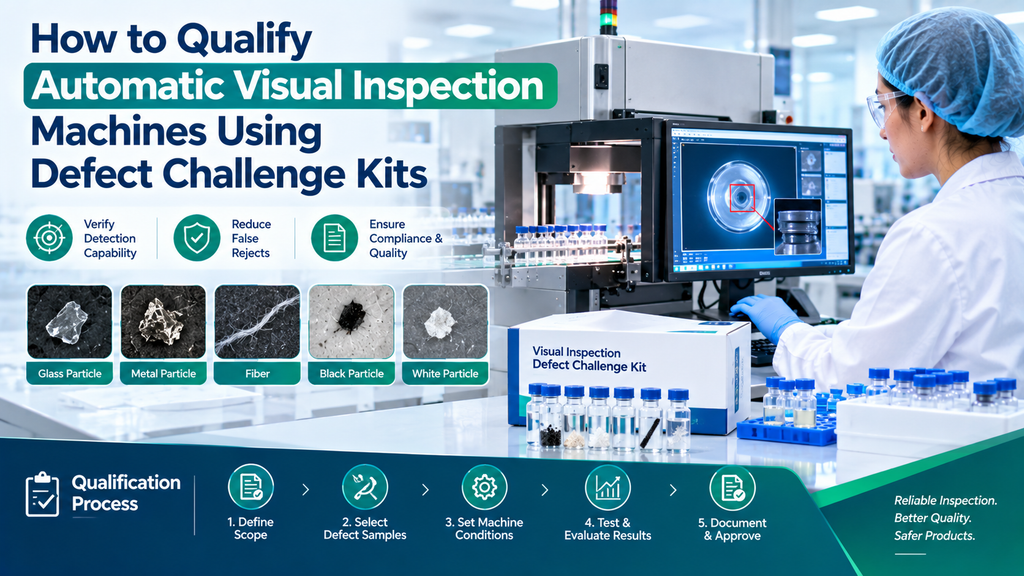
In pharmaceutical manufacturing, an automatic visual inspection machine can inspect thousands of containers faster and more consistently than manual inspection alone. But how can a manufacturer demonstrate that the machine detects the defects it is intended to identify?
Installing an automated inspection system is only one part of the process. Pharmaceutical manufacturers also need a planned approach to evaluating the system’s performance, challenging its detection capability, documenting results, and investigating unexpected outcomes.
This is where an automatic visual inspection machine qualification kit becomes valuable.
Also known as a Knapp Kit or visual inspection defect challenge kit, it contains defined defect samples and, depending on the kit design, good containers or other reference units. These samples can help teams challenge the inspection system under controlled conditions and assess how it handles relevant defects.
For pharmaceutical manufacturers in India, this is particularly important when establishing an automated inspection process, making changes to inspection settings, evaluating new products, or periodically reassessing inspection performance.
Confianca Pharmazon’s visual inspection material describes Knapp Kits designed for automatic visual inspection machine qualification. The company’s offering also includes defect libraries, training kits, qualification kits, and support related to probability-of-detection evaluation.
1. Visual_Inspection_Knapp_Kit.pdf
This guide explains how to plan an automated visual inspection qualification exercise, choose suitable challenge defects, evaluate results, and maintain useful documentation.
What Is an Automatic Visual Inspection Machine Qualification Kit?
An automatic visual inspection machine qualification kit is a set of prepared defect and reference samples used to challenge an automated inspection system.
The kit helps the manufacturer assess whether the system detects selected defects under defined operating conditions.
Depending on the application and kit specification, challenge samples may represent particulate matter, fibers, container defects, or other relevant visual defects. The kit configuration should reflect the product, container format, inspection technology, and qualification objective.
Confianca Pharmazon describes Knapp Kits for automatic visual inspection machines and lists examples of particulate defects including glass, metal, black and white particles, and black and white fibers.
1. Visual_Inspection_Knapp_Kit.pdf
Why are challenge kits important?
Without structured challenge testing, a machine may appear to operate normally while its ability to detect particular defects remains insufficiently demonstrated.
Challenge testing can help teams:
- Assess whether predefined defects are detected.
- Compare performance across defect categories.
- Identify defects that may be difficult for the system to recognize.
- Evaluate inspection settings and operating conditions.
- Document test outcomes for quality review.
- Support investigation of missed detections and false rejects.
A challenge kit does not, by itself, prove that every possible defect will be detected. It provides evidence about performance against the specific samples and conditions included in the approved test plan.
Why Qualify Automatic Visual Inspection Machines?
Automated inspection performance can be influenced by several factors, including the product formulation, container characteristics, defect properties, lighting, machine settings, and inspection algorithms.
For example, a particle may be relatively easy to detect in a clear solution but harder to detect in a colored or opaque product. A defect’s position, movement, size, color, and contrast may also affect detectability.
Qualification helps manufacturers understand how the system performs within its intended scope.
1. Demonstrating Detection Capability
Challenge samples can be used to evaluate whether the machine detects selected defects under defined test conditions.
2. Identifying Detection Limitations
Testing may reveal defect types or operating conditions that require further evaluation, adjustment, or investigation.
3. Evaluating False Rejects
An inspection system that rejects many acceptable containers may increase reinspection workload, reduce throughput, and delay production. Challenge testing should therefore be designed to consider both detection performance and the handling of acceptable reference units.
4. Supporting Quality Documentation
A documented qualification protocol, traceable challenge samples, recorded outcomes, and an approved report can provide useful evidence for internal quality review and applicable audits.
5. Supporting Lifecycle Management
Inspection performance should be considered throughout the equipment lifecycle—not only during initial installation. Changes to products, containers, recipes, machine settings, software, or critical components may trigger an assessment of whether additional testing is appropriate.
How to Qualify an Automatic Visual Inspection Machine Using Defect Challenge Kits
A reliable qualification exercise begins with a clear protocol. The exact test design should be approved by the manufacturer’s quality unit and aligned with the machine’s intended use, product risks, and applicable requirements.
Step 1: Define the Qualification Scope
Start by documenting what the inspection system is expected to inspect.
Include relevant details such as:
- Product name and formulation
- Container type and size
- Vials, cartridges, or prefilled syringes, as applicable
- Inspection machine and configuration
- Defect categories to be challenged
- Operating speed and relevant settings
- Inspection recipe or product-specific parameters
- Qualification objective and acceptance criteria
If one machine inspects multiple product or container formats, do not assume that successful testing with one configuration automatically demonstrates equivalent performance across all others. Determine the required scope through a documented risk-based assessment.
Step 2: Identify Relevant Defect Categories
The challenge samples should represent the defects that matter to the product and inspection process.
Examples may include:
- Glass particles
- Metal particles
- Black particles
- White particles
- Black fibers
- White fibers
- Other specified particles or fibers
- Relevant container or closure defects, where included in the qualification scope
Confianca Pharmazon’s documented Knapp Kit offering lists multiple particle and fiber types and indicates that customer-specified defect requirements can also be considered.
1. Visual_Inspection_Knapp_Kit.pdf
The final selection should be justified by product knowledge, risk assessment, and the system’s intended detection responsibilities.
Tip: Do not choose defects only because they are available in a kit
Prioritize samples that represent meaningful risks or known challenges for the product and machine. Confirm the sample configuration and its suitability with the supplier before ordering.
Step 3: Verify Challenge Kit Documentation
Before testing, review the kit’s accompanying documents.
Depending on the supplier and kit configuration, relevant information may include:
- Defect identification number
- Defect description and category
- Container or sample identification
- Particle or fiber size information, where provided
- Certificate or master list
- Handling and storage instructions
- Sample condition and validity information
- Instructions for identifying or handling the defects
Confianca Pharmazon describes providing a master certificate for each defect kit and a probability-of-detection evaluation sheet as part of its documented offering.
1. Visual_Inspection_Knapp_Kit.pdf
Verify the actual documents supplied with the specific kit. Do not assume every kit contains identical records or that a supplier certificate replaces the manufacturer’s own qualification protocol.
Step 4: Establish Baseline Machine Conditions
Before introducing challenge samples, confirm that the machine is in the intended configuration.
Review relevant items, such as:
- Approved inspection recipe
- Product-specific settings
- Container handling and orientation
- Lighting and imaging conditions
- Rejection mechanism
- Alarm and fault status
- Relevant software or recipe version
- Line speed and operating conditions
- System readiness and maintenance status
Record any critical settings required to reproduce the test.
If the qualification is intended to demonstrate performance under routine production conditions, the test conditions should reflect those conditions or clearly explain any justified differences.
Step 5: Run the Defect Challenge Test
Introduce challenge units according to the approved protocol and the machine manufacturer’s instructions.
A controlled test should preserve traceability between each challenge sample and its observed result.
For every sample, record:
- The unique sample or defect ID.
- The intended defect category.
- The machine’s detection or rejection result.
- Any relevant alarm or system response.
- The test sequence and operating conditions.
- Whether the result met the predefined acceptance criteria.
Where good containers or acceptable reference units are included, assess them according to the protocol as well. The objective is to understand both the machine’s response to challenge defects and its behavior with appropriate reference units.
Important: Challenge testing should use an approved procedure. Do not introduce unidentified or uncontrolled samples into a production process.
Step 6: Evaluate Probability of Detection
Probability of detection (PoD) is a useful concept for understanding inspection performance.
In simple terms, it describes how often a defined defect is detected across a specified set of trials under stated conditions.
For example, if a particular defect is presented in 10 valid trials and is detected in 9, the observed detection proportion is 90%.
This is an illustrative calculation, not a recommended acceptance limit. The appropriate number of trials, sample design, statistical treatment, and acceptance criteria must be defined in the approved protocol.
Confianca Pharmazon describes a PoD evaluation sheet involving 10 inspections per container as part of its documented kit offering.
1. Visual_Inspection_Knapp_Kit.pdf
Whether that approach is suitable for a particular machine qualification depends on the manufacturer’s protocol, risk assessment, and intended use.
What should PoD results tell you?
Results can help identify:
- Defect categories with consistent detection
- Defects that are sometimes missed
- Differences between samples or test conditions
- Potential effects of container orientation or product characteristics
- Areas requiring further investigation
A high observed detection rate on a limited set of samples does not establish that every defect of that type will always be detected. Interpret results within the limits of the test design.
Step 7: Evaluate False Rejects and Acceptable Units
Detection is not the only performance consideration.
A machine may reject a challenge defect correctly but also reject acceptable containers. The qualification plan should therefore define how acceptable reference units will be assessed and how false rejects will be recorded.
Review questions such as:
- Were acceptable units incorrectly rejected?
- Were results consistent across repeated runs?
- Did machine alarms or handling interruptions affect the test?
- Were all samples correctly tracked?
- Did any unexpected behavior require investigation?
The acceptance criteria should be established before testing rather than adjusted after results are known.
Step 8: Investigate Failures and Repeat Testing Appropriately
If the machine fails to detect a challenge defect or produces an unexpected result, do not simply remove the sample and continue.
Document the failure and assess possible causes.
Potential factors may include:
- Incorrect or unsuitable machine settings
- Sample identification errors
- Container orientation
- Lighting or imaging conditions
- Product background or contrast
- Sample movement
- Equipment or rejection-system malfunction
- Test execution error
Any adjustment, corrective action, or repeat test should follow an approved procedure. Preserve the original result and document the reason for repeating the test. A repeat pass should not be used to conceal an unexplained initial failure.
Step 9: Prepare the Qualification Report
The final report should provide a clear account of the test and its outcome.
Consider including:
- Purpose and scope
- Equipment identification
- Product and container configuration
- Protocol and acceptance criteria
- Challenge kit identification
- Defect list and sample traceability
- Machine settings and operating conditions
- Individual test results
- PoD calculations, where applicable
- False-reject observations
- Deviations and investigations
- Corrective actions and retest results
- Conclusion and approval
The report should distinguish between successful test execution, results that meet acceptance criteria, and any unresolved limitations.
How to Choose the Right Knapp Kit for Your Inspection Machine
Selecting the right kit is important because the samples must be suitable for the intended inspection task.
Consider these five factors
1. Product formulation
Clear, colored, oil-based, and other formulations may present different visual backgrounds. Confianca Pharmazon’s brochure describes kit configurations involving different formulations and clear or amber glass containers.
1. Visual_Inspection_Knapp_Kit.pdf
2. Container format
Confirm compatibility with the vial, cartridge, prefilled syringe, or other format being inspected.
3. Defect type
Select relevant particles, fibers, or other defects based on the qualification scope.
4. Defect size and characteristics
Size is important, but it is not the only determinant of visibility. Color, shape, contrast, movement, and orientation may also affect detection.
Confirm what certificates, defect lists, sizing information, handling guidance, and technical support are included.
A suitable automatic visual inspection machine qualification kit should match the machine and the qualification objective—not merely contain a large number of samples.
Common Mistakes to Avoid During Qualification
Even a well-equipped inspection line can produce weak qualification evidence if the test is poorly designed.
Avoid these common mistakes:
- Using unsuitable samples: The defect units may not represent the intended challenge or product configuration.
- Changing settings without documentation: Results may become difficult to reproduce or interpret.
- Ignoring false rejects: Detection performance should be considered alongside the handling of acceptable units.
- Using unclear acceptance criteria: Criteria should be approved before the test begins.
- Losing sample traceability: Every challenge sample should be linked to its result.
- Repeating failures without investigation: Original results and reasons for retesting must remain documented.
- Assuming one product represents all products: Differences in formulation and container format may affect inspection performance.
- Treating kit documentation as the full qualification: The manufacturer’s protocol, risk assessment, machine requirements, and approved quality records remain essential.
A Practical Qualification Checklist for Indian Pharma Teams
Use this checklist when planning a qualification exercise.
- Define the machine and product scope.
- Identify applicable defect categories.
- Select compatible challenge samples.
- Review kit certificates and sample identification.
- Approve the protocol and acceptance criteria.
- Verify machine settings and operating conditions.
- Establish sample traceability.
- Execute the challenge sequence.
- Record detection and rejection outcomes.
- Evaluate PoD using the approved method, where applicable.
- Assess acceptable reference units and false rejects.
- Investigate unexpected results.
- Document corrective actions and retests.
- Prepare and approve the final report.
- Define when reassessment will be required.
This checklist is a planning aid, not a substitute for an approved qualification protocol.
When Should an Automatic Visual Inspection Machine Be Requalified?
Requalification frequency should be established through the site’s quality system, risk assessment, applicable requirements, and equipment lifecycle strategy.
An assessment may be appropriate following changes such as:
- Installation of a new inspection machine
- Introduction of a new product or container format
- Significant recipe or parameter changes
- Software updates affecting inspection performance
- Replacement of critical imaging or handling components
- Major maintenance or equipment modification
- Repeated detection failures
- Relevant deviations or quality trends
Not every change necessarily requires the same level of testing. Document the rationale for the selected assessment and define whether partial or full requalification is appropriate.
How Confianca Pharmazon Supports Visual Inspection Qualification
Confianca Pharmazon offers visual inspection Knapp Kits for manual and automatic inspection applications. Its documented product information includes defect libraries, training kits, and qualification kits with defect and good containers, along with examples of particle and fiber types.
1. Visual_Inspection_Knapp_Kit.pdf
The brochure also describes supporting services such as particle/fiber sizing with certificates, training, technical guidance, and documentation related to the supplied kits.
1. Visual_Inspection_Knapp_Kit.pdf
For Indian pharmaceutical manufacturers, these resources may support a structured approach to challenge testing and inspection qualification. The specific kit should be selected based on the machine, product, container format, defect categories, and qualification protocol.
Explore the Knapp Kit – Visual Inspection Kits, Particles & Particulate Matters to review the available offering.
Internal Linking Suggestions
Use these links naturally in the published article:
1. Knapp Kit – Visual Inspection Kits, Particles & Particulate Matters https://confiancapharmazon.com/product/knapp-kit-visual-inspection-kits-particles-particulate-matters/ Suggested placement: In the section on selecting the right challenge kit.
2. Visual Inspection Booth Automation https://confiancapharmazon.com/product/visual-inspection-booth-automation/ Suggested placement: In the section discussing inspection systems and operating conditions.
3. Particle Characterization Analysis Services https://confiancapharmazon.com/product-category/particle-characterization-analysis-services/ Suggested placement: Where the article discusses particle types, sizing information, and characterization support.
Frequently Asked Questions
What is an automatic visual inspection machine qualification kit?
It is a set of defined challenge samples used to assess how an automated inspection system responds to selected defects under specified test conditions.
What defects can be included in a Knapp Kit?
Depending on the kit configuration, examples include glass, metal, black and white particles, and fibers. Other customer-specified defects may also be available. Confirm the contents with the supplier.
1. Visual_Inspection_Knapp_Kit.pdf
What is probability of detection in visual inspection?
Probability of detection describes how often a defined defect is detected across a specified number of trials under stated conditions. The test design and acceptance criteria should be defined in an approved protocol.
Does a Knapp Kit alone qualify an automatic inspection machine?
No. The kit supplies challenge samples, but qualification also requires an approved protocol, defined operating conditions, traceable results, acceptance criteria, investigation of failures, and an approved report.
How often should an automated inspection machine be requalified?
The frequency should be determined by the site’s quality system, risk assessment, applicable requirements, and equipment lifecycle strategy. Changes or performance issues may trigger reassessment.
Why should challenge samples be documented?
Sample identification and supporting records help ensure that results can be traced to the intended defect and test conditions. They also make investigation and review more reliable.
How do I choose the right automatic visual inspection machine qualification kit in India?
Consider the product formulation, container format, machine configuration, defect types, sample characteristics, documentation, and technical support. Confirm that the proposed kit matches the approved qualification objective.
Conclusion: Build Confidence in Automated Visual Inspection
An automatic visual inspection machine is only as useful as the evidence supporting its performance for the intended application.
A structured challenge-testing program helps pharmaceutical manufacturers evaluate how their system handles defined defects, identify possible detection limitations, assess false rejects, and document outcomes for quality review.
An automatic visual inspection machine qualification kit supports this process by providing identified challenge samples that can be tested under predefined conditions. However, the kit is one component of a complete qualification strategy. Clear acceptance criteria, appropriate test design, traceable records, and investigation of unexpected results are equally important.
For pharmaceutical manufacturers in India, selecting the right Knapp Kit means aligning the challenge samples with the product, container, machine, and quality objectives. A risk-based lifecycle approach can then help determine when additional assessment or requalification is appropriate.
If your team is installing an automated inspection system, qualifying a new product configuration, or reviewing its defect-detection performance, explore Confianca Pharmazon’s Knapp Kits for automatic visual inspection machine qualification and discuss your specific requirements with the technical team.
Your trusted partner for pharma skills, systems, and solutions.