No products in the cart.
Comprehensive SEM EDS Analysis India for Pharmaceutical Particles: Applications in Contamination Investigation
A single unexpected particle inside a pharmaceutical product can turn into a significant quality investigation.
Where did it come from? Was it introduced through the raw material, packaging component, equipment, filtration system, manufacturing environment, or another product-contact surface? Is it metallic, inorganic, polymeric, or another type of material? Most importantly, can the source be identified and prevented from recurring?
Visual inspection can detect particulate matter, but when an investigation requires information about the particle’s morphology and elemental composition, advanced analytical techniques become valuable.
This is where SEM EDS analysis India can support pharmaceutical manufacturers, quality-control laboratories, R&D teams, and contamination-investigation teams.
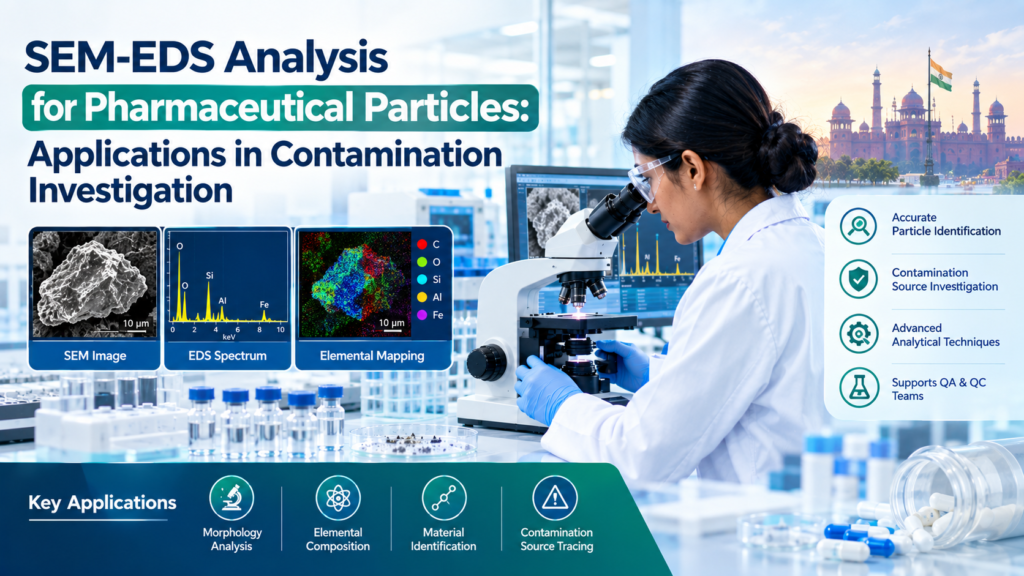
Scanning Electron Microscopy (SEM) can provide high-resolution information about particle morphology and surface characteristics. When combined with Energy Dispersive Spectroscopy (EDS), the analysis can also provide elemental composition information. According to Confianca Pharmazon’s particle-characterization material, SEM with EDS is used for unknown particle/fiber analysis after particle recovery and can support investigation of the contamination source.
This article explains how SEM-EDS fits into a pharmaceutical particle-characterization workflow, where it can be useful, how reference libraries improve investigations, and what pharmaceutical teams should consider when selecting a particle characterization analysis service in India.
What Is SEM-EDS Analysis?
SEM-EDS combines two complementary analytical capabilities.
Scanning Electron Microscopy (SEM)
SEM generates highly magnified images of a sample’s surface. It can help investigators examine:
- Particle morphology
- Surface structure
- Shape and texture
- Fibers and irregular particles
- Surface features
- Differences between unknown particles and reference materials
The Confianca Pharmazon particle-characterization material describes SEM as providing high-resolution imaging and surface morphology analysis at micro- and nano-scale levels, with the referenced system offering imaging up to 300,000×.
Energy Dispersive Spectroscopy (EDS)
EDS works alongside SEM to provide information about the elemental composition of a particle.
For example, if an unknown particle appears metallic under microscopy, EDS can help determine which elements are present. That information can then be compared against materials used in manufacturing equipment, packaging components, filters, or other potential sources.
This makes SEM-EDS particularly useful when an investigation moves beyond “What does the particle look like?” toward “What is the particle made of, and which potential source is consistent with those characteristics?”
Why Pharmaceutical Particle Investigations Need More Than Visual Inspection
Visual inspection remains important for identifying particulate matter. However, visual appearance alone may not establish the identity or origin of an unknown particle.
Consider a simple investigation:
A pharmaceutical manufacturer discovers an unexpected dark particle during inspection.
The particle may be:
- A metallic fragment
- A polymer fragment
- A piece of elastomer
- A process-related material
- A packaging-related contaminant
- An environmental contaminant
- Another foreign material
The visual appearance may narrow the possibilities, but it does not necessarily establish composition.
An analytical investigation can add another layer of evidence.
A typical investigation may ask:
- What does the particle look like?
- What is its morphology?
- Which elements are present?
- Does the elemental profile resemble a known manufacturing material?
- Is there a matching reference material in the product-contact component library?
- Are additional techniques required?
- Can the evidence support a contamination-source investigation?
This is why pharmaceutical particle characterization India services can be relevant to both routine quality investigations and more complex unknown-particle cases.
Applications of SEM-EDS Analysis for Pharmaceutical Particles
1. Unknown Particle Identification
One of the most direct applications is investigation of an unknown particle recovered from a pharmaceutical product.
According to Confianca Pharmazon’s documented workflow, once a library of product-contact components has been prepared, the morphology and bonding-structure information of those components can be used as reference data. An unknown particle or fiber recovered from a product can then be analyzed using SEM with EDS to investigate its potential contamination source.
This creates a more systematic approach than simply examining the unknown particle in isolation.
2. Contamination Source Investigation
The goal of particle analysis is often not merely identification.
For pharmaceutical quality teams, the bigger question is frequently:
Where did the particle come from?
Potential sources may include:
- Product-contact equipment
- Packaging components
- Filters
- Process components
- Manufacturing tools
- Environmental sources
- Fibers from garments
- Other materials present within the manufacturing process
SEM-EDS can contribute morphological and elemental evidence to the investigation.
For example, suppose an unknown particle contains elemental characteristics consistent with a particular metal used in a process component. Investigators can compare that result with reference samples collected from relevant equipment or components.
The result does not automatically prove the source. Instead, it provides analytical evidence that can be combined with manufacturing records, equipment history, process knowledge, and other investigation findings.
3. Building a Reference Library for Pharmaceutical Components
A strong particle-characterization program can become significantly more useful when it includes a reference library.
The documented Confianca Pharmazon workflow includes an optional Gemba activity with the client to identify product-contact and non-contact parts. Coupons can then be collected from identified components and analyzed using multiple technologies, including SEM with EDS, FTIR, TGA/STA, and microscopic analysis.
Why does this matter?
Imagine discovering an unknown particle six months after manufacturing.
If you already have analytical information for relevant product-contact materials, investigators have a reference dataset against which the unknown can be compared.
A library can potentially include materials associated with:
- Manufacturing equipment
- Product-contact parts
- Filters
- Packaging materials
- Process components
- Other relevant materials identified during the investigation
The exact scope should be determined based on the manufacturing process and investigation requirements.
4. Morphology-Based Particle Comparison
Elemental composition is only one part of particle identification.
Two materials can contain similar elements while having very different physical structures.
SEM therefore adds valuable visual information.
Investigators can examine characteristics such as:
- Particle shape
- Surface texture
- Fracture characteristics
- Fiber morphology
- Surface irregularities
- Relative size and structure
When an unknown particle is compared with reference samples, morphology can provide another layer of evidence.
Example
Suppose a manufacturing site uses a polymeric component in a product-contact application.
An unknown fiber is recovered from a product.
SEM examination can help document the fiber’s physical characteristics, while complementary analytical techniques can provide additional information about its composition.
The combination can make the investigation more structured than relying on visual appearance alone.
5. Elemental Composition Using EDS
EDS is particularly useful when investigators need elemental information.
Depending on the sample, elemental analysis can help differentiate between material categories.
For example, an investigation may need to distinguish whether an unknown particulate material is consistent with:
- A metallic component
- An inorganic material
- A mineral-type contaminant
- Another element-containing material
The EDS result should be interpreted alongside SEM morphology and the known materials present within the manufacturing process.
This is important because EDS is an analytical tool, not a standalone root-cause decision-making system.
A scientifically sound investigation considers the complete evidence package.
6. Supporting Root-Cause Analysis
Particle characterization becomes especially valuable when incorporated into a broader contamination investigation.
A practical workflow can look like this:
Step 1: Detect the particle
The particle is observed during inspection, testing, filtration, or another quality-control activity.
Step 2: Document the finding
Record relevant information such as:
- Batch or lot
- Product
- Location
- Container or sample information
- Particle appearance
- Approximate size
- Number of particles
- Date and time
- Relevant process information
Step 3: Recover and preserve the particle
Particle recovery should be performed carefully to reduce the possibility of introducing additional contamination.
Step 4: Perform initial examination
Microscopy can provide initial information about morphology and appearance.
Step 5: Conduct SEM-EDS analysis
SEM provides high-resolution morphology, while EDS provides elemental composition information.
Step 6: Compare with reference materials
Compare the unknown particle with relevant product-contact and non-contact material libraries.
Step 7: Expand the investigation if required
Additional analytical techniques may be considered based on the material and investigation objective.
Step 8: Connect analytical findings with process evidence
Review:
- Equipment history
- Maintenance activities
- Filter information
- Packaging components
- Raw materials
- Cleaning activities
- Environmental monitoring
- Batch records
- Deviations
- Previous contamination events
Step 9: Establish an evidence-based conclusion
The final investigation should distinguish confirmed analytical observations from hypotheses and potential sources.
SEM-EDS Alongside Other Particle Characterization Techniques
SEM-EDS does not necessarily need to operate as a standalone technique.
A multi-technique strategy can provide a more complete characterization profile.
The Confianca Pharmazon material describes an integrated approach involving SEM with EDS, FTIR, TGA/STA, and microscopic analysis for characterization of collected component coupons and unknown particles.
Microscopic Analysis
Microscopic analysis can support rapid detection of microscopic contaminants, including examination of transparent surfaces such as filters and slides. The documented material also notes its use for improving visibility of organic and biological particles.
FTIR
FTIR can provide information about molecular structures and is applicable to materials including powders, polymers, ceramics, liquids, thin films, and other solid-state materials, depending on sample suitability.
TGA/STA
TGA/STA can provide information related to weight changes and thermal events as a function of temperature and time. The documented application includes materials such as polymers, composites, nanomaterials, metals, ceramics, and inorganic materials.
The advantage of combining techniques
Different techniques answer different questions:
| Investigation Question | Potential Technique |
|---|---|
| What does the particle look like? | Microscopy / SEM |
| What elements are present? | EDS |
| What molecular structure is present? | FTIR |
| How does the material behave thermally? | TGA/STA |
| Does it resemble a known component? | Reference library comparison |
| What could be the contamination source? | Combined analytical + process investigation |
The appropriate combination depends on the particle, sample quantity, material characteristics, and investigation objective.
How Indian Pharmaceutical Manufacturers Can Improve Particle Investigations
For companies evaluating SEM EDS analysis India, the analytical instrument is only one part of the equation.
The quality of the investigation also depends on sample handling, documentation, reference materials, and interpretation.
Tip 1: Preserve the Original Particle
An extremely small particle can be difficult to recover again once it has been lost or contaminated.
Maintain appropriate documentation and sample-control practices.
Tip 2: Build the Reference Library Before an Investigation
A proactive reference library can reduce investigation time because potential source materials have already been characterized.
Tip 3: Include Product-Contact Components
Do not limit the library to obvious equipment parts. The scope should be based on the actual manufacturing process and potential contamination pathways.
Tip 4: Capture Manufacturing Context
Analytical results become more meaningful when investigators know what materials were present during production.
Tip 5: Use Complementary Techniques Where Necessary
SEM-EDS can provide important information, but some particles may require molecular, thermal, microscopic, or other analytical approaches.
Tip 6: Separate Evidence From Assumptions
A particle containing elements associated with a piece of equipment does not automatically establish that equipment as the source.
Use analytical findings together with process evidence.
When Should You Consider SEM-EDS Testing?
SEM EDS analysis India can be considered when a pharmaceutical investigation involves questions that cannot be adequately addressed through visual inspection alone.
Typical situations include:
- Unknown particles in finished products
- Unexpected fibers
- Recurrent particulate contamination
- Investigation of visible foreign matter
- Suspected equipment-related contamination
- Comparison with product-contact materials
- Investigation of recurring particulate defects
- Root-cause investigations
- Reference-library development
- Characterization of unusual particulate materials
It can be particularly valuable when the investigation requires both high-resolution morphology and elemental information.
Choosing a Particle Characterization Analysis Service in India
Selecting a laboratory or service provider should involve more than checking whether SEM-EDS equipment is available.
Ask prospective providers about:
1. Sample handling
How will the unknown particle be recovered, transferred, stored, and prepared?
2. Analytical scope
Will the service provide SEM imaging, EDS elemental information, or both?
3. Reference comparison
Can the laboratory support comparison against relevant reference samples?
4. Complementary techniques
Are FTIR, microscopy, TGA/STA, or other analytical technologies available when SEM-EDS alone does not answer the investigation question?
5. Documentation
Will the final report clearly document the analytical observations, methodology, images, and results?
6. Pharmaceutical understanding
Does the provider understand the context of pharmaceutical contamination investigations rather than treating the analysis as a generic materials-testing exercise?
For manufacturers looking for particle characterization analysis India, these questions can help establish whether the service is aligned with the investigation’s actual needs.
A Practical SEM-EDS Investigation Checklist
Before submitting an unknown pharmaceutical particle for analysis, prepare:
- Product and batch information
- Description of the observed particle
- Particle photographs, where available
- Approximate particle dimensions
- Sample location
- Particle recovery information
- Relevant manufacturing process details
- List of potential product-contact materials
- Equipment and component information
- Relevant filter information
- Packaging information
- Previous related deviations or investigations
- Available reference samples
- Specific analytical questions
- Required report format and documentation
A clear analytical question helps the laboratory and quality team align the investigation strategy.
How Confianca Pharmazon Supports Particle Characterization
Confianca Pharmazon, part of Confianca Technologies LLP, documents a laboratory capability in Ahmedabad for Library Preparation & Particle Characterization Testing. Its described workflow includes optional Gemba support with clients to identify product-contact and non-contact parts, collection of coupons, and analysis using SEM with EDS, FTIR, TGA/STA, and microscopic analysis.
For unknown particles or fibers, the documented workflow begins with particle recovery followed by SEM with EDS analysis to investigate the contamination source.
This type of integrated approach can be useful for pharmaceutical manufacturers that need to move from simply detecting particulate matter toward understanding its characteristics and potential origin.
Internal Linking Suggestions
Use contextual internal links throughout the article rather than placing all links at the end.
Suggested Anchor Text: Particle Characterization Analysis Services
Link to: Particle Characterization Analysis Services
Recommended placement: In the introduction or section discussing when manufacturers should consider advanced particle characterization.
Suggested Anchor Text: Knapp Kit – Visual Inspection Kits, Particles & Particulate Matters
Link to: Knapp Kit – Visual Inspection Kits, Particles & Particulate Matters
Recommended placement: In a section connecting routine visual inspection and advanced particle investigation.
Suggested Anchor Text: Visual Inspection Booth Automation
Link to: Visual Inspection Booth Automation
Recommended placement: When discussing the relationship between particulate detection, visual inspection, and laboratory investigation.
Frequently Asked Questions About SEM-EDS Analysis
What is SEM-EDS analysis used for in pharmaceuticals?
SEM-EDS can be used to investigate unknown particles by combining high-resolution surface morphology imaging with elemental composition information. It can support contamination investigations and comparison with potential source materials.
Can SEM-EDS identify an unknown pharmaceutical particle?
It can provide important morphological and elemental information that helps characterize an unknown particle. Identification should be based on the analytical evidence and, where appropriate, comparison with reference materials and complementary techniques.
Why is SEM-EDS useful for contamination investigation?
It can provide two important types of information: detailed particle morphology from SEM and elemental composition information from EDS. Together, these can help investigators evaluate potential contamination sources.
Is SEM-EDS enough for every particle investigation?
Not necessarily. Different materials may require different analytical techniques. A combined approach involving microscopy, SEM-EDS, FTIR, TGA/STA, or other appropriate methods may provide more useful characterization.
What is a pharmaceutical particle reference library?
A reference library contains analytical information about relevant materials, such as product-contact and non-contact components. Confianca Pharmazon’s documented workflow includes collecting component coupons and analyzing them using multiple technologies to establish reference information.
When should an Indian pharmaceutical company consider SEM-EDS analysis?
It can be considered when an unknown or unexpected particle requires deeper characterization, particularly when morphology and elemental composition may help investigate its potential source.
Conclusion: Turning Unknown Particles Into Actionable Investigation Data
Unexpected pharmaceutical particles should not be treated simply as visual defects. They can become important inputs into a broader quality and contamination investigation.
SEM EDS analysis India provides a useful analytical pathway by combining high-resolution SEM imaging with EDS elemental composition information. When supported by appropriate particle recovery, reference-library preparation, process knowledge, and complementary analytical techniques, it can help pharmaceutical teams move from particle detection to particle characterization and contamination-source investigation.
A proactive particle-characterization strategy can also provide value before an investigation occurs. Establishing analytical information for relevant product-contact components creates a reference base that can be used when an unknown particle or fiber is later discovered.
For Indian pharmaceutical manufacturers, the key is to select a particle characterization analysis approach that matches the investigation question—not simply the available instrument.
If your QA, QC, manufacturing, or R&D team is investigating an unknown pharmaceutical particle, building a reference library, or evaluating a contamination source, explore professional particle characterization analysis services and develop an investigation strategy around reliable analytical evidence.
Talk to Confianca Pharmazon about particle characterization, unknown particle analysis, and contamination investigation support.
Your trusted partner for pharma skills, systems, and solutions.