No products in the cart.
Critical Unknown Particle Identification Saudi Arabia: Pharmaceutical Investigation Workflow
An unexpected particle or fiber in a pharmaceutical product can quickly become a quality investigation—not simply because a particle has been observed, but because the investigation team needs to understand what the particle is, where it may have originated, and how the finding relates to materials used in the manufacturing process.
For pharmaceutical manufacturers operating in Saudi Arabia, a structured analytical approach can help turn an unexplained observation into useful evidence for a documented investigation.
This is where unknown particle identification Saudi Arabia becomes particularly relevant. Instead of relying only on visual appearance, pharmaceutical quality teams can combine particle recovery, microscopic examination, elemental analysis and comparison with known materials to investigate a potential contamination source.
The Saudi Food and Drug Authority (SFDA) GMP framework emphasizes documented quality systems, investigation of significant deviations, traceability and investigation of quality defects. For sterile manufacturing, the SFDA GMP guide also addresses the prevention of particulate contamination as part of contamination control.
A particle characterization workflow can therefore provide valuable analytical evidence that supports a broader quality investigation.
In this article, we will explore a practical workflow for unknown particle identification Saudi Arabia, including particle recovery, reference-library preparation, SEM-EDS analysis and complementary characterization techniques.
Why Unknown Particle Identification Matters in Pharmaceutical Manufacturing
Particles found during pharmaceutical manufacturing or quality control can have many possible origins.
Depending on the product and process, an observed particle may potentially be associated with:
- Product-contact components
- Non-product-contact equipment components
- Packaging components
- Processing equipment
- Fibers
- Polymers
- Metals
- Glass
- Other process-related materials
- Environmental or handling-related sources
The visual appearance of a particle alone may not provide enough information to establish its source.
For example, a small dark particle observed during inspection may appear similar to a piece of polymer, rubber, carbonaceous material or another substance. Similarly, a fiber may have an appearance that is insufficient to distinguish between different potential sources.
This is why pharmaceutical particle identification should ideally connect the unknown particle to analytical information about materials actually present in the manufacturing process.
A useful investigation asks three fundamental questions:
- What is the particle?
- What materials could produce a particle with these characteristics?
- Can the unknown particle be associated with a potential contamination source?
A well-designed particle characterization program helps address these questions systematically.
What Is Unknown Particle Identification?
Unknown particle identification is the analytical investigation of an unexpected particle or fiber found in a pharmaceutical product or sample.
The objective is not simply to obtain an image of the particle. The investigation should generate useful information about characteristics such as:
- Morphology
- Surface appearance
- Elemental composition
- Molecular or bonding characteristics, where applicable
- Thermal behavior, where applicable
- Similarity to known manufacturing materials
In the Confianca Pharmazon particle characterization workflow, the process begins with preparation of a material library. This involves identifying product-contact and non-contact parts, collecting coupons from relevant components and characterizing those materials using multiple analytical technologies.
Once the library has been established, an unknown particle or fiber can be recovered from the product and analyzed using SEM with EDS to investigate its potential contamination source.
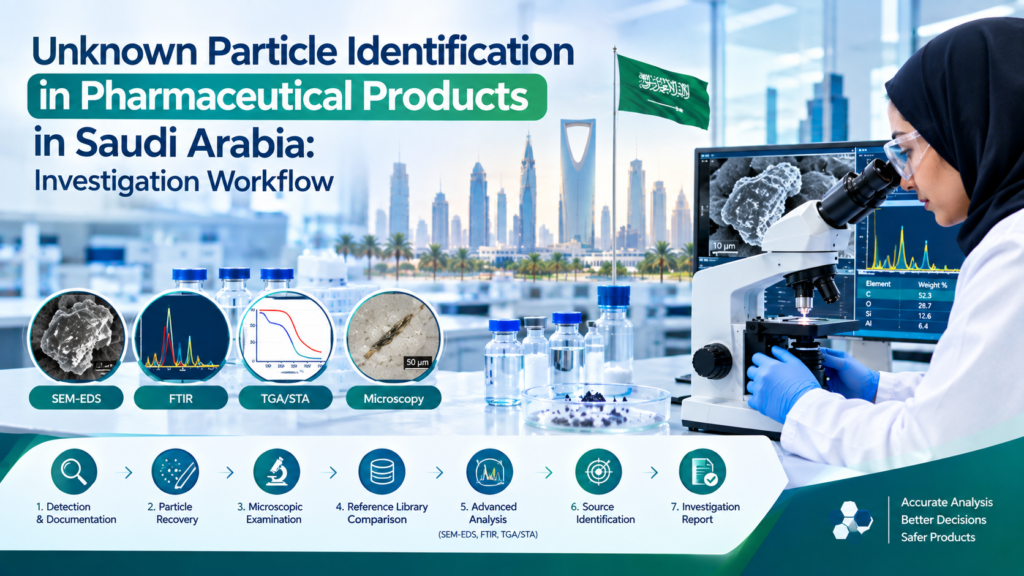
Unknown Particle Identification Saudi Arabia: Step-by-Step Investigation Workflow
A practical investigation can be organized into several stages.
1. Detect and Document the Unknown Particle
The investigation begins when an unexpected particle, fiber or visible contaminant is detected.
Before attempting aggressive handling or removal, document the observation as carefully as possible.
Record information such as:
- Product name
- Batch or lot information
- Location where the particle was observed
- Container or packaging type
- Approximate particle appearance
- Color
- Shape
- Whether it appears to be a particle or fiber
- Approximate size, if available
- Inspection method
- Date and time of observation
- Relevant manufacturing or inspection information
Photographic documentation can also be useful.
Why documentation matters
A particle can be extremely small, and its condition may change during handling. The initial observation therefore becomes an important part of the investigation record.
The goal is to preserve the relationship between the original observation and subsequent analytical results.
2. Recover the Particle Carefully
Particle recovery is a critical step.
If the unknown particle is not recovered appropriately, subsequent analytical results may become difficult to interpret.
The supplied Confianca Pharmazon workflow specifically describes particle recovery as the first analytical step before SEM with EDS analysis for an unknown particle or fiber.
The recovery approach should consider:
- Particle size
- Particle location
- Product characteristics
- Container type
- Potential contamination during recovery
- Sample handling requirements
- Preservation of the particle for analysis
The objective is to recover enough representative material for characterization without introducing additional contamination.
Practical tip
Maintain clear sample identification throughout recovery, transfer and analysis. A highly sophisticated analytical result has limited investigation value if the chain between the original sample and the analyzed particle is unclear.
3. Prepare a Material Reference Library
One of the most useful elements of the workflow is the creation of a reference library of manufacturing materials.
Rather than analyzing an unknown particle in isolation, investigators can characterize materials that could potentially contribute to contamination.
The Confianca Pharmazon library-preparation workflow includes an optional Gemba with the client to identify:
- Product-contact parts
- Non-product-contact parts
Coupons are then collected from identified components for laboratory analysis.
This creates a reference dataset describing relevant materials.
What can be included in the library?
Depending on the manufacturing process, the library can potentially include representative materials from:
- Product-contact equipment
- Process components
- Packaging components
- Sealing materials
- Polymer components
- Metallic components
- Other relevant parts
The exact scope should be based on the manufacturing process and investigation objectives.
4. Characterize Reference Materials
The reference coupons can be analyzed using multiple analytical technologies.
The Confianca Pharmazon workflow identifies four technologies:
- SEM with EDS
- FTIR
- TGA/STA
- Microscopic analysis
Using complementary techniques can provide a broader understanding of the materials than relying on visual comparison alone.
SEM with EDS
Scanning Electron Microscopy provides high-resolution information about particle morphology and surface characteristics.
According to the supplied service material, the SEM system can provide imaging up to 300,000× magnification and is equipped with SE, BSE, UVD and STEM detectors. When combined with EDS, it can provide information about elemental composition.
For an unknown particle investigation, this can help answer questions such as:
- Does the unknown particle resemble a known material?
- What is its surface morphology?
- What elements are detected?
- Does its elemental profile correspond with a potential source material?
SEM-EDS is therefore an important component of unknown particle analysis.
5. Use Microscopic Analysis for Particle and Fiber Evaluation
Microscopic analysis can provide rapid visual information about small contaminants.
The supplied Confianca Pharmazon material describes microscopic analysis for detecting microscopic contaminants on transparent surfaces such as filters and slides. It can also improve visibility of organic and biological particles.
Microscopy can help characterize:
- Shape
- Surface appearance
- Fiber structure
- Particle morphology
- Distribution
- Visual similarity to reference materials
However, visual similarity should not automatically be treated as proof of a common source.
Instead, microscopy can serve as one layer of evidence within the overall investigation.
6. Apply FTIR Where Molecular Characterization Is Relevant
FTIR can provide information about molecular structures and is particularly useful for various organic and solid-state materials.
The supplied laboratory material describes FTIR applications for powders, thin films, polymers, ceramics, liquids and other solid-state materials, excluding gases.
In a pharmaceutical contamination investigation, FTIR can be useful when the question involves the molecular characteristics of a material.
For example, where a suspected unknown particle may be associated with a polymeric or other organic material, molecular characterization can provide another comparison point against reference materials.
7. Consider TGA/STA for Thermal Characterization
Thermal analysis can provide additional information when material behavior under controlled temperature conditions is relevant.
The supplied service documentation describes the simultaneous thermal analyzer as combining:
- Thermogravimetric Analysis (TGA)
- Differential Thermal Analysis (DTA)
- DSC conversion capability
It is described for applications involving polymers, composites, nanomaterials, metals, ceramics and inorganic materials.
This means TGA/STA can serve as a complementary technique when the investigation requires additional material characterization.
It should not necessarily replace SEM-EDS or other analytical methods. Instead, the technique selected should match the material and investigation question.
8. Compare the Unknown Particle Against the Reference Library
This is where the investigation becomes particularly valuable.
Once analytical data are available for the unknown particle, the results can be compared with characterized reference materials.
The comparison can consider:
- Morphology
- Elemental composition
- Molecular characteristics
- Thermal characteristics
- Particle or fiber appearance
The reference library provides a baseline against which the unknown can be evaluated.
Example
Imagine a pharmaceutical manufacturer discovers a small fiber during inspection.
The investigation team could:
- Recover the fiber.
- Document its appearance.
- Analyze the fiber using SEM-EDS.
- Characterize relevant manufacturing materials.
- Compare the unknown fiber with the reference materials.
- Determine whether the analytical characteristics are consistent with a potential source.
- Use the evidence as part of the broader contamination investigation.
This approach is more informative than simply recording that the particle was “black,” “white,” “metallic” or “fibrous.”
9. Investigate the Potential Contamination Source
The ultimate objective is often not merely identification.
The quality team may also need to understand where the particle could have originated.
The material-library approach is particularly useful because it creates analytical information about product-contact components and other relevant parts before an unknown particle is investigated.
The supplied Confianca Pharmazon workflow states that once the library is prepared, information is available regarding the morphology and bonding structure of product-contact components. An unknown particle or fiber can then be recovered and analyzed using SEM-EDS to investigate the source of contamination.
This can support a more evidence-based investigation.
However, analytical similarity should be interpreted within the context of the manufacturing process, equipment history, batch records, handling practices and other investigation evidence.
Why a Reference Library Improves Particle Characterization Analysis
A major advantage of library preparation is that it changes the investigation from an isolated analytical exercise into a comparative investigation.
Without reference information, a result may tell you:
“The particle contains certain elements.”
With a reference library, the question can become:
“Does the unknown particle have characteristics consistent with one of the materials present in the manufacturing process?”
That distinction is important.
A reference library can help pharmaceutical quality teams:
- Organize material information
- Identify relevant potential sources
- Compare unknown and known materials
- Support contamination investigations
- Improve investigation efficiency
- Build institutional knowledge over time
It can also reduce the need to start every investigation without historical material information.
Common Mistakes During Unknown Particle Investigations
Mistake 1: Relying Only on Visual Appearance
A particle’s color or shape may provide useful preliminary information, but it may not establish its identity.
Better approach: Combine visual examination with appropriate analytical characterization.
Mistake 2: Analyzing the Particle Without Understanding the Process
An analytical result becomes more useful when investigators understand what materials are actually present in the manufacturing environment.
Better approach: Develop a material reference library covering relevant product-contact and non-contact parts.
Mistake 3: Poor Particle Recovery
Incorrect handling can compromise a very small sample.
Better approach: Establish controlled recovery and sample-handling practices.
Mistake 4: Using One Technique for Every Material
Different materials have different analytical characteristics.
Better approach: Select analytical techniques based on the particle and investigation question.
Mistake 5: Treating Analytical Similarity as Standalone Proof
Finding that two materials have similar characteristics does not automatically establish the complete contamination pathway.
Better approach: Combine analytical findings with manufacturing and quality-system investigation evidence.
When Should Pharmaceutical Manufacturers in Saudi Arabia Consider Particle Characterization?
A particle characterization service Saudi Arabia search may become relevant when internal teams need specialized analytical support for an investigation.
Situations may include:
- Unknown particles found in finished products
- Fibers discovered during inspection
- Recurring particulate observations
- Suspected contamination from equipment components
- Investigation of product-contact materials
- Need for reference-material characterization
- Complex contamination investigations
- Need for SEM-EDS or complementary analytical techniques
The appropriate analytical scope should always be determined according to the product, particle, investigation objective and available evidence.
For Saudi manufacturers, this work can fit into a broader quality investigation framework. SFDA’s GMP guidance states that significant deviations should be recorded and investigated to determine root cause and implement appropriate corrective and preventive action.
Practical Checklist for Unknown Particle Identification Saudi Arabia
Before sending a sample for unknown particle identification Saudi Arabia, prepare the following information where available:
Sample information
- Product name
- Batch number
- Dosage form
- Container/closure type
- Sample quantity
- Particle/fiber description
Investigation information
- Where the particle was detected
- When it was detected
- Inspection method
- Relevant batch/process information
- Known deviations
- Equipment or component history
Reference information
- Product-contact components
- Non-contact components
- Packaging materials
- Relevant process materials
- Available component coupons
Analytical objectives
Define what you need to know:
- Identity?
- Morphology?
- Elemental composition?
- Molecular characteristics?
- Thermal characteristics?
- Potential contamination source?
A clearly defined question helps the laboratory select the most relevant characterization approach.
Benefits of a Structured Particle Characterization Workflow
A systematic workflow can help organizations move from observation → recovery → characterization → comparison → investigation.
Key benefits include:
Better evidence
Analytical data provide more information than visual descriptions alone.
Better source comparison
Reference-library data allow unknown particles to be compared against known manufacturing materials.
More focused investigations
Instead of investigating every possible contamination source equally, analytical findings can help narrow the investigation.
Better knowledge management
A reference library can become a useful resource for future particle investigations.
Cross-functional collaboration
Quality, QC, production, engineering and laboratory teams can use analytical findings as part of a common investigation.
How Confianca Pharmazon Supports Particle Characterization Analysis
Confianca Pharmazon’s supplied service material describes a laboratory in Ahmedabad for Library Preparation & Particle Characterization Testing. The workflow includes an optional Gemba with the client, identification of product-contact and non-contact parts, collection of coupons and characterization using SEM with EDS, FTIR, TGA/STA and microscopic analysis.
For unknown particles or fibers, the described workflow begins with particle recovery followed by SEM-EDS analysis to investigate the potential contamination source.
This makes particle characterization particularly relevant when a pharmaceutical investigation requires more than a basic visual description.
Explore Particle Characterization Analysis Services
For broader visual inspection and particulate-defect qualification requirements, Confianca Pharmazon also provides Knapp Kits for manual and automatic visual inspection applications.
Explore the Knapp Kit for Visual Inspection and Particulate Matters
FAQ: Unknown Particle Identification in Pharmaceutical Products
1. What is unknown particle identification in pharmaceuticals?
Unknown particle identification is the analytical characterization of an unexpected particle or fiber found in a pharmaceutical product or process. The investigation may examine morphology, elemental composition and other material characteristics to help determine its identity and potential source.
2. What is the primary technique used for unknown particle analysis?
The appropriate technique depends on the sample and investigation objective. In the Confianca Pharmazon workflow, an unknown particle or fiber is recovered and analyzed using SEM with EDS to investigate the contamination source.
3. Why is a reference material library useful?
A reference library provides characterization data for relevant manufacturing materials. Unknown particles can then be compared with those known materials instead of being evaluated in isolation.
4. What technologies can be used for particle characterization?
The supplied Confianca Pharmazon workflow identifies SEM-EDS, FTIR, TGA/STA and microscopic analysis as technologies used for library preparation and particle characterization.
5. Can particle characterization identify the contamination source?
Analytical characterization can provide evidence about whether an unknown particle is consistent with a known material. Establishing the complete contamination source should also consider manufacturing records, process information and other quality-investigation evidence.
6. When should a pharmaceutical company use an external particle characterization laboratory?
External support may be useful when specialized analytical equipment, reference-library development or advanced characterization capabilities are not readily available internally.
7. Is particle identification the same as particle counting?
No. Particle counting determines the number or distribution of particles according to a defined measurement approach. Particle identification focuses on understanding the characteristics and potential identity or source of an individual unknown particle.
Conclusion: Build an Evidence-Based Particle Investigation
An unexpected particle in a pharmaceutical product should not be treated as simply a visual defect. It can become an important quality investigation requiring careful sample recovery, analytical characterization and comparison with materials used throughout the manufacturing process.
For pharmaceutical manufacturers searching for unknown particle identification Saudi Arabia, a structured workflow can provide a practical path:
Detect → Document → Recover → Characterize → Compare → Investigate → Document the conclusion
A reference library can make this process even more powerful by establishing analytical information about relevant product-contact and non-contact materials before an unknown particle is encountered.
SEM-EDS can provide detailed morphological and elemental information, while FTIR, TGA/STA and microscopy can provide complementary characterization where appropriate. The result is a more systematic approach to pharmaceutical contamination analysis and potential source investigation.
For QA, QC and manufacturing teams in Saudi Arabia, the key is to treat particle characterization as part of a broader investigation—not as an isolated laboratory test.
If your organization is dealing with an unknown particle, fiber or suspected particulate contamination, consider developing a structured particle characterization analysis program with reference-library preparation and appropriate analytical techniques.
Talk to Confianca Pharmazon about particle characterization analysis, reference-library preparation and unknown particle investigation support for pharmaceutical applications.
Your trusted partner for pharma skills, systems, and solutions.