No products in the cart.
Ensuring Excellence in Library Preparation for Pharmaceutical Particle Characterization: A Practical Guide for Saudi Pharma Companies
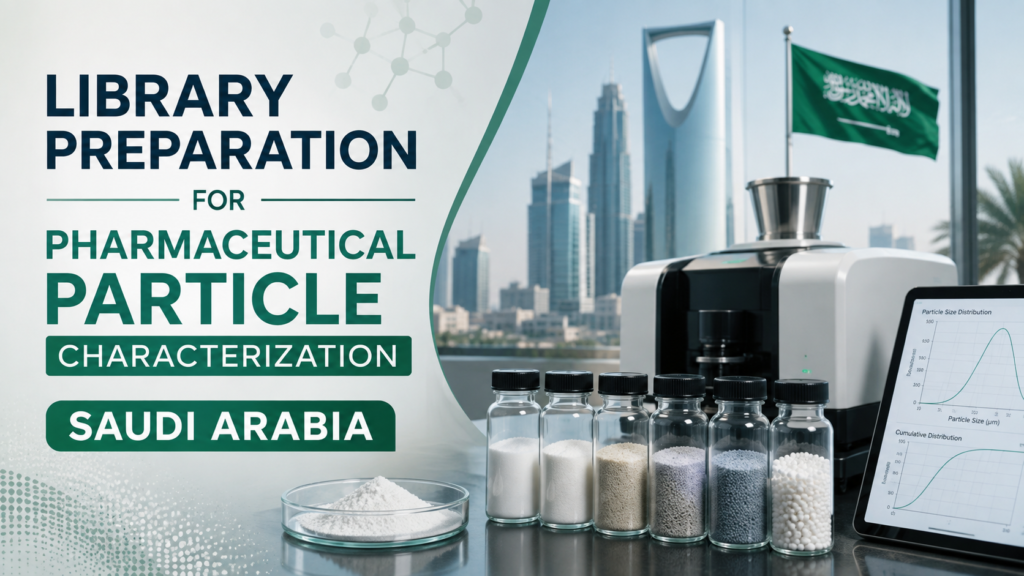
An unexpected particle in a pharmaceutical product can create a much bigger problem than its physical size suggests.
A fiber, metallic fragment, polymer particle, glass particle or other foreign material discovered in a product can trigger a detailed investigation involving Quality Assurance, Quality Control, manufacturing, engineering and regulatory teams.
The first question is usually:
“What is this particle?”
But for an effective investigation, pharmaceutical manufacturers need to go further:
Where did it come from? Could it have originated from a product-contact component? What material does it match? What evidence supports the suspected source? And what actions can prevent recurrence?
This is where pharmaceutical particle characterization becomes an important part of a contamination investigation.
For pharmaceutical companies operating in Saudi Arabia, a proactive library preparation strategy can provide a structured reference for investigating unknown particles. Instead of trying to identify an unknown particle without context, manufacturers can first characterize relevant materials used throughout their manufacturing processes and establish a reference library.
Confianca Pharmazon’s library preparation approach involves identifying product-contact and non-product-contact components, collecting representative coupons and analyzing them using multiple technologies, including SEM with EDS, FTIR, TGA/STA and microscopic analysis.
Saudi pharmaceutical manufacturers also operate within a regulatory environment overseen by the Saudi Food and Drug Authority (SFDA). The SFDA maintains GMP guidance for medicinal-product manufacturing, making robust quality systems and documented manufacturing controls important considerations for pharmaceutical operations in the Kingdom.
So, how does library preparation work, and why should it be considered before an unknown-particle investigation occurs?
Let’s explore it step by step.
What Is Library Preparation in Pharmaceutical Particle Characterization?
Library preparation is a systematic process of identifying relevant manufacturing components and creating a scientifically characterized reference collection of those materials.
A pharmaceutical manufacturing facility can contain many potential particle sources, including:
- Product-contact components
- Elastomers
- Plastics
- Filters
- Tubing
- Gaskets
- Seals
- Metallic components
- Processing equipment
- Packaging components
- Other materials located around critical manufacturing areas
Not every material represents the same contamination risk.
Therefore, the first objective is to understand the manufacturing process and identify the components that could potentially contribute particles to the product.
The library preparation process offered by Confianca Pharmazon includes an optional Gemba activity with the client to identify product-contact and non-product-contact parts. Coupons are then collected from identified components for laboratory analysis.
This creates an important baseline.
Instead of asking only what an unknown particle looks like, investigators can compare it against known materials already characterized from the manufacturing environment.
Why Is Library Preparation Important for Saudi Pharmaceutical Manufacturers?
Imagine a pharmaceutical company discovers an unknown fiber during an investigation.
Without a reference library, the investigation team may have to consider a large number of possible sources.
Could it be:
- A manufacturing component?
- A filter?
- A polymer?
- A garment fiber?
- Packaging material?
- A maintenance-related material?
- A component degradation product?
The possibilities can quickly become difficult to manage.
A reference library can narrow the investigation.
If the unknown particle has morphological, elemental, chemical or thermal characteristics consistent with a known material, investigators have stronger scientific evidence to guide the next stage of the investigation.
This does not automatically prove that the material is the root cause.
Instead, it helps investigators develop a more evidence-based hypothesis.
That distinction is critical.
Analytical characterization supports root cause investigation; it does not replace the broader quality investigation.
How Library Preparation Works
A practical library preparation project can be divided into several stages.
1. Manufacturing Process Assessment
The process should be understood before samples are collected.
The team can review:
- Process flow
- Equipment
- Product-contact surfaces
- Single-use components
- Filters
- Tubing
- Seals
- Gaskets
- Filling components
- Packaging interfaces
- Other relevant materials
The objective is to determine which materials should be represented in the reference library.
For Saudi pharmaceutical manufacturers, this approach can be especially useful when manufacturing processes involve multiple product-contact materials or complex equipment trains.
2. Gemba-Based Component Identification
A Gemba activity can help connect documentation with what actually exists on the manufacturing floor.
Confianca Pharmazon’s library preparation process describes an optional Gemba activity conducted with the client to identify product-contact and non-product-contact components.
This can help answer practical questions such as:
- Which components actually contact the product?
- Which materials are located near critical operations?
- Which components can potentially shed particles?
- Which materials should be represented in the library?
- Have equipment or component changes introduced new potential sources?
This step is important because contamination investigations should be connected to the actual manufacturing process.
3. Coupon Collection
After relevant components have been identified, representative coupons can be collected.
Examples may include samples from:
- Elastomeric components
- Plastic components
- Stainless-steel parts
- Filters
- Tubing
- Gaskets
- Seals
- Other product-contact materials
Each sample should have appropriate traceability.
Useful information can include:
- Component identification
- Material description
- Equipment or line
- Location
- Product-contact status
- Supplier information, where relevant
- Sample identification number
- Collection date
Good documentation makes the reference library more useful during future investigations.
4. Laboratory Characterization
Once coupons are collected, laboratory analysis can begin.
A key advantage of the approach is the use of complementary analytical technologies.
The Confianca Pharmazon library preparation material identifies four technologies for coupon analysis:
- SEM with EDS
- FTIR
- TGA/STA
- Microscopic Analysis
Each technique provides a different type of information.
SEM With EDS for Pharmaceutical Particle Characterization
Scanning Electron Microscopy (SEM) provides detailed information about particle morphology and surface characteristics.
The reference material describes SEM capability for high-resolution imaging and morphology analysis at micro- and nano-scale levels. When paired with EDS, the system can also provide elemental composition information.
This can be particularly useful for unknown particles.
For example, investigators may want to understand:
- What does the particle’s surface look like?
- Is it irregular or fractured?
- Does its morphology resemble a known component?
- What elements are present?
- Does its elemental profile support a potential source?
SEM with EDS therefore provides two complementary perspectives:
Morphology + elemental composition.
FTIR for Chemical Structure and Bonding Information
Fourier Transform Infrared Spectroscopy (FTIR) provides information about molecular structures and chemical characteristics.
This can be particularly useful for materials such as:
- Polymers
- Elastomers
- Organic materials
- Certain coatings
- Fibrous materials
The library preparation reference describes FTIR as suitable for characterization of molecular structures across a wide spectral range and for analysis of materials including polymers, ceramics, liquids and solid-state materials.
This is valuable because two materials can appear visually similar while having different chemical structures.
FTIR adds another level of evidence to the investigation.
TGA/STA for Thermal Characterization
Thermogravimetric Analysis (TGA) and Simultaneous Thermal Analysis (STA) can provide information about how materials respond to controlled temperature changes.
The reference material describes STA as combining TGA and differential thermal analysis, with DSC conversion capability, to study weight changes and thermal events as a function of temperature and time.
Thermal characteristics can help differentiate materials and provide additional reference information.
This can be especially useful when the suspected particle is associated with polymers, composites, elastomers or other materials where thermal behavior can contribute to material identification.
Microscopic Analysis for Initial Particle Assessment
Microscopic analysis provides another important layer of information.
It can help evaluate:
- Particle morphology
- Shape
- Color
- Size
- Fiber structure
- Surface appearance
- General characteristics
The library preparation reference describes microscopic analysis as supporting detection of microscopic contaminants on transparent surfaces such as filters and slides.
Microscopy can therefore provide an initial visual profile before more advanced analytical techniques are applied.
From Library Preparation to Unknown Particle Identification
The real value of library preparation becomes clear when an unknown particle is found.
Consider this simplified workflow:
Unknown particle discovered → Particle recovery → Characterization → Comparison with reference library → Potential source identification → Root cause investigation
Once the library is prepared, the available reference data includes information regarding morphology and bonding structure of product-contact components.
The Confianca Pharmazon workflow specifies that an unknown particle or fiber identified in a product can be recovered and analyzed using SEM with EDS to investigate its potential source of contamination.
Example: Unknown Particle Found in an Injectable Product
Consider a hypothetical injectable manufacturing scenario in Saudi Arabia.
During an inspection activity, an unexpected particle is identified in a product unit.
The QA team initiates an investigation.
Step 1: Recover the particle
The particle is carefully recovered so it can be submitted for characterization.
Step 2: Perform initial examination
The laboratory evaluates the particle’s basic characteristics.
Step 3: Perform SEM with EDS
SEM provides detailed morphology, while EDS provides elemental information.
Step 4: Compare against the library
The analytical characteristics are compared with reference materials from relevant manufacturing components.
Step 5: Investigate the suspected source
If the characteristics are consistent with a specific material, the manufacturing team can investigate that component.
The investigation may then review:
- Component condition
- Equipment history
- Maintenance
- Cleaning
- Assembly
- Supplier information
- Previous deviations
- Process changes
- Previous particle findings
The laboratory result becomes an evidence-based input into the larger investigation.
Why Multiple Technologies Strengthen the Investigation
One analytical technique cannot answer every particle-identification question.
Consider the difference:
| Technology | Main Information |
|---|---|
| Microscopy | Appearance, morphology and initial assessment |
| SEM | High-resolution morphology |
| EDS | Elemental composition |
| FTIR | Molecular/chemical structure |
| TGA/STA | Thermal characteristics |
Using complementary techniques can produce a more comprehensive material profile.
For example, an elastomer fragment may look similar to several other materials under basic microscopy. FTIR may provide useful chemical information, while thermal characterization can provide additional differentiation.
Similarly, an inorganic or metallic particle may benefit significantly from SEM and EDS.
The objective is not simply to use as many techniques as possible.
The objective is to select analytical techniques that generate useful evidence for the specific investigation.
How Pharmaceutical Particle Characterization Supports Root Cause Analysis
The ultimate goal is not simply to give a particle a name.
The goal is to understand what happened.
Pharmaceutical particle characterization can support root cause investigations by helping investigators establish whether an unknown material is consistent with known manufacturing components.
This can support:
Deviation investigations
Analytical results can help narrow potential sources.
Root cause analysis
Material evidence can help develop or eliminate potential hypotheses.
CAPA
Once a likely source is identified and confirmed through the wider investigation, corrective and preventive actions can be developed.
Process improvement
Manufacturers can identify areas where component selection, handling, maintenance or process controls may need improvement.
Contamination prevention
A reference library can provide a proactive foundation for future investigations.
A Practical Checklist for Building a Particle Reference Library
Saudi pharmaceutical manufacturers considering a library preparation project can start with the following checklist.
Process mapping
- Document the manufacturing process.
- Identify product-contact components.
- Identify relevant non-contact components.
- Review potential particle-generating materials.
- Review recent process or equipment changes.
Sample collection
- Identify representative coupons.
- Assign unique sample IDs.
- Document component information.
- Maintain sample traceability.
Laboratory analysis
- Microscopic analysis
- SEM with EDS
- FTIR
- TGA/STA, where appropriate
Library management
- Maintain reference records.
- Link samples to their manufacturing locations.
- Review the library after relevant component changes.
- Use the library during unknown-particle investigations.
7 Practical Tips for Saudi Pharma Companies
1. Start With High-Risk Components
Prioritize materials that have direct product contact or a credible pathway to the product.
2. Involve Manufacturing Personnel
Quality teams may know the documentation, while operators and engineers often know how the equipment actually operates.
3. Use Gemba Where Useful
An on-floor assessment can reveal components or process details that may not be obvious from drawings alone.
4. Do Not Depend Only on Visual Appearance
A particle’s appearance is useful, but additional analytical evidence can significantly improve identification.
5. Keep the Library Traceable
Every reference material should be linked to the component from which it came.
6. Update the Library After Significant Changes
New suppliers, new components, equipment modifications or process changes may introduce new materials.
7. Connect Results With the Quality System
Analytical findings should feed into the appropriate deviation, investigation, CAPA and risk-management processes.
Library Preparation and the Saudi Regulatory Environment
Saudi pharmaceutical manufacturers operate under the oversight of the Saudi Food and Drug Authority.
The SFDA publishes and maintains GMP guidance for medicinal products, and its official guidance portal continues to be updated.
That means companies should avoid treating contamination investigation as purely an analytical exercise.
A strong investigation should connect:
Manufacturing controls + quality systems + analytical evidence + documented investigation + corrective action.
Library preparation can contribute to that framework by establishing reference information before an unknown-particle event occurs.
Importantly, the specific analytical approach and acceptance criteria should be established according to the product, process, risk assessment, applicable procedures and regulatory expectations of the individual manufacturer.
Common Mistakes to Avoid
Mistake 1: Building the library without understanding the process
A collection of random materials is less useful than a risk-based reference library connected to the manufacturing process.
Mistake 2: Characterizing only the most obvious components
Potential sources may extend beyond the components that initially appear most likely.
Mistake 3: Relying on one analytical technology
Different particles require different analytical approaches.
Mistake 4: Poor sample traceability
If the reference material cannot be confidently linked to its original component, its investigative value is reduced.
Mistake 5: Treating similarity as definitive proof
An analytical match should support—not replace—the complete root cause investigation.
Mistake 6: Allowing the library to become outdated
Manufacturing environments change. The reference library should evolve accordingly.
FAQ: Library Preparation and Pharmaceutical Particle Characterization
What is library preparation for pharmaceutical particle characterization?
It is a structured process of identifying relevant manufacturing components, collecting representative coupons and characterizing those materials to establish a reference library for future particle investigations.
Why is library preparation useful?
It allows an unknown particle to be compared against known materials from the manufacturing environment, helping investigators narrow down potential sources.
Which technologies can be used?
The library preparation approach described by Confianca Pharmazon uses SEM with EDS, FTIR, TGA/STA and microscopic analysis for coupon characterization.
What happens when an unknown particle is found?
The particle can first be recovered and then characterized. Once the reference library is available, its characteristics can be compared against known component materials. The documented workflow uses SEM with EDS for analysis of unknown particles or fibers after recovery.
Can particle characterization identify the exact contamination source?
It can provide valuable scientific evidence about the material and potential source. However, a laboratory similarity should be evaluated alongside manufacturing records, equipment history, process information and other investigation evidence before a final root cause is established.
Is this relevant only to injectable manufacturers?
No. The approach can be considered wherever foreign particles or material contamination may affect pharmaceutical product quality. The appropriate analytical strategy depends on the product and manufacturing process.
How often should a reference library be updated?
There is no single frequency suitable for every facility. It should be reviewed when relevant components, suppliers, equipment or manufacturing processes change.
Conclusion: Build the Reference Before You Need the Answer
An unknown particle investigation becomes much easier when the manufacturer already understands the materials that exist within its process.
That is the fundamental value of library preparation.
For pharmaceutical companies in Saudi Arabia, establishing a reference library can create a proactive foundation for pharmaceutical particle characterization, contamination investigations and source identification.
The process can begin with a Gemba-based understanding of product-contact and non-product-contact components, followed by coupon collection and laboratory analysis using complementary technologies such as:
- SEM with EDS
- FTIR
- TGA/STA
- Microscopic analysis
Once the library is established, an unknown particle recovered from a pharmaceutical product can be compared with characterized reference materials.
This can help transform an investigation from:
“We found an unknown particle.”
into:
“We have analytical evidence that can help us investigate which manufacturing material may be associated with this particle.”
That difference can be extremely valuable for QA, QC, manufacturing and engineering teams.
If your pharmaceutical facility in Saudi Arabia is developing a contamination investigation strategy, experiencing recurring particulate findings, or wants to establish a reference library for product-contact materials, professional pharmaceutical particle characterization can provide an important analytical foundation.
Explore Particle Characterization Analysis
For more information about Confianca Pharmazon’s particle characterization and library preparation capabilities:
Particle Characterization Analysis Services
Your trusted partner for pharma skills, systems, and solutions.