No products in the cart.
Pharmaceutical Contamination Analysis Using SEM-EDS: A Complete Guide for Saudi Pharma Manufacturers
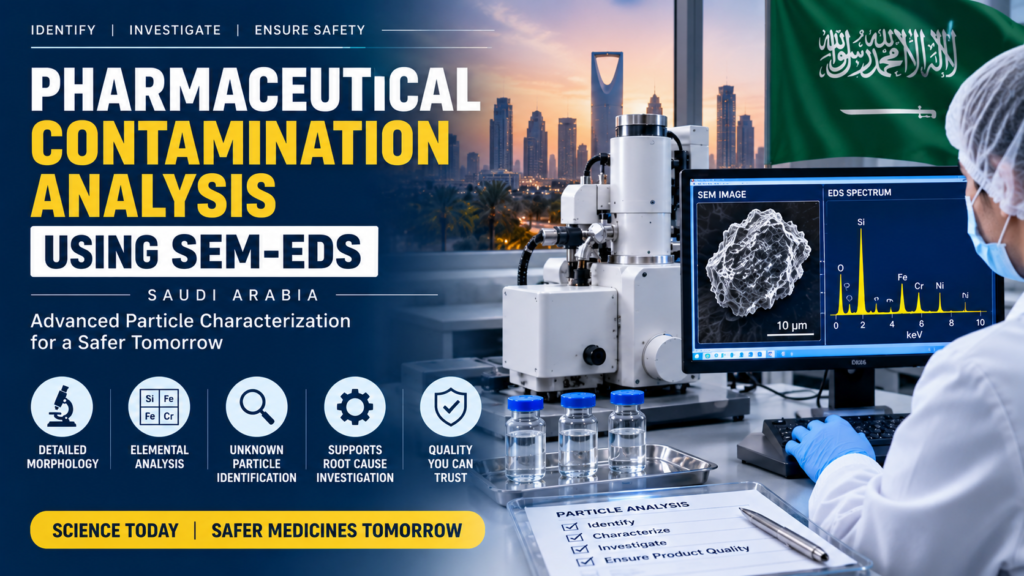
In pharmaceutical manufacturing, finding an unexpected particle in a product can quickly turn into a major quality investigation.
The immediate questions are usually straightforward:
What is the particle? Where did it come from? Could it have entered the product during manufacturing? And how can the risk of recurrence be reduced?
For pharmaceutical manufacturers in Saudi Arabia, these questions are particularly important because sterile-product manufacturing requires strong controls against microbial, particulate and other contamination risks. The Saudi Food and Drug Authority (SFDA) GMP Guide emphasizes minimizing particulate contamination and applying Quality Risk Management (QRM) and contamination-control principles throughout sterile manufacturing.
Visual inspection can identify that a particle exists, but visual observation alone often cannot establish its material composition.
This is where pharmaceutical contamination analysis using SEM-EDS can provide valuable analytical evidence.
Scanning Electron Microscopy (SEM) can produce high-resolution images of an unknown particle, while Energy Dispersive X-ray Spectroscopy (EDS) can provide information about its elemental composition.
Together, these techniques can help quality and laboratory teams move from “an unknown particle was observed” toward a more scientifically supported understanding of what the particle may be and which potential sources should be investigated.
For Saudi pharmaceutical manufacturers, this can be especially useful when investigating injectable products, foreign matter, equipment-related contamination, component failures, deviations and recurring particulate observations.
Why Pharmaceutical Contamination Analysis Matters
Pharmaceutical contamination can have multiple potential sources.
An unexpected particle may potentially originate from:
- Manufacturing equipment
- Stainless-steel components
- Product-contact parts
- Glass containers
- Polymer components
- Elastomeric seals and gaskets
- Filters and tubing
- Packaging materials
- Maintenance activities
- Process interventions
- Environmental sources
- Material handling
The challenge is that several potential sources may look similar to the naked eye.
A small metallic-looking particle, for example, does not automatically prove that it came from a particular machine component.
Likewise, a dark particle is not automatically rubber, and a transparent particle is not necessarily glass.
A robust contamination investigation therefore requires analytical evidence.
The investigation typically needs to answer four questions:
- What does the particle look like?
- What is the particle made of?
- Which manufacturing materials have a similar composition?
- Is there credible evidence connecting the particle to a potential source?
SEM-EDS can contribute significantly to the second question and provide supporting evidence for the third.
What Is SEM-EDS?
SEM-EDS combines two complementary analytical capabilities.
Scanning Electron Microscopy
Scanning Electron Microscopy uses an electron beam to generate high-resolution images of a sample.
For pharmaceutical particle analysis, SEM can provide detailed information about:
- Particle morphology
- Shape
- Surface characteristics
- Texture
- Fracture patterns
- Particle structure
- Fine surface features
This is important because particle morphology can provide clues about how a material was generated.
For example, a particle that appears fractured may tell a different story from one that appears deposited or formed through another mechanism.
SEM does not, by itself, establish the complete chemical identity of every particle. However, its detailed images can provide an important first layer of analytical information.
What Does EDS Add to SEM?
Energy Dispersive X-ray Spectroscopy adds elemental analysis.
When the electron beam interacts with the sample, characteristic X-rays can be produced. The EDS system detects these signals and helps determine which elements are present.
Depending on the sample and analytical conditions, the resulting data can help distinguish materials based on their elemental profiles.
For example, an unknown particle may show detectable elements associated with:
- Iron
- Chromium
- Nickel
- Silicon
- Aluminum
- Calcium
- Other elements
The result can then be compared with information about materials used in the manufacturing process.
Example: Suspected metal contamination
Imagine a Saudi pharmaceutical manufacturer discovers an unexpected particle in an injectable product.
The facility uses stainless-steel equipment throughout the manufacturing process.
SEM reveals that the particle has an irregular metallic morphology.
EDS provides an elemental profile containing elements that may be associated with a stainless-steel component.
This does not automatically prove the source.
However, it gives the investigation team a scientifically useful direction for reviewing equipment, component materials, maintenance history and process conditions.
That distinction is essential.
Analytical identification and root-cause confirmation are related but different steps.
How Pharmaceutical Contamination Analysis Using SEM-EDS Supports Investigations
A well-designed investigation should not rely on a single observation.
Instead, SEM-EDS can form part of a broader analytical workflow.
A typical sequence can include:
Particle detection → recovery → microscopy → SEM-EDS → reference comparison → manufacturing investigation → root-cause assessment
Each stage adds information.
Step 1: Detect the particle
The particle may be discovered through:
- Visual inspection
- Product inspection
- Customer complaint
- Deviation investigation
- Stability investigation
- In-process observation
- Quality-control testing
The initial observation should be documented carefully.
Step 2: Recover the particle
The particle must be recovered in a way that minimizes the risk of introducing additional contamination.
Documentation should consider:
- Sample identification
- Product and batch information
- Recovery method
- Handling conditions
- Storage
- Chain of custody where applicable
Poor sample handling can compromise the value of subsequent analysis.
Step 3: Perform microscopic examination
Before advanced instrumentation, microscopic examination can provide useful information about:
- Color
- Shape
- Size
- Surface appearance
- Fiber-like characteristics
- Agglomeration
- General morphology
This information can help determine which analytical techniques are appropriate.
Step 4: Perform SEM-EDS
SEM provides high-resolution imaging.
EDS provides elemental information.
Together, the results can establish a more detailed profile of the unknown particle.
Step 5: Compare with potential sources
This is one of the most valuable steps.
The unknown particle can potentially be compared with relevant manufacturing materials.
Potential reference materials may include:
- Equipment components
- Product-contact materials
- Filters
- Tubing
- Gaskets
- Seals
- Glass
- Packaging components
- Other process materials
The stronger the reference database, the easier it can be to narrow the investigation.
Why Reference Material Libraries Are Valuable
One of the challenges in pharmaceutical contamination investigations is that an unknown particle is often discovered after an event has occurred.
At that point, investigators may need to collect and analyze numerous possible source materials.
A better approach can be to develop a reference library proactively.
A reference-library program can involve:
- Identifying relevant manufacturing components.
- Separating product-contact and non-product-contact materials.
- Collecting representative material samples or coupons.
- Characterizing the materials.
- Documenting their analytical profiles.
- Maintaining the information for future investigations.
If an unknown particle is later discovered, the investigation team has a structured reference set against which it can compare the analytical results.
This can potentially make investigations more focused and efficient.
SEM-EDS and Different Types of Pharmaceutical Contamination
Not every particle behaves the same way analytically.
Metallic Particles
SEM-EDS can be particularly useful when metallic contamination is suspected.
Potential sources include:
- Equipment wear
- Mechanical components
- Manufacturing tools
- Stainless-steel surfaces
- Maintenance activities
The elemental profile can provide useful evidence for comparison with suspected sources.
Glass Particles
Glass-related particulate contamination can be relevant to injectable products packaged in glass containers.
SEM can provide detailed morphology, while EDS can provide elemental information that supports material characterization.
A published study has demonstrated the use of complementary microscopy and SEM-EDS approaches in characterizing thin glass particulates associated with parenteral drug products.
The lesson is important: particle morphology and elemental composition can provide complementary evidence during contamination investigations.
Inorganic Particles
SEM-EDS can also be useful when investigating particles suspected to be inorganic.
Elemental information may help distinguish different classes of materials and guide further investigation.
Organic and Polymer Particles
SEM-EDS can still provide useful supporting information for some polymeric materials, but elemental analysis alone may not provide sufficient molecular information.
This is where complementary techniques such as FTIR can become valuable.
For example:
SEM-EDS → morphology + elemental composition
FTIR → molecular/chemical information
A combined strategy can therefore be more informative when the particle’s identity is uncertain.
When Should SEM-EDS Be Used?
A practical question for pharmaceutical laboratories is:
When should we select SEM-EDS instead of another analytical technique?
SEM-EDS may be particularly appropriate when:
- A metallic particle is suspected.
- An inorganic particle has been detected.
- Equipment wear is suspected.
- Elemental composition is important.
- High-resolution particle morphology is required.
- Glass contamination is being investigated.
- The particle is too small for straightforward visual identification.
- Several potential material sources need to be differentiated.
However, technique selection should always be based on the characteristics of the sample and the investigation objective.
SEM-EDS vs Other Particle Characterization Techniques
SEM-EDS should not necessarily be viewed as a standalone solution.
Different techniques answer different questions.
| Technique | Main Information | Potential Application |
|---|---|---|
| Microscopy | Appearance and morphology | Initial particle examination |
| SEM | High-resolution morphology | Detailed particle structure |
| EDS | Elemental composition | Metals and inorganic materials |
| FTIR | Molecular/chemical information | Polymers, organics and fibers |
| TGA/STA | Thermal behavior | Material characterization |
| Combined approach | Multiple evidence streams | Complex unknown-particle investigations |
This is why particle characterization analysis is often strongest when the analytical plan is built around the investigation rather than around one instrument.
The Role of Particle Characterization in Root Cause Investigation
Identifying the particle is only one part of a contamination investigation.
The next question is:
Why was the particle present?
Suppose SEM-EDS indicates that an unknown particle is consistent with a material used in manufacturing.
The investigation may then review:
- Equipment design
- Equipment condition
- Maintenance records
- Component replacement
- Cleaning procedures
- Manufacturing interventions
- Operator activities
- Process changes
- Supplier materials
- Previous deviations
- Environmental conditions
This is where analytical results become part of a broader Quality Risk Management process.
SFDA’s GMP guidance emphasizes risk management and root-cause investigation for procedural, process or equipment failures, with suitable corrective and preventive actions where appropriate.
Therefore, pharmaceutical contamination analysis using SEM-EDS should be considered an evidence-generating activity within the larger pharmaceutical quality system—not a replacement for process investigation.
Importance for Saudi Pharmaceutical Manufacturers
Saudi pharmaceutical manufacturers operate within a regulatory environment where GMP and contamination control are important components of pharmaceutical quality.
SFDA’s current GMP framework specifically addresses sterile medicinal products and emphasizes minimizing risks associated with microbial, particulate and endotoxin/pyrogen contamination. It also highlights Quality Risk Management and the use of a Contamination Control Strategy (CCS).
The guidance also emphasizes that monitoring or testing alone does not provide assurance of sterility and that facility, equipment and process design should be considered alongside procedures and monitoring.
This creates an important practical lesson for quality teams:
Particle analysis should support—not replace—the contamination-control strategy.
Analytical findings can help manufacturers understand potential contamination mechanisms and identify areas where controls may need strengthening.
A Practical SEM-EDS Investigation Checklist
When an unknown particle is identified, consider the following checklist.
Sample information
- Product identified
- Batch number recorded
- Location of observation documented
- Particle appearance recorded
- Recovery procedure documented
- Sample integrity maintained
Analytical information
- Microscopic examination completed
- Particle morphology documented
- SEM imaging performed where appropriate
- EDS elemental information obtained
- Analytical limitations documented
- Additional techniques considered where necessary
Source investigation
- Product-contact components reviewed
- Non-contact potential sources reviewed
- Equipment history checked
- Maintenance records reviewed
- Recent changes investigated
- Reference materials considered
- Previous contamination events reviewed
Quality investigation
- Risk assessment completed
- Potential root causes evaluated
- CAPA considered where appropriate
- Contamination-control strategy reviewed
- Effectiveness of corrective actions assessed
Common Mistakes in SEM-EDS Contamination Investigations
1. Treating EDS Results as Absolute Source Identification
An elemental match does not necessarily prove that a particular component generated the particle.
The result should be interpreted alongside manufacturing evidence.
2. Skipping Sample Documentation
Without proper documentation, analytical results may become difficult to interpret later.
3. Using Only Visual Appearance
Visual appearance provides useful clues but should not automatically be treated as material identification.
4. Ignoring Reference Materials
Without reference materials, investigators may struggle to distinguish between several plausible sources.
5. Using One Technique for Every Particle
Different particles require different analytical approaches.
A polymer particle and a metallic particle should not necessarily be investigated in exactly the same way.
How to Build a Strong Particle Characterization Program
For pharmaceutical organizations, a proactive program can be more valuable than relying exclusively on reactive investigations.
Start by mapping potential sources.
Identify:
- Product-contact components
- Equipment materials
- Filters
- Tubing
- Elastomers
- Packaging materials
- Maintenance-related materials
Then develop analytical references.
Characterize representative materials using appropriate techniques.
Finally, establish an investigation workflow.
Define:
- Who receives the sample
- How particles are recovered
- Which laboratory performs analysis
- Which analytical techniques are selected
- How results are compared
- How findings are communicated to QA and manufacturing
- How results feed into root-cause investigation
This approach can make particle investigations more consistent and scientifically defensible.
FAQ: Pharmaceutical Contamination Analysis Using SEM-EDS
What is pharmaceutical contamination analysis using SEM-EDS?
It is an analytical approach that uses Scanning Electron Microscopy to examine particle morphology and Energy Dispersive X-ray Spectroscopy to obtain elemental information about an unknown particle.
Can SEM-EDS identify the source of a pharmaceutical particle?
SEM-EDS can provide valuable evidence about a particle’s composition and morphology, but identifying a potential material does not automatically establish the manufacturing source. Additional process and equipment investigation is normally required.
Is SEM-EDS useful for injectable products?
Yes. It can be particularly useful when investigating visible or recovered particles where elemental composition and detailed morphology may help characterize the material.
Can SEM-EDS identify polymer particles?
SEM-EDS may provide supporting elemental information, but other techniques such as FTIR may provide more useful molecular information for many polymers.
What is the difference between SEM and EDS?
SEM primarily provides high-resolution imaging and morphology. EDS adds elemental composition information.
Why is reference material analysis important?
Reference materials allow investigators to compare an unknown particle against known manufacturing components and potentially narrow the list of possible sources.
Does particle analysis alone prove contamination root cause?
No. Analytical characterization provides evidence. A complete root-cause investigation should also consider manufacturing processes, equipment, maintenance, materials, personnel and contamination-control measures.
Conclusion: Turning an Unknown Particle Into Actionable Evidence
An unknown particle in a pharmaceutical product can create a difficult investigation.
But the right analytical strategy can make that investigation much more structured.
Pharmaceutical contamination analysis using SEM-EDS provides two valuable forms of information: detailed particle morphology through SEM and elemental composition through EDS.
When combined with microscopy, reference-material analysis and complementary techniques such as FTIR or thermal analysis, the results can provide a much stronger picture of an unknown particle.
For pharmaceutical manufacturers in Saudi Arabia, this approach can support investigations involving:
- Injectable products
- Foreign particles
- Equipment-related contamination
- Manufacturing deviations
- Component-related contamination
- Customer complaints
- Recurring particulate observations
- Root-cause investigations
Most importantly, the analytical result should be connected to the wider pharmaceutical quality system.
SFDA’s GMP framework emphasizes risk management, contamination prevention and root-cause investigation as part of effective sterile-product manufacturing.
If your pharmaceutical facility needs scientific support for an unknown particle investigation, Confianza Pharma Zone’s Particle Characterization Analysis Services can be explored as part of a structured contamination-investigation strategy.
Explore Particle Characterization Analysis Services
Your trusted partner for pharma skills, systems, and solutions.