
No products in the cart.
USP 790 Defect Kits Saudi Arabia | Visual Inspection Qualification
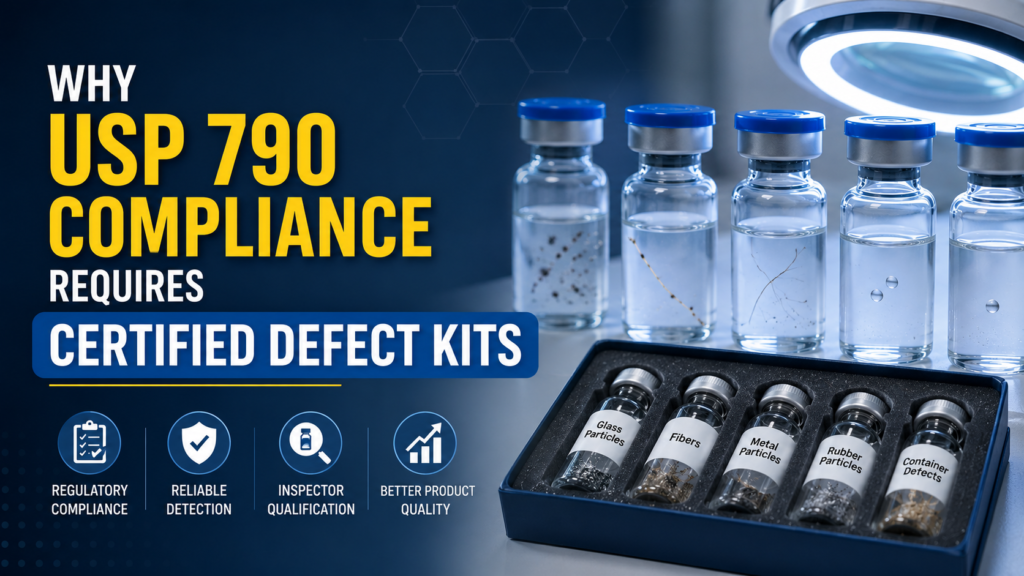
When pharmaceutical manufacturers talk about USP <790> compliance, the discussion often starts with one simple question:
Can our inspectors reliably detect visible particulate matter in injectable products?
The answer is more complicated than simply putting vials under a light and asking an operator to identify particles.
Visual inspection is influenced by the product, container, particle characteristics, inspection environment, inspection speed, operator capability and the method used. USP <1790> describes visual inspection as a probabilistic process, meaning the probability of detecting a visible particle can change according to factors such as particle size, shape, color, density, dosage form and container design.
For pharmaceutical manufacturers in Saudi Arabia, this makes controlled defect samples particularly valuable.
A properly designed USP 790 Defect Kits Saudi Arabia strategy can provide representative challenge samples for inspector training, qualification, periodic assessment and automated inspection evaluation.
But there is an important distinction:
USP <790> does not say that a manufacturer must purchase a commercially “certified defect kit.”
Instead, the regulatory objective is to establish an effective visual inspection process. Saudi GMP guidance goes further by stating that manually inspecting operators should undergo visual inspection qualification using appropriate samples from the manufacturer’s defect library, taking worst-case scenarios into account. For automated inspection, the equipment should be challenged using representative defects before start-up and at regular intervals during the batch.
That distinction matters when selecting a Knapp Kit or visual inspection defect kit.
The question should not simply be:
“Is this kit certified?”
The better question is:
“Are these controlled, representative and appropriately documented defects suitable for our visual inspection qualification program?”
Let’s explore what pharmaceutical manufacturers in Saudi Arabia should know.
What Does USP <790> Actually Require?
USP <790>, Visible Particulates in Injections, states that products intended for parenteral administration must be visually inspected for particulate matter as specified in the applicable USP requirements. It describes particulate matter as extraneous mobile undissolved particles unintentionally present in solutions and gives examples including fibers, glass, metal, elastomeric materials and precipitates.
This makes visible particulate inspection a critical part of injectable-product quality control.
However, USP <790> should not be interpreted as saying:
“Buy a certified commercial defect kit and you are compliant.”
Compliance is broader.
A robust program needs to consider:
- Inspection procedure
- Inspection environment
- Lighting
- Background
- Inspection rate
- Operator training
- Operator qualification
- Defect library
- Representative challenge samples
- Worst-case conditions
- Automated inspection validation, where applicable
- Documentation
- Trending
- Investigation of adverse trends
- Corrective and preventive actions
The U.S. FDA similarly describes visible particulate control as a holistic, risk-based process involving manufacturing controls, visual inspection techniques, particulate identification, investigation and corrective actions. It also notes that meeting a USP compendial standard alone is not generally sufficient to demonstrate compliance with CGMP requirements for injectable products.
Why Defect Kits Matter for Visual Inspection Qualification
Imagine a pharmaceutical facility has 30 visual inspectors.
All 30 have completed an SOP training session.
Does that prove they can reliably identify defects?
Not necessarily.
An SOP can explain:
- What a visible particle is
- How inspection should be performed
- What equipment should be used
- What constitutes a reject
- How results should be documented
But practical competency requires more.
Inspectors need exposure to representative visual challenges.
This is where visual inspection defect kits Saudi Arabia can become an important training and qualification tool.
A controlled defect kit allows a manufacturer to move from:
“The operator has been trained.”
to:
“The operator has demonstrated the ability to perform the inspection under defined conditions.”
That is a much stronger quality-system approach.
Saudi GMP Expectations Make Defect Libraries Particularly Important
For companies manufacturing or supplying sterile medicines in Saudi Arabia, the Saudi Food and Drug Authority’s GMP framework is especially relevant.
The SFDA GMP guidance states that sterile manufacturing must minimize risks from microbiological, particulate and pyrogen contamination and emphasizes the importance of personnel skill, training and carefully established procedures.
More specifically, the guidance states that when inspection is performed manually:
- Inspection should occur under suitable and controlled illumination and background.
- Inspection rates should be appropriately controlled and qualified.
- Operators should undergo visual inspection qualification.
- Qualification should use appropriate samples from the manufacturer’s defect library sets.
- Worst-case scenarios should be considered.
- Eyesight checks should be included.
- Operator distractions should be minimized.
- Appropriate breaks should be provided.
For automated inspection, the guidance calls for validation against known defects and representative defects to challenge equipment before start-up and at regular intervals throughout the batch. Inspection results and defect trends should also be recorded and evaluated.
This is highly relevant when developing a USP 790 Defect Kits Saudi Arabia strategy.
What Makes a Defect Kit “Qualified”?
The word qualified is more useful than simply saying “certified.”
A defect kit should be evaluated according to its intended application.
Consider the following factors.
1. Known Defect Characteristics
The manufacturer should understand what the challenge sample is intended to represent.
Examples can include:
- Glass
- Metal
- Fibers
- Elastomeric materials
- Other foreign particles
- Product-specific visual defects
USP <790> itself identifies several of these categories as examples of visible particulate matter.
2. Appropriate Container Format
The same defect may behave differently in different containers.
A kit may therefore need to correspond to the manufacturer’s actual packaging format, such as:
- Glass vials
- Cartridges
- Prefilled syringes
The inspection characteristics of the container can influence detection.
USP <1790> specifically recognizes that container design and dosage-form characteristics can affect the ability to detect visible particles.
3. Relevant Particle Characteristics
Particle detection isn’t determined by size alone.
Important characteristics can include:
- Size
- Shape
- Color
- Density
- Movement
- Transparency
- Contrast
A large dark particle may be easier to detect than a smaller translucent fiber.
Therefore, a useful defect library should represent meaningful inspection challenges rather than simply containing a random collection of particles.
Why “Certified” Is Not the Same as “Compliant”
This distinction deserves special attention.
A supplier may describe a product as:
- Certified
- Qualified
- Calibrated
- Controlled
- Traceable
- Validated
These terms can have different meanings.
A pharmaceutical quality team should ask the supplier exactly what the documentation demonstrates.
For example:
Ask for:
- Certificate of conformity, where applicable
- Defect identification
- Sample identification
- Relevant particle characteristics
- Container information
- Manufacturing/traceability information
- Recommended application
- Storage requirements
- Inspection instructions
- Documentation supporting the intended use
The goal is to establish fitness for the intended qualification or training application.
A certificate alone does not make the overall inspection process compliant.
USP <790> vs USP <1790>: Why Both Matter
A common SEO and regulatory mistake is treating USP <790> and USP <1790> as identical.
They are related but serve different purposes.
USP <790>
USP <790> focuses on visible particulates in injections and the requirement for applicable parenteral products to be visually inspected for particulate matter.
USP <1790>
USP <1790> provides broader guidance for visual inspection of injections, including the probabilistic nature of inspection and factors affecting detection.
For a pharmaceutical manufacturer, therefore:
<790> → What is expected regarding visible particulates
<1790> → Guidance for designing and understanding the visual inspection process
Together, they provide a more useful framework for developing an effective inspection program.
Why Visual Inspection Is a Probabilistic Process
This is one of the most important concepts for anyone purchasing Knapp Kits Saudi Arabia.
Suppose two inspectors examine the same vial.
Inspector A detects the particle.
Inspector B does not.
Does that automatically mean one inspector is careless?
Not necessarily.
Detection probability can be influenced by:
- Particle size
- Particle shape
- Particle color
- Particle density
- Product formulation
- Container design
- Lighting
- Background
- Inspection motion
- Inspection time
- Operator fatigue
USP <1790> explicitly recognizes this variability.
That is why representative challenge samples are useful.
They allow manufacturers to study and qualify performance under controlled conditions instead of assuming that every defect is equally detectable.
How Knapp Kits Can Support a Saudi Pharmaceutical Facility
A well-designed Knapp Kit or visual inspection defect kit can support several activities.
1. Initial Inspector Training
New inspectors can be introduced to representative defect types.
Instead of relying only on images, the trainee can work with physical challenge samples.
2. Qualification
The manufacturer’s approved protocol can use representative samples to evaluate inspector performance.
3. Periodic Requalification
Saudi GMP guidance specifies visual inspection qualification for manual inspection operators and states that this should occur at least annually.
A defect library can therefore become part of the recurring qualification program.
4. Worst-Case Evaluation
Qualification can incorporate conditions such as:
- Inspection time
- Line speed
- Container size
- Fatigue
These are specifically mentioned in Saudi GMP guidance as worst-case considerations.
5. Automated Inspection Challenges
For automated systems, representative defects can be used to challenge inspection equipment.
This can help manufacturers evaluate whether the system identifies intended defect categories under predefined conditions.
What Should a Saudi Pharmaceutical Company Look for When Buying Defect Kits?
Before purchasing a USP 790 Defect Kits Saudi Arabia solution, use a structured supplier evaluation.
Step 1: Define your inspection process
Document:
- Product type
- Container type
- Inspection method
- Manual or automated process
- Defect categories
- Inspection conditions
Step 2: Define your defect library
Identify the defects relevant to your product and process.
Step 3: Evaluate sample suitability
Ask whether the supplied defects represent the intended inspection challenges.
Step 4: Review documentation
Don’t select a kit solely based on price or the word “certified.”
Step 5: Review supplier technical capability
Ask whether the supplier understands pharmaceutical visual inspection and qualification.
Step 6: Build the kit into your quality system
The kit should have a defined purpose within:
- SOPs
- Training
- Qualification
- Requalification
- Investigation
- Continuous improvement
Common Mistakes Companies Make
Mistake 1: Treating the Kit as the Compliance Program
A defect kit is a tool.
It does not replace the complete visual inspection system.
Mistake 2: Using Random Particles
A random particle inside a vial isn’t necessarily a scientifically suitable challenge sample.
The defect should be relevant to the intended inspection purpose.
Mistake 3: Ignoring Worst-Case Conditions
Qualification under ideal conditions may not represent actual manufacturing conditions.
Saudi GMP specifically highlights worst-case factors such as inspection time, line speed, container size and fatigue.
Mistake 4: Focusing Only on Particle Size
Two particles of identical size can have different detectability because of differences in color, shape, density and movement.
USP <1790> recognizes these variables.
Mistake 5: Forgetting Automated Inspection
Automated inspection requires its own appropriate challenge strategy.
Saudi GMP guidance says automated inspection processes should be validated to detect known defects and challenged with representative defects before start-up and periodically during the batch.
Building a Strong Visual Inspection Defect Library
For Saudi pharmaceutical manufacturers, a defect library can become a long-term quality resource.
A practical library can be organized by:
Material
- Glass
- Metal
- Fiber
- Elastomer
- Other materials
Appearance
- Dark
- Light
- Transparent
- Irregular
- Thread-like
Size
Multiple representative sizes appropriate to the inspection application.
Container
- Vial
- Cartridge
- Prefilled syringe
Product
- Clear liquid
- More difficult-to-inspect formulation
- Lyophilized product
The exact library should be determined through product and process risk assessment.
How Defect Kits Fit Into a Broader Contamination-Control Strategy
Visible particulate inspection is only one part of contamination control.
If a visible particle is detected, the next question is:
Where did it come from?
Possible sources can include:
- Product-contact components
- Equipment
- Elastomeric components
- Glass
- Metal
- Fibers
- Packaging
- Personnel
- Manufacturing environment
This is where visual inspection and particle characterization can work together.
Visual inspection can identify a potential visible defect.
Particle characterization can help investigate its identity and potential source.
For example, analytical techniques such as microscopy, FTIR or SEM/EDS can be used within an appropriate laboratory investigation strategy.
This creates a broader quality loop:
Detection → Classification → Investigation → Root Cause → CAPA → Prevention
FAQ: USP <790> Defect Kits in Saudi Arabia
Does USP <790> require a certified defect kit?
No. USP <790> requires applicable injectable products to be visually inspected for visible particulate matter, but it does not state that manufacturers must purchase a commercially certified defect kit.
The more accurate approach is to use suitable, controlled and representative samples within a qualified inspection program.
Does Saudi GMP mention defect libraries?
Yes. Saudi GMP guidance states that manual visual inspection qualification should use appropriate samples from the manufacturer’s defect library sets and consider worst-case scenarios.
Are Knapp Kits required for SFDA compliance?
There is no basis in the cited SFDA guidance to say that a particular commercial brand or Knapp Kit is mandatory.
The important requirement is the effectiveness and qualification of the inspection process.
Can Knapp Kits be used for automated inspection?
Yes, appropriately designed representative defect samples can support automated inspection challenges. Saudi GMP specifically requires automated inspection equipment to be challenged with representative defects.
How often should manual visual inspectors be qualified?
The Saudi GMP guidance cited above states that operators performing manual inspection should undergo visual inspection qualification at least annually, along with consideration of eyesight checks and worst-case inspection conditions.
Is USP <790> alone enough for injectable GMP compliance?
No. FDA guidance emphasizes that satisfying a USP compendial standard alone is not generally sufficient to demonstrate current GMP compliance for injectable products. A broader, risk-based particulate-control system is required.
Conclusion: Build a Qualified, Evidence-Based Visual Inspection Program
For pharmaceutical manufacturers in Saudi Arabia, USP <790> should be viewed as one component of a broader injectable-product quality strategy.
The most important takeaway is that USP 790 Defect Kits Saudi Arabia should not be approached simply as a purchasing exercise.
A commercially “certified” label does not automatically make an inspection program compliant.
Instead, manufacturers should focus on:
- Representative defects
- Controlled samples
- Appropriate defect libraries
- Trained inspectors
- Qualified inspection conditions
- Worst-case challenges
- Documented qualification
- Periodic requalification
- Automated inspection challenges
- Defect trending
- Investigation and CAPA
Saudi GMP guidance makes the importance of appropriate defect-library samples particularly clear for manual inspection qualification, while representative defects are also important for automated inspection systems.
For Saudi pharmaceutical manufacturers producing injectable products, selecting the right Knapp Kits Saudi Arabia solution can therefore help create a structured foundation for visual inspection training and qualification—provided the kit is integrated into an appropriately designed quality system.
Strengthen Your Visual Inspection Qualification Program
Confianca Pharmazon’s Knapp Kits and Visual Inspection Defect Kits can be positioned as practical tools for pharmaceutical manufacturers seeking controlled challenge samples for manual and automated visual inspection applications.
For facilities preparing for customer audits, GMP inspections, qualification activities or ongoing inspector competency assessment, the right defect kit can help turn visual inspection from a largely experience-based activity into a more structured, documented and repeatable process.
Explore the visual inspection defect kit solution and discuss the appropriate configuration for your injectable product, container and inspection process.
Your trusted partner for pharma skills, systems, and solutions.