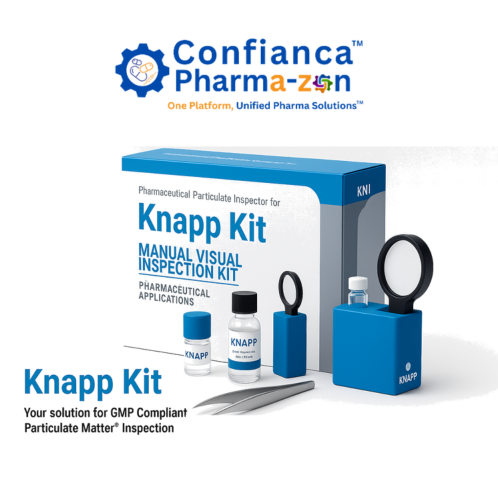
Why Knapp Kits Matter: The Complete Guide to Visual Inspection Qualification in Pharma

Introduction: The Critical Role of Knapp Kits in Pharma Quality
Every injectable product that reaches a patient must be free from visible particulate matter. Even a single fiber, glass shard, or metal particle can trigger regulatory action, product recalls, or—most importantly—compromise patient safety.
This is where Knapp Kits play a crucial role. Designed for visual inspection qualification, these kits provide a standardized way to train inspectors, qualify automated systems, and demonstrate compliance during FDA, EMA, or WHO audits.
In this guide, we’ll explore:
- What Knapp Kits are and why they matter
- How they’re prepared, qualified, and used in pharma
- Practical SOP steps for defect kit handling
- How Confianca Pharmazon provides industry-leading Knapp Kits and services
What Are Knapp Kits?
The term Knapp comes from Dr. John E. Knapp, who pioneered the statistical approach for determining Probability of Detection (POD) during visual inspection of injectables.
- Not a generic word: In German, “knapp” means “scarce,” but in pharma, Knapp Kits simply refer to defect library sets based on Dr. Knapp’s methodology.
- Purpose: To establish reject zones (≥70% POD), accept zones (≤30% POD), and grey zones (30–70%) to train and qualify inspectors.
- Applications:
- Manual visual inspection training
- Qualification of automatic inspection machines
- Periodic requalification of inspectors
- Compliance demonstration during audits
By using Knapp Kits, pharma companies ensure their visual inspection qualification programs meet global standards like USP <790>, USP <1790>, EU GMP Annex 1, and 21 CFR Part 11.
Why Knapp Kits Matter in Pharma Quality Systems
Visual inspection is one of the last quality gates before a product reaches a patient. Regulators like the FDA expect companies to:
- Qualify inspectors — ensuring they can reliably detect defects.
- Demonstrate compliance — using POD-based defect libraries.
- Maintain defect libraries — for both manual and automated systems.
Without Knapp Kits, companies risk:
- Failed audits due to lack of standardized defect kits
- Inconsistent inspection results across teams
- Regulatory citations under data integrity and cGMP
👉 In short: Knapp Kits = Audit readiness + patient safety + inspector confidence.
Step-by-Step SOP for Knapp Kit Preparation & Use
Here’s a practical checklist (adapted from Confianca Pharmazon’s methodology):
1. Objective
To prepare, qualify, and maintain Knapp Kits for training, qualification, and requalification.
2. Materials Required
- Product containers: vials, ampoules, cartridges, syringes
- Defect sources: glass, rubber, fibers, metal, silicone oil
- Microscope (particle sizing)
- Visual inspection booth (2,000–3,750 lux, black/white backgrounds)
- Documentation logbook / Part 11 compliant e-records
3. Preparation of Defect Standards
- Collect real defects or seed particles into sterile containers
- Verify particle size with calibrated microscopes
- Categorize into:
- Rejects (≥70% POD)
- Accepts (≤30% POD)
- Grey zone (optional, 30–70%)
4. Qualification of Defects
- Inspect each unit 30–50 times by multiple inspectors
- Record detection/miss counts
- Calculate POD → categorize defect
5. Assembly of Test Sets
- 10% defective, 90% good units (to avoid inspector bias)
- Label with UV ink codes (not visible to inspectors)
- Create different sets for solutions, suspensions, lyophilized products
6. Documentation & Validation
- Maintain a Master Log with:
- Kit ID
- Defect details & sizes
- Qualification results
- Expiry/requalification schedule
7. Training & Qualification
- New inspectors → initial qualification
- Experienced → annual requalification
- Use kits to benchmark inspectors vs. reference POD values
8. Requalification & Maintenance
- Recheck kits every 6–12 months
- Replace damaged units or lost particles
9. Storage & Handling
- Store under cleanroom conditions
- Clearly label: “Training Use Only – Not for Patient Use”
Features of Confianca Pharmazon Knapp Kits
According to the Confianca Pharmazon brochure:
- High-quality particle standards: Glass, metal, fibers, elastomers.
- Defect libraries: Manual inspection kits, qualification kits, training kits.
- Audit-ready support: Certificates, particle sizing per USP guidance.
- Extended shelf life: 2–3 years expiry certification.
- Regulatory compliance: USP <790>, USP <1790>, FDA/EMA standards.
- Value-added services:
- Free UV torch for defect ID
- Free replacement of defective containers (transport damage)
- Onsite/offsite visual inspection training
- 24×7 online expert support
💡 Why choose Confianca over global suppliers?
- Faster delivery, longer shelf life, cost-effective kits, and personalized training services.
Tips for Successful Visual Inspection Qualification
- Train under realistic conditions: Same lighting, background, and pace as routine inspection.
- Use varied defect types: Include glass, fibers, cracks, wrong fills, stopper issues.
- Maintain inspector alertness: Schedule breaks, use audio buzzers (per Part 11 booths).
- Trend results: Track inspector POD scores → identify training needs.
- Integrate automation: Use Knapp Kits for qualification of automatic inspection machines.
FAQ Section
Q1. How often should inspectors be requalified using Knapp Kits?
➡ Industry best practice: every 12 months, or after long absence from inspection duties.
Q2. Are Knapp Kits mandatory for FDA audits?
➡ While not explicitly mandated, regulators expect POD-based defect libraries. Knapp Kits are the industry standard for compliance.
Q3. Can the same Knapp Kit be used for both clear and amber vials?
➡ No. Separate kits should be prepared for different container types and formulations.
Q4. How long does a Knapp Kit last?
➡ Typically 2–3 years, provided periodic requalification and proper storage.
Q5. Do Confianca Pharmazon Knapp Kits come with certificates?
➡ Yes. Each defect kit includes a Master Certificate and POD evaluation sheet.
Conclusion: Knapp Kits = Compliance, Confidence, and Patient Safety
In a world of increasing regulatory scrutiny, Knapp Kits are not just a training tool—they’re a compliance necessity. They ensure:
- Inspectors are trained and qualified.
- Automated systems meet acceptance criteria.
- Audit queries are answered with confidence.
For pharma companies, investing in Knapp Kits means fewer audit observations, stronger quality culture, and above all—safer medicines for patients.
👉 CTA: Ready to upgrade your visual inspection program? Explore Confianca Pharmazon Knapp Kits here and request a demo today.