
Manual vs Automatic Visual Inspection: Why Knapp Kit Qualification is Critical for Compliance & Particle Detection
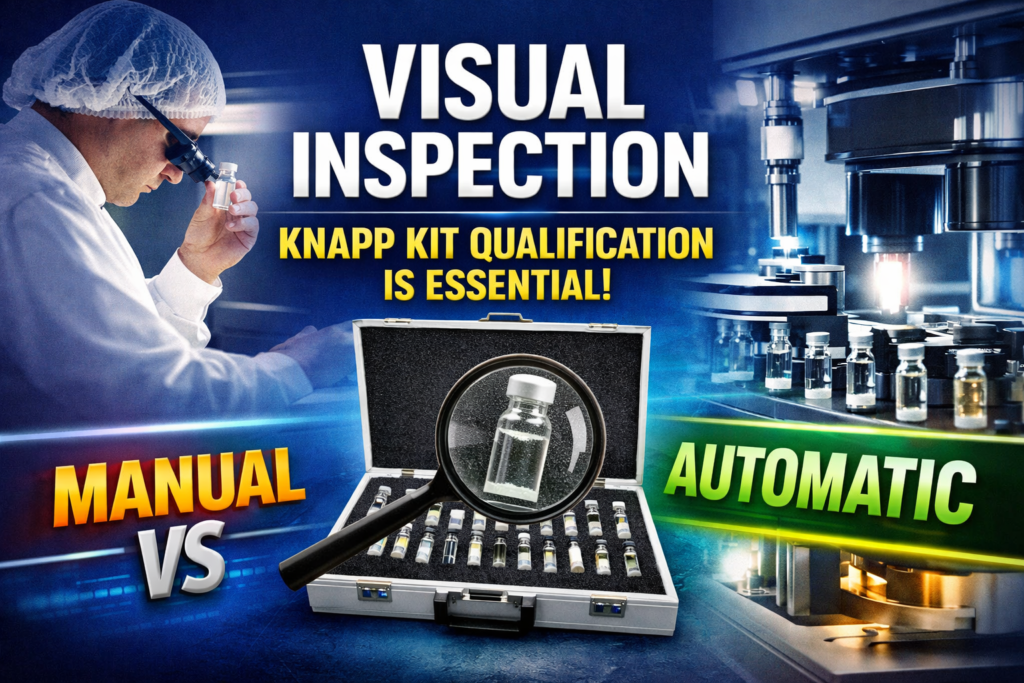
🚀 Introduction: The Hidden Risk in Visual Inspection
In the pharmaceutical industry, especially in sterile manufacturing and injectable products, visual inspection is the last line of defense before a product reaches the patient.
Yet, here’s the uncomfortable truth:
👉 Even the most advanced automated systems or highly trained human inspectors can fail to detect critical defects without proper qualification.
This is where Knapp Kit Qualification becomes non-negotiable.
Whether you rely on manual visual inspection or automated inspection machines, Knapp kits play a crucial role in ensuring:
- Consistent defect detection
- Regulatory compliance (USP <790>, <1790>)
- Improved Probability of Detection (POD)
- Reduced risk of product recalls
In this blog, we’ll break down:
- Manual vs automated inspection differences
- Why both require Knapp Kit Qualification
- Real-world compliance implications
- How to implement it effectively
🔍 What is Visual Inspection in Pharmaceuticals?
Visual inspection is the process of examining injectable products to detect:
- Particulate matter (glass, fibers, metal, etc.)
- Cosmetic defects
- Container closure issues
- Cracks or seal defects
These inspections can be performed in two ways:
👨🔬 Manual Visual Inspection
- Performed by trained human inspectors
- Uses controlled lighting (Tyndall effect)
- Relies on human judgment
🤖 Automated Visual Inspection
- Uses cameras, sensors, AI algorithms
- High-speed and consistent
- Ideal for large-scale production
⚖️ Manual vs Automated Visual Inspection – Key Differences
| Parameter | Manual Inspection | Automated Inspection |
|---|---|---|
| Accuracy | Variable (human dependent) | Consistent (machine-based) |
| Speed | Slower | High-speed |
| Fatigue Impact | High | None |
| Flexibility | High | Medium |
| Compliance Risk | Higher (if not qualified) | Lower (if validated properly) |
👉 But here’s the key insight:
⚠️ Both systems are only as good as their qualification process.
And that’s where Knapp Kit Qualification comes into play.
🎯 What is Knapp Kit Qualification?
Knapp Kit Qualification is a standardized method used to:
- Evaluate visual inspection performance
- Train inspectors and machines
- Measure detection capability (POD)
These kits contain known defects like:
- Glass particles
- Fibers (black/white)
- Metal particles
- Cosmetic defects
According to industry practices, these defects are precisely fabricated and certified to simulate real-world contamination scenarios .
🧪 Why Knapp Kit Qualification is Critical for Both Systems
🔹 1. Ensures Regulatory Compliance (USP <790> & <1790>)
Regulatory bodies require that:
- Products must be “essentially free from visible particulates”
- Inspection processes must be validated
Knapp Kit Qualification helps you:
✅ Demonstrate compliance
✅ Provide audit-ready documentation
✅ Reduce regulatory risk
🔹 2. Improves Probability of Detection (POD)
POD measures how effectively defects are detected.
Without Knapp Kit Qualification:
- You don’t know your detection capability
- You risk false negatives (undetected defects)
With Knapp kits:
- You test real-world defect scenarios
- You quantify detection accuracy
🔹 3. Standardizes Training Across Inspectors
Manual inspection is highly subjective.
Knapp kits help:
- Train inspectors with real defects
- Align decision-making
- Reduce variability
As per industry practice, qualification kits include both defective and good containers for effective training .
🔹 4. Validates Automated Systems
Even machines require qualification.
Knapp kits are used to:
- Challenge machine algorithms
- Validate detection thresholds
- Ensure consistency across batches
🔹 5. Supports Audit Readiness
During audits, common questions include:
- How do you validate inspection systems?
- How do you ensure defect detection capability?
Knapp Kit Qualification provides:
✔ Certification of defects
✔ POD evaluation sheets
✔ Audit-support documentation
⚠️ Risks of Skipping Knapp Kit Qualification
Ignoring Knapp Kit Qualification can lead to:
- ❌ Product recalls
- ❌ Regulatory observations (483, Warning Letters)
- ❌ Patient safety risks
- ❌ Brand damage
🧩 Real-World Example
Imagine:
A pharma company relies only on automated inspection.
They skip proper Knapp kit qualification.
👉 Result:
- Machine misses low-contrast particles
- Batch gets released
- Market complaint arises
💥 Outcome:
- Recall
- Regulatory action
- Financial loss
🛠️ How to Implement Knapp Kit Qualification Effectively
✅ Step 1: Use Certified Defect Kits
Ensure defects are:
- Size-certified
- USP-compliant
- Real-world simulated
✅ Step 2: Perform POD Studies
- Inspect each container multiple times
- Record detection rates
✅ Step 3: Train Inspectors Regularly
- Use defect libraries
- Conduct qualification programs
✅ Step 4: Validate Machines
- Challenge automated systems
- Adjust sensitivity
✅ Step 5: Maintain Documentation
- Certification records
- Training logs
- Audit-ready reports
🧠 Advanced Insight – Human vs Machine + Knapp Kits
The future is not manual vs automated.
👉 It’s Human + Machine + Knapp Kit Qualification
Why?
- Humans detect complex patterns
- Machines ensure consistency
- Knapp kits validate both
📊 Key Benefits of Knapp Kit Qualification
- Improves inspection accuracy
- Enhances compliance readiness
- Reduces batch rejection
- Builds inspector confidence
- Validates automated systems
❓ FAQs
❓ What is Knapp Kit Qualification in pharma?
It is a method to evaluate and validate visual inspection systems using known defects to measure detection capability.
❓ Is Knapp Kit required for automated inspection?
Yes. Even automated systems require Knapp Kit Qualification for validation and compliance.
❓ What defects are included in Knapp kits?
Glass particles, fibers, metal particles, cosmetic defects, and more.
❓ How often should qualification be done?
- Initial qualification
- Periodic requalification
- After system changes
❓ What is POD in visual inspection?
Probability of Detection (POD) measures how effectively defects are identified during inspection.
🏁 Conclusion: Don’t Choose Between Manual & Automated—Qualify Both
In today’s regulatory environment, the question is no longer:
👉 “Manual or automated inspection?”
The real question is:
👉 “How well is your inspection system qualified?”
Without Knapp Kit Qualification, both manual and automated systems are incomplete.
But with it, you achieve:
- Compliance
- Confidence
- Consistency
- Patient safety
📢 CTA (Call to Action)
If you’re serious about improving your visual inspection process, compliance readiness, and defect detection capability, it’s time to implement Knapp Kit Qualification the right way.
👉 Explore high-quality, certified Knapp Kits here:
https://confiancapharmazon.com/product/knapp-kit-visual-inspection-kits-particles-particulate-matters/
Your trusted partner for pharma skills, systems, and solutions.