
No products in the cart.
Automated Visual Inspection Booths in Injectable Plants: Why They Are Replacing Manual Inspection Setups
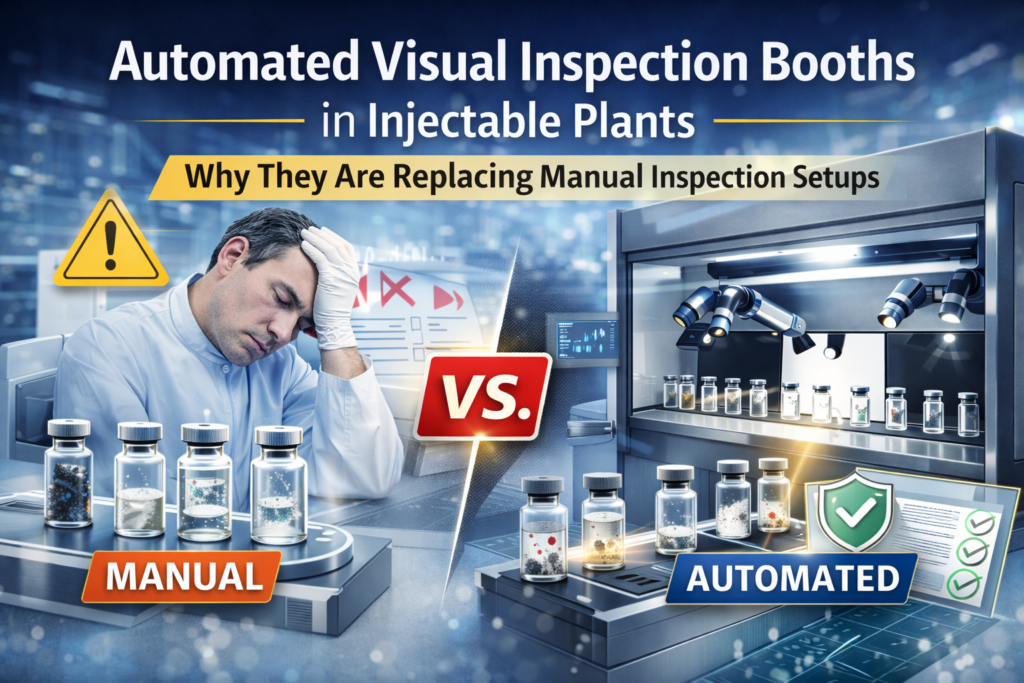
The pharmaceutical industry is evolving rapidly. Injectable manufacturing, in particular, faces intense regulatory scrutiny, zero-defect expectations, and increasing global competition.
One area undergoing significant transformation is visual inspection.
For decades, manual inspection setups dominated injectable plants. However, today Automated Visual Inspection Booths are becoming the new industry standard.
But why is this shift happening?
Is automation really superior to manual inspection?
Let’s explore the real reasons why automated systems are replacing traditional setups — and what it means for injectable manufacturing.
🟦 The Critical Role of Visual Inspection in Injectable Plants
In sterile manufacturing, visual inspection is not optional — it is mandatory.
Injectables must be:
- Essentially free from visible particulates (USP <790>)
- Inspected for cosmetic and critical defects
- Compliant with EU GMP Annex 1
- Fully traceable under 21 CFR Part 11 (where applicable)
Defects in injectable products may include:
- Glass particles
- Fibers
- Metal fragments
- Cracks in vial
- Seal integrity issues
- Wrong fill volume
- Cosmetic defects
A single missed defect can result in:
- Product recalls
- Regulatory observations
- Warning letters
- Import alerts
- Patient safety risks
This is why inspection systems must be highly reliable.
🟦 Limitations of Manual Visual Inspection Booth Setups
Manual inspection booths typically include:
- Black & white background
- Defined luminous intensity
- Magnifying lens
- Adjustable height
- Eye rest buzzer
- Lux measurement
While these setups have served the industry for years, they come with serious limitations.
🔹 1. Human Fatigue
Visual inspectors experience:
- Eye strain
- Reduced detection capability over time
- Fatigue-related errors
Studies show Probability of Detection (POD) decreases significantly after continuous inspection.
🔹 2. Subjectivity
Different inspectors may:
- Detect different particle sizes
- Interpret cosmetic defects differently
- Apply acceptance criteria inconsistently
This leads to variability.
🔹 3. Documentation Challenges
Manual logging creates:
- Risk of data entry errors
- Traceability gaps
- Audit observations
🔹 4. Scalability Issues
With increasing production volumes:
- More inspectors are required
- Training burden increases
- Quality variability increases
Manual systems struggle to scale.
🟦 What Are Automated Visual Inspection Booths?
Automated Visual Inspection Booths integrate:
- Controlled inspection environment
- Digital tracking systems
- Data logging
- Workflow automation
- Compliance-ready reporting
These booths are designed for:
- GMP environments
- Sterile injectable plants
- 21 CFR Part 11 compliance
- Real-time documentation
They provide:
- Defined inspection zones
- Standardized illumination
- Controlled ergonomic setup
- Automated record keeping
This is where Visual Inspection Booth Automation changes the game.
🟦 Why Automated Visual Inspection Booths Are Replacing Manual Setups
Let’s break down the core reasons.
1️⃣ Compliance Pressure is Increasing
Regulators now expect:
- Electronic audit trails
- Tamper-proof records
- Time-stamped inspection logs
- Data integrity compliance
Manual systems struggle to meet:
- 21 CFR Part 11
- EU Annex 11
- Data Integrity Guidelines
Automated Visual Inspection Booths ensure:
- Electronic logs
- Secure access control
- User-level permissions
- Automated audit trails
This dramatically reduces regulatory risk.
2️⃣ Improved Detection Reliability
Automation provides:
- Standardized inspection conditions
- Consistent lux intensity
- Controlled background contrast
- Ergonomic consistency
When environmental variables are standardized:
- Inspector performance improves
- POD variability reduces
- Error rate decreases
Injectable Plant Visual Inspection becomes more predictable and defensible during audits.
3️⃣ Reduction in Human Errors
Manual processes are vulnerable to:
- Missed entries
- Skipped logs
- Incorrect timestamps
- Fatigue-based oversight
With Automated Visual Inspection Booths:
- Inspection time is tracked
- Eye rest alerts are automated
- Rejection bins are logged
- Data cannot be altered
This reduces common audit observations.
4️⃣ Data-Driven Decision Making
Modern Visual Inspection Booth Automation allows:
- Performance analytics
- Inspector qualification tracking
- Trend analysis
- Rejection pattern analysis
Imagine being able to analyze:
- Which shift has higher rejection?
- Which batch shows recurring cosmetic defects?
- Which defect type is increasing?
Automation converts inspection from reactive to proactive.
5️⃣ Higher Productivity
Manual inspection speed is limited by:
- Human concentration capacity
- Fatigue cycles
- Training level
Automated systems allow:
- Optimized workflow
- Structured inspection cycles
- Reduced downtime
- Faster throughput
Injectable plants aiming for higher capacity cannot rely solely on manual systems anymore.
🟦 Real Example Scenario
Consider a mid-size injectable plant:
- 20 inspectors
- 3 shifts
- 15 million vials per month
Common issues:
- Inconsistent rejection rates
- Audit observations on documentation
- Inspector fatigue complaints
After implementing Automated Visual Inspection Booths:
- Electronic logs reduced audit observations by 70%
- Inspector productivity improved by 18%
- Rejection trend analysis reduced recurring defects by 25%
This is not theory — it’s operational reality.
🟦 Financial Perspective – Is Automation Worth It?
Many assume automation is expensive.
Let’s compare.
Manual Setup Costs:
- Rework
- Batch rejection
- Recall risk
- Audit penalties
- Inspector retraining
- Documentation errors
Automation Investment:
- One-time installation
- Reduced long-term compliance risk
- Lower recall probability
- Reduced manpower dependency
The cost of one recall can exceed the cost of multiple Automated Visual Inspection Booths.
It’s not just equipment.
It’s risk management.
🟦 Key Features to Look for in an Automated Visual Inspection Booth
When selecting a system, ensure:
- 21 CFR Part 11 compliant reports
- Defined black & white background
- Online lux measurement
- Adjustable ergonomic height
- Eye rest alarm system
- Rejection storage tracking
- User-wise access logs
- Tamper-proof documentation
These features align with modern GMP expectations.
🟦 Manual vs Automated – Quick Comparison
| Parameter | Manual Booth | Automated Visual Inspection Booths |
|---|---|---|
| Data Integrity | Manual logs | Electronic audit trail |
| Compliance | Limited | 21 CFR Part 11 Ready |
| Variability | High | Controlled |
| Traceability | Weak | Strong |
| Productivity | Moderate | High |
| Scalability | Limited | Excellent |
The shift is inevitable.
🟦 FAQs
❓ Are Automated Visual Inspection Booths mandatory?
Not mandatory yet, but increasingly expected for data integrity compliance.
❓ Can manual inspection still be used?
Yes, but must meet strict documentation and validation standards.
❓ Does automation eliminate human inspectors?
No. It enhances inspector performance and compliance.
❓ Is automation suitable for small plants?
Yes — especially if exporting to regulated markets.
🟦 Conclusion – The Future is Automated
Injectable manufacturing is entering a new era.
Regulatory scrutiny is intensifying.
Data integrity expectations are rising.
Competition is increasing.
Manual inspection setups are no longer enough.
Automated Visual Inspection Booths provide:
- Compliance security
- Operational efficiency
- Data transparency
- Audit readiness
- Scalable growth
For injectable plants aiming to stay ahead, automation is not just an upgrade — it is a strategic necessity.
If your facility is planning modernization, now is the time to transition toward intelligent inspection systems.
Explore our advanced Visual Inspection Booth Automation solutions designed specifically for sterile injectable environments
Your trusted partner for pharma skills, systems, and solutions.