
No products in the cart.
Visual Inspection Booth Automation: Common Visual Inspection Failures and How to Prevent Them in Pharma Manufacturing
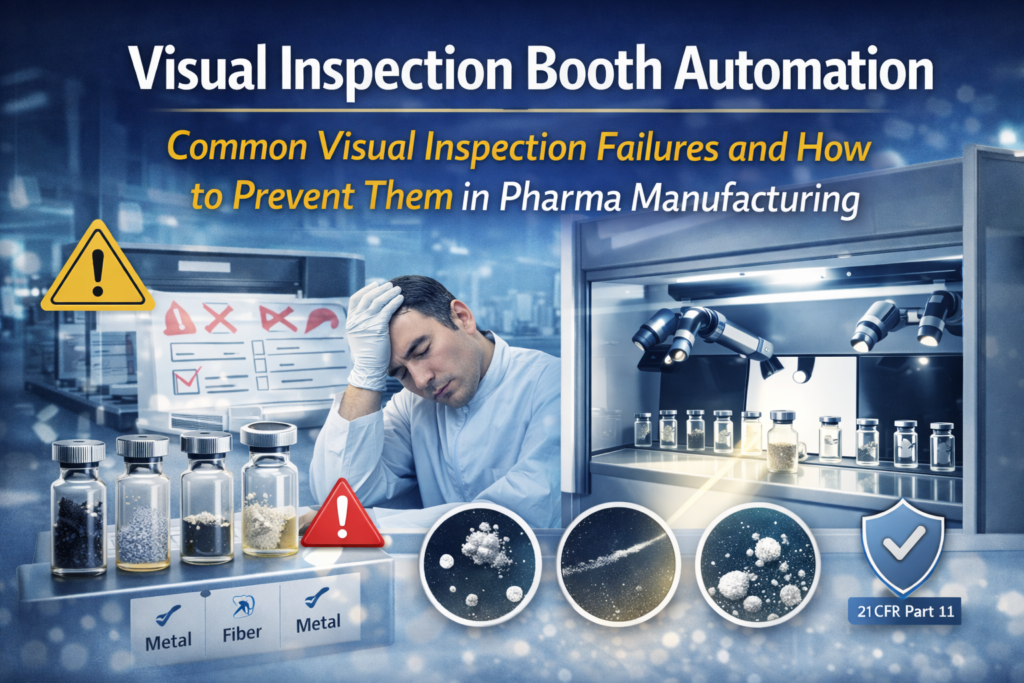
Catchy Introduction
In pharmaceutical manufacturing, one tiny particle can lead to a product recall, regulatory warning letter, or worse — patient harm.
Visual inspection is often the last line of defense before an injectable product reaches a patient. Yet, many pharma companies still rely heavily on manual inspection setups prone to fatigue, inconsistency, and documentation gaps.
The question is:
Are your visual inspection processes audit-ready — or audit-risky?
This is where Visual Inspection Booth Automation transforms the entire inspection ecosystem — from human-dependent judgment to controlled, measurable, compliant performance.
In this detailed guide, we will break down:
- Most common visual inspection failures
- Why manual booths fall short
- How automation prevents costly errors
- Regulatory expectations (USP 790, 21 CFR Part 11)
- Practical implementation roadmap
Let’s dive in.
Why Visual Inspection Is a High-Risk Step in Pharma
Visual inspection directly impacts:
- Patient safety
- Product sterility assurance
- Regulatory compliance
- Brand credibility
- Market approval
Especially in sterile injectable manufacturing, even visible particulate contamination can:
- Trigger batch rejection
- Cause import alerts
- Lead to warning letters
- Damage company reputation
USP <790> clearly mandates that injectable products must be “essentially free from visible particulate matter.”
The challenge?
Human inspection is inherently variable.
Common Visual Inspection Failures in Pharma Manufacturing
Let’s examine the most frequent failure modes.
1. Inspector Fatigue
Manual inspection requires:
- Continuous concentration
- High visual acuity
- Repetitive motion
- Fixed posture
After 30–45 minutes, detection accuracy drops significantly.
Impact:
- Missed particulates
- Inconsistent rejection rates
- Reduced Probability of Detection (POD)
2. Inconsistent Lighting Conditions
Improper:
- Lux intensity
- Background contrast (black/white)
- Glare control
- Swirling angle
These inconsistencies directly affect particulate visibility.
3. Poor Documentation & Traceability
Many manual booths lack:
- Electronic logs
- Inspector tracking
- Eye-rest monitoring
- Tamper-proof audit trails
This creates compliance risk under 21 CFR Part 11.
4. Improper Eye Rest & Inspection Time Control
Regulatory guidance requires:
- Defined inspection duration
- Eye-rest intervals
- Controlled inspection speed
Manual tracking often leads to:
- Over-inspection fatigue
- Under-inspection risk
- Audit observations
5. Lack of Data for Probability of Detection (POD)
Regulators expect measurable detection capability.
Without automation:
- POD becomes subjective
- Qualification data becomes weak
- Inspector performance tracking becomes unreliable
6. Variability in Background & Ergonomics
Improper booth height
Poor background contrast
Non-uniform inspection surface
All lead to:
- Detection inconsistency
- Reduced compliance
- Increased rejection variability
Why Manual Inspection Booths Fail Modern Regulatory Expectations
Modern regulators expect:
- Data integrity
- Traceability
- Controlled environments
- Measurable performance
- Lifecycle documentation
As highlighted in Confianca’s integrated pharma solutions model Confianca Pharmazon Products Br…, compliance today is about systems, not isolated activities.
Manual booths were designed for basic inspection — not digital compliance ecosystems.
What Is Visual Inspection Booth Automation?
Visual Inspection Booth Automation is a controlled inspection environment equipped with:
- Controlled black & white background zones
- Calibrated lux measurement
- Eye-rest audio buzzer system
- Electronic log generation
- 21 CFR Part 11 compliant reporting
- Inspector traceability
- Digital performance monitoring
It transforms inspection from:
Human-dependent → System-controlled
How Visual Inspection Booth Automation Prevents Failures
Now let’s connect each failure to its automated solution.
1. Fatigue Control Through Timed Alerts
Automated booths include:
- Audio buzzer for eye-rest alerts
- Timed inspection cycle
- Operator performance monitoring
Result:
- Sustained detection efficiency
- Reduced fatigue-driven errors
2. Controlled Lux Measurement
Automation provides:
- Online lux measurement
- Calibrated lighting intensity
- Uniform illumination
Impact:
- Consistent particle visibility
- Compliance with USP expectations
- Audit-ready lighting validation
3. 21 CFR Part 11 Compliant Reporting
With Visual Inspection Booth Automation, you get:
- Time-stamped logs
- Tamper-proof electronic records
- Inspector identity tracking
- Audit-ready documentation
This eliminates data integrity observations.
4. Standardized Background & Working Zone
Features include:
- Black & white inspection backgrounds
- Height-adjustable ergonomic setup
- Defined working zone
- Magnifying lens integration
Outcome:
- Reduced human variability
- Improved inspector comfort
- Better defect detection
5. Improved Probability of Detection (POD)
Automation supports:
- Structured POD studies
- Inspector qualification tracking
- Performance analytics
This improves:
- Qualification robustness
- Regulatory confidence
- Audit defense strategy
Real-World Example
Consider a sterile injectable facility performing 30,000 vial inspections daily.
Manual System:
- 4% rejection variability
- 2 audit observations on documentation
- High inspector fatigue complaints
After implementing Visual Inspection Booth Automation:
- Rejection variability reduced to 1.2%
- Zero documentation observation
- Improved POD metrics
- 30% improvement in inspection consistency
This is not just automation.
This is risk mitigation.
Regulatory Alignment
Visual Inspection Booth Automation supports compliance with:
- USP <790>
- USP <1790>
- 21 CFR Part 11
- EU GMP Annex 1
- Data Integrity Guidelines
Modern inspections must be:
- Controlled
- Documented
- Traceable
- Measurable
Automation makes this possible.
Implementation Roadmap
If you’re planning to upgrade:
Step 1: Gap Assessment
Evaluate:
- Current lux control
- Documentation method
- POD study robustness
- Inspector fatigue management
Step 2: Risk Analysis
Identify:
- High-risk injectable lines
- Audit history
- Recall exposure risk
Step 3: Booth Selection
Ensure system includes:
- 21 CFR Part 11 compliance
- Eye-rest buzzer
- Online lux measurement
- Adjustable ergonomic design
Step 4: Qualification & Training
Include:
- IQ/OQ/PQ
- Inspector qualification program
- POD study validation
Frequently Asked Questions (FAQ)
Q1: Is Visual Inspection Booth Automation mandatory?
Not legally mandatory — but practically essential for audit resilience and risk mitigation.
Q2: Does automation replace inspectors?
No. It enhances inspector performance by controlling environment and documentation.
Q3: Can it support both manual and automatic inspection qualification?
Yes. It complements both manual visual inspection and automatic inspection validation systems.
Q4: Does it improve audit readiness?
Absolutely. Electronic logs and traceability eliminate many common data integrity findings.
Q5: Is it suitable for sterile injectables only?
Primarily yes, but also useful for:
- Lyophilized products
- Cartridges
- PFS systems
- Liquid formulations
Key Takeaways
✔ Manual inspection = High variability
✔ Automation = Controlled consistency
✔ Fatigue reduction = Better detection
✔ Electronic records = Audit-ready compliance
✔ Measurable POD = Regulatory confidence
Final Thoughts — Don’t Wait for an Audit to Upgrade
Visual inspection is not a cosmetic process.
It is a patient safety control point.
Every missed particulate is a potential:
- Complaint
- Recall
- Import alert
- Regulatory finding
Investing in Visual Inspection Booth Automation is not a cost — it is a long-term compliance and risk-reduction strategy.
If your facility still relies on traditional manual booths without electronic controls, this is the right time to upgrade.
👉 Explore advanced Visual Inspection Booth Automation solutions designed for regulatory-ready pharma manufacturing.
Your trusted partner for pharma skills, systems, and solutions.